

Achieving sales target sales plan template ppt ideas




Try Before you Buy Download Free Sample Product
 Impress Your
 Audience
 100%
100% Editable
 Save Hours
 of Time


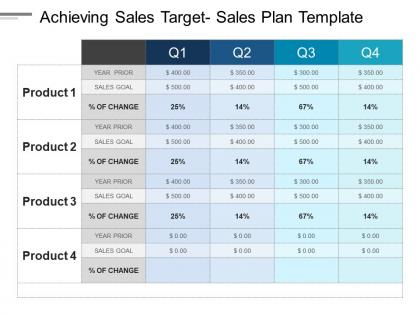
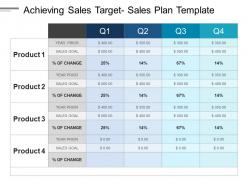
Use our achieving sales target sales plan template PPT ideas slide. Planning is the most important aspect in achieving success in every field. Similarly, to achieve the sales target you need to plan things in the right way. This presentation layout can be used to assess the performance of different products in each quarter. Every organization set sales target and create strategy to achieve them but not all of them are able to achieve success as it requires proper planning while considering certain factors such as production plan, inventory plan, new product development plan, strategic initiative plan and resulting financial plan. This PowerPoint template can also be used to highlight other key aspects that are important to create an effective sales plan such as define your goal, assess the current situation, evaluate your strengths, work on sales call planning, recognize the needs etc. So, grab achieving sales target sales plan PPT template to share the message about the effective sales strategy in accomplishing sales targets. Folks get inspired to act for the common good due to our Achieving Sales Target Sales Plan Template Ppt Ideas. They will decide to join forces.
People who downloaded this PowerPoint presentation also viewed the following :
Achieving sales target sales plan template ppt ideas with all 5 slides:
Assess clinically with our Achieving Sales Target Sales Plan Template Ppt Ideas. Delve deeper into every aspect.


FAQs for Achieving sales target sales plan
Look at what you actually hit last quarter vs what you projected first. That'll give you a reality check. Market conditions matter too - plus seasonal stuff and any big changes to your territory or products. Oh, and team capacity is huge. If Sarah's out on maternity leave for half the quarter, your numbers are obviously gonna take a hit. I'd start with last year's baseline, then adjust based on your pipeline health and recent conversion rates. Honestly, being optimistic is fine but don't go crazy with it. You want ambitious but not delusional, you know?
Honestly, your sales history is like having a crystal ball for setting targets. Pull at least 2-3 years of monthly data - trust me on this one, you don't want one random year messing with your head. Look for stuff that happens every year: seasonal spikes, which products always tank, how external chaos (hello 2020) screwed things up. Growth patterns matter way more than the raw numbers though. Like if you hit 15% growth during a crazy market boom, maybe dial it back to 10% this year? Start with monthly breakdowns and hunt for those repeating patterns. Short answer: data tells you what's actually possible vs what sounds nice in a meeting.
Honestly, market research is like your sanity check for sales targets. Look at what competitors are charging, how big your market actually is, and what customers are buying. Trust me, you don't want to be that person who promised crazy numbers based on pure optimism! Dig into demand trends and buying patterns first. This stuff helps you spot real opportunities while avoiding those impossible targets that'll just burn everyone out. I learned this the hard way at my last job - leadership kept pushing these fantasy numbers until we finally showed them actual data. Get your research done before planning meetings. Makes your targets way more believable.
Look at who you actually have on the team first. New reps can't hit the same numbers as your veteran closers - trust me, I tried that once and it was a disaster. Check their track record, how well they know the product, and what their pipeline looks like right now. Also factor in any training you're planning to do. You want to push them but not to the point where they're drowning. Honestly, the best targets are the ones that make people stretch without setting them up to fail completely. Base it on their real skills, not some fantasy version of what you wish they could do.
Don't just dump targets on people - that never works. Get your team involved in breaking down those annual numbers into smaller chunks they can actually wrap their heads around. Weekly check-ins are clutch for catching problems early. I'd honestly start by explaining WHY these numbers matter, then ask what roadblocks they're already seeing. When someone hits a milestone, make noise about it. People need to see how their piece fits the whole puzzle, and they'll bust their ass way harder if they helped build the plan themselves.
Look, seasonal patterns are everything when setting targets. You can't just divide your annual goal by 12 and call it a day - that's financial suicide honestly. Pull at least 2-3 years of data to see what months consistently perform well. Retail stores know Q4 demolishes Q1 because of holiday shopping, but every industry has rhythms. Maybe your slow season is summer when decision-makers are on vacation? Build those dips into your projections upfront. Set lower expectations during dead periods so you can really push when things heat up. Way better than scrambling to explain why February sucked again.
Revenue attainment percentage is huge - track actual vs target monthly, not quarterly. Way easier to fix things before you're screwed. Pipeline velocity shows how fast deals move through your funnel, which honestly predicts your quarter better than most fancy forecasting tools. Conversion rates by stage tell you exactly where stuff gets stuck. Don't sleep on activity metrics either - calls and demos per week are solid leading indicators. Just throw it all in a simple dashboard that updates weekly. You'll catch problems early instead of scrambling at month-end.
Dude, get yourself a proper CRM like Salesforce or HubSpot. They'll automatically pull all your sales data and show you exactly how you're tracking against targets. Way better than those nightmare Excel sheets we all pretend to understand. Set up alerts so you know when things are slipping, and track stuff like pipeline velocity to predict if you'll actually hit your numbers. The dashboards are honestly game-changers for spotting problems early. Just connect whatever sales data you've got to one platform first – I guarantee you'll find gaps you had no clue about.
Look at three main things: demand shifts, competition, and economic stuff. When demand drops, cut volume targets but maybe push for better margins to keep revenue steady. New competitors? You'll probably need to dial back price targets and focus more on grabbing market share. Economic downturns are weird - I've watched teams freak out and cut everything, which is usually dumb. Better to give relationship sales more time and prioritize keeping current customers over chasing new ones. Don't wait until you're already behind to fix things. Check your targets every quarter instead of being reactive.
Look, your sales team literally talks to customers all day - they know what's actually happening out there. Set up monthly check-ins where they can tell you stuff like "deals are taking way longer now" or point out opportunities you'd never see from your desk. Don't just ask during the yearly planning circus. Honestly? Targets without their input are either completely unrealistic or miss obvious growth spots. They'll catch things like shifting customer behavior before anyone else does. Make it regular, not just a one-time thing.
Dude, customer data totally changes how you set sales targets. Look at your buying patterns from the past 2-3 years - you'll see seasonal stuff, which products actually move, how people react to price changes. Way better than just throwing out "let's do 20% growth" and hoping for the best. Your data shows which customer groups are buying more or less. Honestly, I was skeptical at first but it really does reveal opportunities you'd never think of otherwise. Pull your top segments' purchase history and hunt for patterns. That's where the good stuff is.
Honestly, new products are tricky because you're just guessing without any real data to go off. I'd start conservative - do some market research, maybe run a small pilot, then add extra time because launches always get messy. Way different story with established products though. You've got sales history, you know the seasonal ups and downs, plus your team already knows what works. The confidence level is night and day. With new stuff, I'd actually focus more on hitting learning goals alongside revenue - like figuring out your ideal customer or nailing the messaging. Established products? Just push for steady growth based on what's already proven.
Dude, don't set crazy high targets - your team will just get bummed when they keep missing them. High turnover becomes a real problem because people hate feeling like they're failing constantly. Plus desperate reps might start cutting corners or doing sketchy stuff to hit numbers. Your forecasting gets all wonky too when targets have nothing to do with what's actually possible. I'd go with something challenging but not insane - like 15% over last year? That pushes people without making them want to quit.
Honestly, just ask each person what actually motivates them first - saves you so much guesswork. Mix up rewards with both money stuff and personal perks like flexible schedules or growth opportunities. Don't wait until quarter-end though, celebrate those smaller wins along the way or people burn out. Public shoutouts work great for your competitive types, but some folks hate being put on the spot so feel them out. Dashboards and friendly team competitions keep things visible and fun. Oh, and milestone parties are clutch - way better than just hitting targets in silence.
Look, competitive analysis is basically your sanity check for sales targets. Check what competitors are charging, how they're doing market-wise, when they're dropping new products - that stuff tells you if your goals make sense or if you're being delusional. Trust me, missing targets by like 40% because you ignored the competition is not fun to explain to your boss. Use their data to see what's actually possible in your market. Sometimes you'll spot opportunities they missed too. Bottom line: base your targets on real market conditions, not whatever sounds good in a meeting.
-
Great quality product.
-
Easily Editable.