


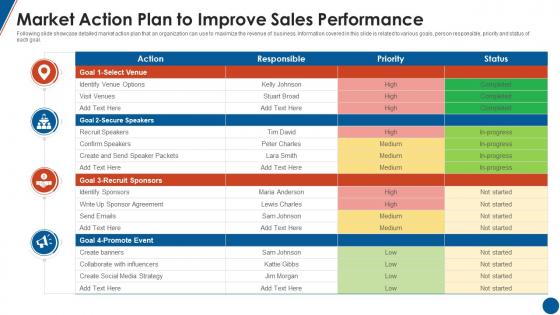
Market Action Plan To Improve Sales Performance




Try Before you Buy Download Free Sample Product
 Impress Your
 Audience
 100%
100% Editable
 Save Hours
 of Time


Following slide showcase detailed market action plan that an organization can use to maximize the revenue of business. Information covered in this slide is related to various goals, person responsible, priority and status of each goal.
People who downloaded this PowerPoint presentation also viewed the following :
Market Action Plan To Improve Sales Performance with all 6 slides:
Use our Market Action Plan To Improve Sales Performance to effectively help you save your valuable time. They are readymade to fit into any presentation structure.





FAQs for Market Action Plan To
Okay so you need five main things: clear goals, knowing your audience inside and out, checking what competitors are doing, actual tactics with deadlines, and ways to measure success. Honestly, most people totally bomb the audience part - like they'll say "millennials aged 25-35" and call it a day. That's useless. You gotta dig into what actually keeps these people up at night, how they make decisions, where they hang out online. Oh and don't forget to assign budgets to each thing you want to try. Start with a basic template and just work through it section by section instead of bouncing around randomly.
Start by connecting each business goal to actual market moves. Like if you want 20% growth, figure out which customer segments and campaigns will get you there. Most teams totally skip this part - then act shocked when their marketing doesn't work. I'd create a simple chart showing how each marketing initiative connects to your bigger goals. Keeps everyone honest about what actually matters. Otherwise you're just throwing stuff at the wall and hoping it sticks, which... we've all been there.
Focus on the basics first - revenue growth, market share, and customer acquisition cost. Those tell you if things are actually working. Brand awareness and customer lifetime value matter too since they predict what's coming next. Here's the thing though: most people go crazy tracking like 20 different metrics and end up overwhelmed. Pick maybe 5-6 that actually connect to your goals. Check them monthly, not daily (you'll drive yourself nuts otherwise). Set up a simple dashboard so you can catch problems early. Way easier than trying to fix a mess later.
I'd say monthly at minimum, honestly. Fast-moving markets change too quick to wait three months between reviews. Do the deep quarterly analysis for major pivots, but monthly lets you spot problems early. My old team used to do weekly check-ins during product launches - probably overkill but it worked. The real trick is actually sticking to whatever schedule you pick. Block time on your calendar right now, even if it's just 30 minutes to check metrics and tweak things. Don't be like me and forget for two months straight lol.
Dude, you're gonna hit resource problems first - never enough people or money for what sounded amazing in meetings. Different teams will totally misread the plan too, which is so frustrating. Market stuff changes way faster than you can pivot. Oh, and sometimes? The plan was just wishful thinking from the start lol. Build in extra time and budget upfront - like 20% more than you think. Weekly check-ins are clutch for catching problems before they blow up everything. Trust me on this one.
Basically, market segmentation helps you customize your action plan for different customer groups instead of trying to please everyone at once. Why blow your budget on LinkedIn ads when you're targeting Gen Z, you know? It's way smarter to craft specific messaging for each segment and pick channels that actually make sense. Your conversion rates will be so much better because you're talking directly to what each group cares about. Plus, you can track which tactics work best for who. Honestly, I'd start simple - just pick your top 3 customer segments and tailor your approach from there. Makes everything less overwhelming too.
Look, competitor analysis is basically your sanity check before you do anything stupid in the market. Pick like 3-5 direct competitors and figure out their pricing, messaging, what they're crushing at, and where they're totally missing the mark. You don't want to accidentally launch the exact same thing three other companies already own, trust me. It's honestly the best way to spot opportunities they're ignoring and figure out how you'll be different. Plus you can set goals that actually make sense based on what's working for them - or what's failing miserably. Start with mapping their main strategies first.
Honestly, just track what's actually moving the needle vs what's eating your budget. Set up dashboards showing conversion rates and customer behavior in real-time - that way you're not guessing for months like most teams do. Pick 3-4 metrics that actually matter to your bottom line. Then double down on what's working and ditch the rest. I learned this the hard way after wasting way too much on campaigns that looked good on paper but weren't converting. Quick pivots based on real data will save you so much headache.
Get your team building the plan with you from the start - seriously, that's what makes or breaks it. People actually care when they help create something instead of just getting told what to do. Always explain WHY you're doing each thing, not just what needs to happen. I can't tell you how many times I've watched plans crash because leadership thought everyone just "got it." Oh, and find those people in each department who everyone listens to. Get them hyped first - they'll do half your work convincing everyone else. Regular check-ins help too so people can actually speak up about what's not working.
Look, you can't just copy-paste the same strategy everywhere - different regions need totally different approaches. Research the hell out of cultural preferences, buying habits, and what regulations you're dealing with. Then tweak your messaging, pricing, and how you actually reach people. Urban vs rural markets? Completely different beasts. Same with premium pricing in budget-conscious areas - learned that one the hard way. Set goals that actually make sense for each region, not some cookie-cutter metrics. Oh, and definitely test in just one area first before going all-in everywhere.
Dude, you absolutely need customer feedback for your market plan. It shows you what's really working, not just what you think is working. Skip this and your campaigns will probably tank - I've watched it happen so many times. Customers will tell you straight up when your messaging sucks, which features they actually care about, and what problems you're missing. Honestly, it's like having a cheat sheet. The feedback helps you figure out where to spend your money and adjust your positioning. Plus you'll spot opportunities you never would've seen otherwise. Start collecting it early and keep doing it throughout.
Look at three things: ROI potential, what resources you'll need, and how fast you'll see results. Go for the quick wins first - they don't cost much but give you momentum and credibility for bigger stuff later. I've watched so many teams chase the shiny expensive projects right out the gate, then completely burn out halfway through. Pick things that actually move the needle on your main revenue streams and show results in 3-6 months. Make a simple grid rating impact vs effort. Tackle high-impact, low-effort wins first. Trust me on this one.
Look, three big things to watch out for legally. Don't do sketchy stuff when researching competitors - no fake identities or shady tactics to get intel. Antitrust laws can bite you if you're doing partnerships or aggressive pricing moves (honestly this one trips up more companies than you'd think). Your marketing claims need to be legit and provable too, or the FTC will come knocking. Run everything by a lawyer before you launch, especially if your industry's super regulated. Better safe than sorry on this stuff - legal headaches aren't worth it.
Honestly, the right tech makes everything so much faster. I'd grab a project management tool first - Asana's pretty solid for tracking campaigns and deadlines. Marketing automation handles the boring stuff like email sequences while you focus on strategy. But here's the thing - analytics dashboards are where the magic happens. You can actually see what's working in real time instead of guessing. No more waiting around for weeks to figure out if something flopped. Pick whatever fixes your biggest headache first, then build from there.
Honestly, just do an exec summary first - those people need to get it in 60 seconds or they're out. Different audiences need different info though. Your sales team doesn't care about the same stuff leadership does, you know? I make a one-pager for the C-suite and then a detailed playbook for the people actually doing the work. Nobody's reading 20 pages these days anyway. Throw in some visuals - timelines, charts, whatever helps it stick. Oh, and definitely set up regular check-ins so you can pivot when stuff isn't working like you thought it would.
-
It saves your time and decrease your efforts in half.
-
Out of the box and creative design.