

Performance Improvement Plan For Sales Employee




Try Before you Buy Download Free Sample Product
 Impress Your
 Audience
 100%
100% Editable
 Save Hours
 of Time


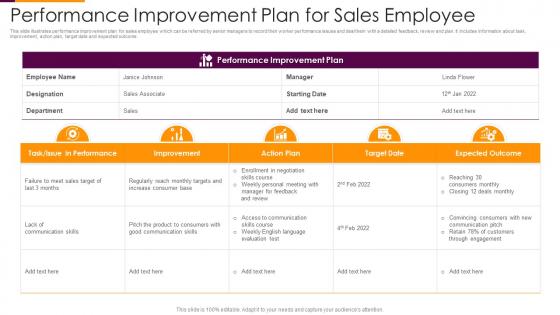
This slide illustrates performance improvement plan for sales employee which can be referred by senior managers to record their worker performance issues and deal them with a detailed feedback, review and plan. It includes information about task, improvement, action plan, target date and expected outcome.
People who downloaded this PowerPoint presentation also viewed the following :
Content of this Powerpoint Presentation
Every team is relevant to the company, but the sales team is the most important. This team helps in sales, which leads to profit generation for the company. The rule is simple - if you have a robust sales team, your business will reach a new height; otherwise, the company will take a downturn.
Sales teams face various challenges, such as expectations to meet sales targets or selling products and services. These can threaten business growth and market position. Therefore, SlideTeam has developed a dedicated PowerPoint Presentation for the sales team, which can show the team's performance and give the company complete data.
Do you want to improve the performance of your sales team and boost sales? Click here.
Measure Your Sales Team Performance with Our Templates
Our PowerPoint Layout is crucial for identifying, discussing, and resolving performance issues. It can be used by a manager or the company's human resource department. Use it to streamline the process of managing performance issues or prepare an employee report.
Standardizing the approach to performance management ensures consistency, saves valuable management time, and sets clear expectations and accountability for all parties involved.
Get a proper performance improvement plan checklist with follow-ups using our PowerPoint layout.
Let’s begin!
Template 1: Performance Improvement Plan for Sales Employee
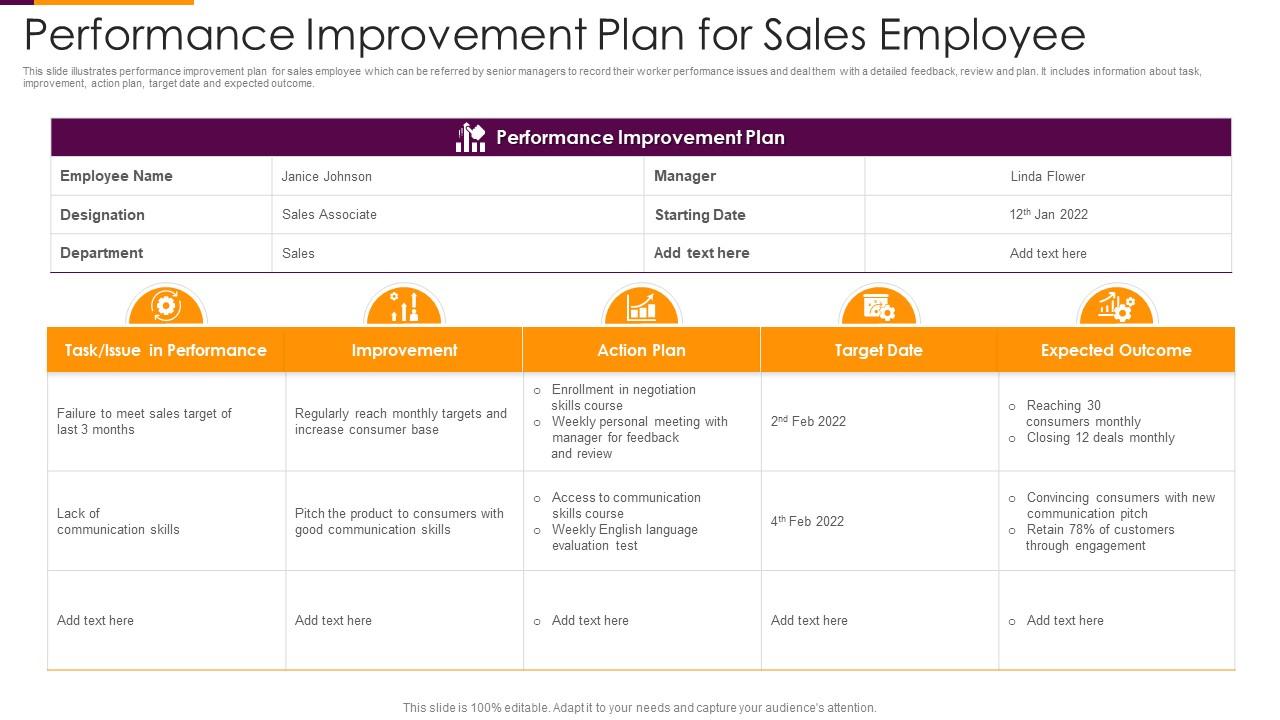
Use this PPT Template to calculate the sales team's performance. This slide has two sections. The first section captures all essential employee information, such as name, designation, department, manager, and starting date. The second section shows a complete table with headings such as task/issue in performance, improvement, action plan, target date, and expected outcome through which you can collect and measure the essential data.
Prepare Employees Report Quickly with Our Templates
Our PowerPoint Framework helps companies address sales performance challenges effectively. It streamlines the managerial process so that you can make effective decisions. Furthermore, it creates a transparent and supportive environment for employees to improve. It's better to have achievable targets, develop proper strategies to achieve them and convey expected outcomes to the teams.
Improve your team’s performance by using our improvement plans.
Performance Improvement Plan For Sales Employee with all 6 slides:
Use our Performance Improvement Plan For Sales Employee to effectively help you save your valuable time. They are readymade to fit into any presentation structure.





FAQs for Performance Improvement Plan
So you'll need clear, measurable goals first - like specific numbers or deadlines they can actually hit. Give them 30-90 days depending on the situation. Schedule regular check-ins so you're not just disappearing on them. Document everything (I know, it's annoying but you'll thank me later). Also spell out what training or help they'll get. The consequences part is weird to write but necessary - they need to know what happens if things don't improve. Get them to sign off on it all. Honestly, if it feels too harsh or punitive, you're probably doing it wrong.
Honestly, you'll know when it's time if you've already had those awkward performance talks multiple times and still nothing's changed. Missing deadlines constantly, sloppy work, drama with teammates - that kind of stuff. But here's the thing: you can't just blindside someone with a PIP. They need to have gotten clear feedback first, otherwise that's just cruel. Sometimes there's other stuff going on though - maybe they need training or they're dealing with personal issues. Try coaching first. PIPs are for when regular conversations aren't cutting it and you need that formal timeline to either fix things or... well, you know.
Oh man, the vague goals thing will kill you every time. Like saying "be better at communication" instead of "respond to emails within 24 hours" or whatever. Honestly, some managers just use PIPs to build a paper trail for firing people, which is shitty but happens. Don't set crazy timelines either - you're setting them up to fail. Actually follow through on the support you promise too. Regular check-ins, training, all that stuff. And yeah, document everything from the start. If you're not genuinely trying to help them succeed, skip the whole PIP charade.
Honestly, you gotta be crystal clear from the start - expectations, deadlines, what happens if they don't improve. Write everything down! I mean everything. The problems, what "better" actually looks like, specific dates. Weekly check-ins are clutch here, none of that vague "you're doing better" nonsense. They need real feedback each time. Oh, and make sure they can actually ask questions without feeling weird about it. Too many managers mess this up by being all mysterious about whether someone's improving or not. The employee should never be guessing where they stand.
Pick metrics you can actually measure and track easily. Deadlines met, customer satisfaction scores, sales numbers - stuff that's concrete for their specific role. I've watched so many PIPs crash because managers set fuzzy goals like "better communication." That's useless. Instead: respond to emails in 24 hours, hit 85% customer ratings, submit error-free reports. Your employee needs to know exactly how they're being judged. Numbers don't lie, and there's no room for interpretation later. Schedule regular check-ins to see how it's going - don't just wait until the end.
Honestly, I'd go with every 2-4 weeks for PIP reviews. Weekly makes sense if it's a short timeline or the issues are pretty serious - you need that tight feedback loop. But here's what I've noticed: managers who space them monthly usually regret it unless they're dealing with a really long-term plan. You want consistent touchpoints so your employee isn't guessing where they stand. Oh, and definitely set all those dates upfront when you kick off the PIP. Takes away any awkwardness about scheduling later and they'll know exactly what to expect.
So basically, you and your manager will hammer out 3-5 really specific goals that tackle whatever's not working. Think SMART goals but with actual teeth - there's usually a tight deadline, like 30-90 days. None of that "perform better" BS either. We're talking concrete stuff like "get customer response time under 24 hours" or "finish your certification by month-end." The whole point is nailing down exactly what success looks like from day one. Trust me, you don't want any gray area here because later on, you'll both be referring back to these when deciding if you've actually turned things around.
Honestly, weekly check-ins are your lifeline here - don't just do the formal bookend meetings. I've watched way too many PIPs crash because managers only gave feedback at the start and finish. That's brutal for everyone involved. Focus on actual behaviors instead of wishy-washy "performance issues." Yeah, document everything (you have to), but your person shouldn't feel like they're under surveillance 24/7. Schedule those touchpoints in your calendar today or you'll blink and realize three weeks passed. Oh, and if something isn't working, pivot the approach - PIPs aren't set in stone.
Talk to them constantly - like weekly check-ins, not radio silence. I've watched managers completely disappear during PIPs and it's such a mess. Make it about growth, not punishment. Be super specific about what winning looks like and actually celebrate when they hit small milestones. Get them training or a mentor, whatever they need to feel ready. The biggest thing though? You gotta genuinely want them to succeed. People know when you're faking it and honestly, real support changes everything about how they approach the whole situation.
Honestly, most managers totally bomb this because they use the same cookie-cutter approach for everyone. Some people from certain cultures find direct feedback super harsh, so try framing things more as "let's work together on this." Others need everything written down instead of just talking it through. Language barriers are huge too - and don't forget some folks have family stuff or just think about deadlines differently than you do. I learned this the hard way with one employee who needed way more examples. Best thing? Just ask them upfront what kind of support actually helps them.
Honestly, PIPs can bite you in the ass if you mess them up - they become smoking gun evidence in wrongful termination lawsuits. Document everything like crazy. Make the goals actually achievable and measurable, not some impossible BS. Here's the thing that gets tricky: employees think it's retaliation, especially if they just complained about something or asked for accommodations. You can't be putting only certain types of people on PIPs either - that creates a nasty pattern. My advice? Get HR involved from day one and treat this thing like the legal document it'll become in court. Don't wing it.
Listen first - don't get rattled when they push back. Usually they're just confused or scared about the whole thing. I've watched managers completely lose it over some pushback, which honestly just makes everything ten times worse. Acknowledge what they're saying without backing down from what needs to happen. Explain the why behind each goal, not just the what. Make it clear you're supporting them, not trying to trip them up. But yeah, definitely document your conversations and their responses. If they keep fighting you on it, bring HR in sooner rather than later.
Honestly, there's a bunch of stuff that can help you crush this thing. Training programs are obvious - also mentorship if your company does that. Your manager or HR might do coaching sessions with you. Most places have online learning platforms now which are actually pretty decent for technical stuff. Some companies bring in outside trainers but that's rare these days with everyone cutting budgets. Oh and skill-building workshops if they're relevant to your specific gaps. The main thing is matching the resources to what's actually in your PIP, not just random professional development crap. I'd definitely sit down with your manager week one and figure out exactly what support you can get.
Look, your team probably already suspects something's going on anyway - people aren't dumb. Just be honest that there's a process happening without getting into details. I'd focus conversations on their own work instead of the PIP drama. Don't let the person get completely isolated though, that's just cruel. Keep giving feedback and recognition to everyone else so they're not spiraling about their own jobs. Maybe throw in some team activities? The key is maintaining normal vibes while being real about the situation. It's awkward but doable.
Look, a good PIP actually makes your culture stronger because people see you're trying to help them grow instead of just finding excuses to fire them. Most employees respect managers way more when there's a fair, consistent process - honestly, it builds trust. They know they'll get real feedback and support before anything drastic happens. The trick is framing PIPs as development opportunities, not some kind of punishment. Be upfront about how it all works and definitely celebrate the wins when someone turns things around. It shows everyone you're serious about giving people chances to succeed.
-
The templates are easy to get, and the chat customer support is excellent.
-
Editable templates with innovative design and color combination.