

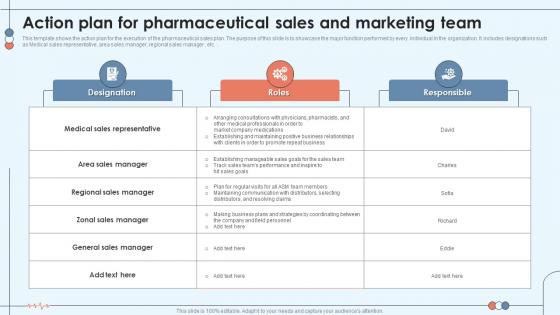
Action Plan For Pharmaceutical Sales And Marketing Team




Try Before you Buy Download Free Sample Product
 Impress Your
 Audience
 100%
100% Editable
 Save Hours
 of Time


This template shows the action plan for the execution of the pharmaceutical sales plan. The purpose of this slide is to showcase the major function performed by every individual in the organization. It includes designations such as Medical sales representative, area sales manager, regional sales manager, etc.
People who downloaded this PowerPoint presentation also viewed the following :
Action Plan For Pharmaceutical Sales And Marketing Team with all 6 slides:
Use our Action Plan For Pharmaceutical Sales And Marketing Team to effectively help you save your valuable time. They are readymade to fit into any presentation structure.





FAQs for Action Plan For Pharmaceutical Sales
Dude, pharma sales is going totally digital now. Customers want virtual meetings and data about real outcomes, not just trial results. Those fancy dinner relationships? Dead. Specialty drugs are taking over too, which is actually good because you get smaller, focused customer lists instead of calling on everyone. Oh, and patient access programs are huge - insurance companies are being super picky about everything. You really need to get comfortable with digital tools and health economics. Trust me, reps who don't adapt are getting left behind fast.
LinkedIn's your best bet for connecting with healthcare providers - way better than cold calling these days. Email campaigns work well for nurturing those leads too. Honestly, CRM integration changed everything for me since you can track every interaction and tailor your approach based on who's prescribing what. I know social media feels awkward in pharma, but it's actually solid for sharing clinical studies and educational stuff. Just don't ditch the face-to-face meetings completely. Map out your sales funnel first and see where digital touchpoints make sense with your current relationships.
Dude, data analytics is like having a crystal ball for pharma sales. You can see which docs are worth targeting and when to hit them up. Prescription patterns show you who's prescribing what - honestly, the amount of intel available now is insane. Track your reps against competitors, spot seasonal trends, figure out which territories need backup. Oh, and it predicts where you should dump more resources too. I'd start simple though - just pick one metric like prescription volume in your biggest accounts. You'll start seeing patterns that'll shape your whole approach pretty quick.
Know your audience first - match their expertise level. Lead with clinical benefits, then back it up with science. Complex stuff needs to be broken down (honestly, analogies are your best friend here - compare pathways to everyday things they get). Visual aids help tons. Don't info-dump everything at once though. Ask questions to check if they're following along. Always circle back to patient outcomes - that's what actually matters to them. And here's the big one: if you don't know something, just say so and promise to follow up. Way better than winging it and looking like an idiot later.
Show up consistently, not just when you're hawking something new. Listen to what they're actually dealing with and bring stuff that helps - clinical data, patient resources, whatever makes their day easier. Too many reps just see dollar signs and then act shocked when docs stop returning calls. Be quick to respond when they reach out. Follow through on what you promise (seriously, this one's huge). Their schedules are insane so don't waste time. Oh, and track how each doc prefers to communicate - some love emails, others want quick calls between patients.
Dude, compliance knowledge literally controls everything you can say to prospects. The FDA will come for you if you make bogus product claims or use unapproved materials with the wrong audience types. You've gotta document every interaction properly too. Here's the thing though - once you know the rules inside and out, it's actually freeing. You can be way more confident because you're not worried about crossing some legal line you didn't know existed. Also targeting gets easier since compliance tells you exactly which providers you can pitch specific products to. Just stay on top of training updates - I swear they change rules every other month.
Start with the basics - prescribing volume, therapeutic focus, practice type. Geographic clusters and patient demos come next. Your high-volume specialists deserve the A-team, obviously, but those mid-tier docs? Way easier to flip and honestly underrated. I can't tell you how many reps I've watched chase after providers who'll never switch from their go-to drugs. Check your CRM for actual prescription patterns and ROI per segment. Rank current accounts by revenue potential versus how hard they are to reach. That's gonna show you exactly where your time's worth spending.
Dude, cross-functional stuff is huge in pharma. R&D gives you the real science so you don't sound like an idiot talking to doctors. Marketing knows the competitive landscape, and your field insights help them fix their messaging. It's way messier than normal B2B since you're dealing with regulations and clinical data - honestly, the whole thing is just more complex when lives are on the line. Companies that get this right absolutely crush product launches. If you haven't already, set up regular check-ins with marketing and R&D people. Trust me on this one.
Honestly, patient outcomes are everything now - that's where the real money is. HCPs are impossible to reach in person these days, so you've gotta nail the digital stuff. Generic outreach is basically dead... AI personalization is where it's at. Value-based partnerships work great too - tie your pricing to actual results instead of just volume. Patient advocacy programs build crazy trust, though that takes time. Oh, and definitely audit your current digital tools first. See what you can personalize better for HCP interactions. That's probably your quickest win right there.
Set up real-time dashboards for your main stuff - call conversion rates, script lift in your target areas, rep activity levels. Veeva's great for pushing live data on physician engagement and sample distribution. Fair warning though, the data fire hose is brutal at first but you adapt. Weekly script trends through IQVIA are clutch. Don't forget digital engagement metrics if you're doing online campaigns. Pick 3-4 KPIs that actually move the revenue needle and check them daily. Trust me on this one - you'll go crazy trying to track everything under the sun.
Dude, patient engagement seriously changes everything in pharma sales. Doctors totally notice when their patients actually stick to treatment plans and understand what they're taking. You create this whole cycle where engaged patients ask for your drug specifically - which is honestly the best kind of marketing you can get. The trick is making it feel genuinely useful, not like you're just trying to sell something. Digital tools, education programs, support services - whatever works. I'd probably start by figuring out one major pain point your current drugs could solve better through patient engagement. It's way more effective than traditional detailing sometimes.
Oh man, cultural stuff totally makes or breaks pharma sales globally. Japan's all about relationship-building and getting everyone on board before decisions happen. Meanwhile Americans want you to hit them with data right away - no fluff. European markets are obsessed with health economics (fair enough I guess), but Latin America focuses more on educating doctors and patient access. Religious attitudes toward certain treatments? That's a whole other minefield. You've got to change your messaging, timing, even team setup for each region. Do your homework on local healthcare hierarchies first - seriously, don't wing the pitch part.
Disease state education mixed with consultative selling - that's where you want to start. Reps need to actually get the clinical data and patient journey, not just memorize product features. Role-playing with real physician scenarios helps tons. Also, virtual detailing skills are huge now since everything's gone digital. Old school "smile and dial" is basically useless at this point, honestly. Don't forget compliance training either - boring but necessary. I'd audit your team's gaps first though, then build around what they're actually missing instead of doing generic sales training that nobody remembers anyway.
LinkedIn's your best bet - that's where all the doctors actually are. Post educational stuff like study summaries and disease awareness content, not sales pitches. Twitter's okay for medical news but honestly the engagement is kinda meh lately. Build relationships first through good content before you even think about sales conversations. Oh and compliance is huge in pharma social media - there's like a million regulations to follow. I'd start by finding 20-30 key opinion leaders in your area and engage with their posts first. Once you've done that for a while, then create your own content strategy.
Getting feedback from doctors is honestly a game-changer for your sales game. They'll tell you straight up which data actually moves the needle vs. what your marketing department dreamed up in a conference room (usually totally different things). Open-ended questions during calls work best - then just shut up and listen. You'd be amazed what comes out. Their input helps you nail your messaging and catch objections early. Doctors remember when you actually hear them out too, so they're more likely to take your calls down the road. Worth the effort for sure.
-
Awesomely designed templates, Easy to understand.
-
My search for complete decks ended with SlideTeam. Such a surplus collection of HD PowerPoints. Moreover, their standard and widescreen formats have helped me in delivering bullseye presentations.