


Sales planning powerpoint slide presentation examples





Try Before you Buy Download Free Sample Product
 Impress Your
 Audience
 100%
100% Editable
 Save Hours
 of Time


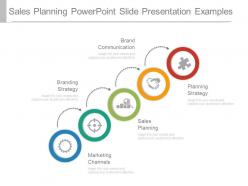
Choose our sales planning PowerPoint Slide presentation examples. The PPT template has been crafted by team of passionate designers after complete research and analysis. The template slide is a five stage process such as brand communication, branding strategy, marketing channels, sales planning and planning strategy. A sale planning is important for the business development, organizations work on various strategies to come up with the action plan that they will be perfect to engage the consumer with their product or services. Besides this, there are many other ways that one can take to create an effectual sales strategy i.e. define your goal, assess the present situation, evaluate your strengths, work on sales call planning, recognize the needs etc. It enables you to define a set of targets for your business. So, highlight the importance of sales planning in the presentation slide and then make an impact on your audience. Also, check out other presentation designs.Our Sales Planning Powerpoint Slide Presentation Examples combine beauty and brains. They will build glamorous aspirations.
People who downloaded this PowerPoint presentation also viewed the following :
Sales planning powerpoint slide presentation examples with all 5 slides:
Leave a lasting impression. High quality Sales Planning Powerpoint Slide Presentation Examples design for every presentation need.

FAQs for Sales planning powerpoint
Market analysis and revenue targets are your starting point. Figure out who your ideal customers are, then divide up territories between team members. Honestly, most people completely botch the goal-setting part - make them challenging but not impossible. Don't forget to map out your budget and tools upfront. Competition research helps too, shows you where the real opportunities are hiding. Oh, and build in those regular check-ins because plans always need tweaking. Resource allocation sounds fancy but it's just figuring out what you actually need to hit your numbers.
Dude, forecasting is a total game-changer for strategy stuff. You can actually predict revenue trends instead of just guessing, which means smarter decisions about hiring reps or where to focus your efforts. I used to just wing it (not my proudest moment lol) but tracking patterns changed everything. You'll spot seasonal drops before they wreck your quarter. Plus having real data makes budget meetings way less painful - no more awkward "trust me" moments with leadership. Conversion rates by month are where I'd start. Once you have that foundation, everything else like quota planning and product launches becomes so much easier.
Honestly, you can't just guess at sales numbers without knowing if people actually want what you're selling. Market research shows you who your real customers are and what problems they're trying to solve. Do some surveys to get the hard data, but also talk to people directly - those conversations tell you way more than spreadsheets sometimes. Look at your competitors too so you know how to stand out. The research helps you spot trends and figure out realistic targets instead of just throwing darts at a board. Without it, you're basically planning in the dark.
Honestly, your CRM is sitting there with all this gold you're probably not using. Pull up last quarter's closed deals first - see what patterns pop out. Which lead sources actually convert? What deal sizes have the best win rates? I usually tell people to spend like 30 minutes a month on this stuff, but most skip it (big mistake). You'll start noticing seasonal trends and can figure out realistic quotas instead of just guessing. Also check your sales cycle lengths - some activities actually move deals while others are just busywork. It's way better than flying blind with your forecasting.
Start with revenue targets, conversion rates, and pipeline velocity - those three will tell you everything. Deal size and sales cycle length are solid secondary metrics for forecasting. Lead volume's fine but honestly, I'd rather have 10 good leads than 100 garbage ones. CAC and lifetime value are where you see if you're actually making money or just burning cash. Activity stuff like calls and demos? Sure, track them but don't go crazy. Pick maybe 4 metrics you'll actually look at weekly and build your dashboard around those. Less is more here.
Look back at your last 2-3 years of sales data first - you'll start seeing the patterns pretty quick. Maybe December's always crazy but January totally sucks (been there). Once you know when your busy seasons hit, you can actually plan ahead instead of panicking. Stock up inventory before the rush, not during it. Same with hiring - get temp staff lined up early or you'll be competing with everyone else scrambling in November. Map out those peak months first, then figure out your marketing budget and production timeline around them. Cash flow becomes way less stressful when you're not caught off guard every year.
Look at your sales data from the past 2-3 years first - what you actually hit vs. what you thought you'd hit. Factor in market stuff, new products, team changes, seasonal patterns. I learned the hard way to always build in a buffer because, honestly, stuff goes sideways. Your sales team's input is gold since they're in the trenches daily. Break that annual number into quarterly chunks so you can pivot fast if things aren't tracking. Set goals that stretch people but won't crush morale if you miss by 5%. Nobody wins when targets are completely unrealistic.
Honestly, this is a game changer for forecasting. Your marketing team has all this campaign data and lead quality info - when they share it, you can actually predict what's coming instead of just guessing. Sales feedback helps them figure out what's working too. You'll catch trends early and avoid those weird situations where marketing sends over leads that never close. I'd start with monthly meetings to swap metrics and talk through what's planned. The quotas you build from real pipeline data are so much better than random targets pulled from nowhere.
Start with a solid CRM - that's where everything lives. Most have forecasting built right in, which saves you from buying another tool. Honestly, I still use spreadsheets for weird data stuff that CRMs can't handle well. Territory mapping's useful if you've got geographic teams. Marketing automation helps with lead scoring too. My advice? Get your CRM and forecasting sorted first. Then see what's actually broken in your process before adding more tools. You'll probably find you need less than you think.
Quarterly reviews are the bare minimum, but monthly check-ins work way better if you can manage it. Things move so fast now - your January plan could be totally irrelevant by March. Do deep dives quarterly where you're really digging into numbers vs targets and shifting strategy. Monthly stuff can be lighter, just catching trends before they bite you. Honestly, I'd put both on your calendar right now and treat them like actual client meetings you can't reschedule. Otherwise you'll keep pushing them off and suddenly it's been six months since you looked at anything.
Honestly, most people screw up by setting targets that are way too aggressive - been there! Your sales team needs to be part of planning from day one, otherwise good luck getting buy-in later. Don't just copy-paste last year's numbers either, especially if your market's shifting. Seasonality always bites me in the ass because I forget about it every single time. Keep your plan flexible since stuff will change constantly. Track leading indicators instead of just looking backwards at what already happened. New hires take forever to actually contribute - like, way longer than you think. Check your assumptions against real data regularly or you'll be flying blind.
First thing - grab coffee with finance and marketing people. They're usually the only ones who actually know what's going on priority-wise. Figure out the big company goals first (revenue targets, new products, whatever), then work backwards to see what your sales team needs to hit. Map everything - territories, activities, resources - directly back to those business objectives. Random quotas are useless honestly. Every sales initiative should connect to something that actually matters. Oh and definitely review quarterly because priorities will shift. They always do.
Honestly, start with the basics - age, location, company size stuff. Then dig into how they actually behave: what they buy, how they engage with your content. The psychographic stuff is where it gets interesting though - their actual pain points and values matter way more than people think. Your existing customers are basically a cheat sheet for finding similar prospects, so definitely mine that data. CRM analytics and surveys beat doing everything by hand (obviously). Keep it simple with maybe 3-4 segments tops, then test different messaging with each group. You'll figure out pretty quick what hits and what doesn't.
Honestly, CRM systems like Salesforce or HubSpot can save you so much time on this stuff. They automatically track your pipeline and forecast revenue using historical data - no more endless spreadsheet calculations. The AI analytics are actually pretty crazy at spotting patterns you'd totally miss. Your team can update deals from their phones wherever they are, which is clutch. Just make sure whatever tools you pick actually integrate well together. I learned that the hard way when we had three different systems that couldn't talk to each other. Map out your current workflow first and figure out what's eating up the most time.
Honestly, training is what makes or breaks whether you'll actually hit those numbers. Your strategy can look amazing on paper, but if your team can't execute it? You're screwed. I've seen this happen so many times - companies skip the training part and wonder why nothing works. Keep everyone updated on product stuff, how to handle pushback, new tools, whatever. It also helps people stick around instead of jumping ship. Just don't do those boring generic workshops that waste everyone's time. Make sure it actually connects to what you're trying to achieve saleswise.
-
Easily Editable.
-
Very well designed and informative templates.