


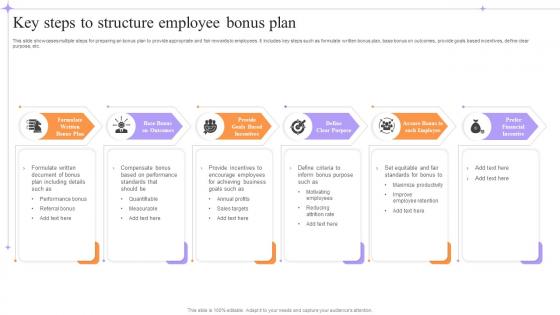
Key steps to structure employee bonus plan




Try Before you Buy Download Free Sample Product
 Impress Your
 Audience
 100%
100% Editable
 Save Hours
 of Time


This slide showcases multiple steps for preparing an bonus plan to provide appropriate and fair rewards to employees. It includes key steps such as formulate written bonus plan, base bonus on outcomes, provide goals based incentives, define clear purpose, etc.
People who downloaded this PowerPoint presentation also viewed the following :
Key steps to structure employee bonus plan with all 6 slides:
Use our key steps to structure employee bonus plan to effectively help you save your valuable time. They are readymade to fit into any presentation structure.





FAQs for Key steps to structure
Key factors include performance metrics alignment, budget allocation, timing of payouts, eligibility criteria, and transparency in communication. These elements work together by ensuring fairness, motivating desired behaviors, and supporting organizational goals, with many companies finding that well-structured bonus plans enhance employee retention, boost productivity, and ultimately deliver improved business performance while maintaining cost control.
Organizations can align bonus structures with business objectives by linking compensation directly to key performance indicators, strategic goals, revenue targets, customer satisfaction metrics, and operational efficiency measures. This strategic approach ensures employees focus on activities that drive company success, with many financial services firms and retail organizations finding that objective-based bonuses increase productivity, enhance team collaboration, and ultimately deliver stronger business outcomes.
Effective performance metrics include goal achievement rates, customer satisfaction scores, team collaboration assessments, skill development progress, and innovation contributions. These metrics enhance engagement by connecting individual efforts to organizational success, providing clear growth pathways, and recognizing diverse contributions, with many companies finding that balanced scorecards combining quantitative and qualitative measures ultimately deliver higher retention and productivity outcomes.
Bonus plans should align with departmental objectives, incorporating role-specific metrics like sales targets for revenue teams, project completion rates for operations, and customer satisfaction scores for service departments. Strategic tailoring enables organizations to drive targeted performance across functions while maintaining overall business alignment, with many companies finding that customized incentive structures enhance both individual motivation and cross-departmental collaboration.
Employee feedback plays a crucial role in shaping bonus structures by identifying performance metrics that truly motivate, revealing gaps between intended and actual outcomes, and ensuring plans align with employee values and career goals. Through surveys, focus groups, and regular reviews, organizations can refine their bonus frameworks to enhance engagement, reduce turnover, and ultimately deliver stronger performance outcomes across all departments.
Transparency in bonus calculations improves employee morale by eliminating uncertainty, building trust between management and staff, and ensuring perceived fairness across teams. When employees understand exactly how bonuses are determined, they feel more valued and motivated to achieve specific goals, with many organizations finding that clear communication around compensation structures significantly reduces workplace tension and enhances overall job satisfaction.
Legal considerations for bonus plans include compliance with wage and hour laws, tax regulations, employment contracts, anti-discrimination statutes, and state-specific requirements. These frameworks ensure organizations maintain regulatory compliance while structuring incentive programs, with many companies finding that proper legal review streamlines implementation and minimizes liability risks across different jurisdictions.
Businesses can measure bonus program ROI by tracking productivity metrics, revenue per employee, retention rates, and comparing pre- and post-implementation performance data. Through analyzing cost savings from reduced turnover, increased sales figures, and enhanced goal achievement, companies streamline compensation strategies while delivering measurable returns, with many organizations finding that strategic bonus structures ultimately enhance both employee satisfaction and bottom-line profitability.
Team-based bonus plans foster collaboration, knowledge sharing, and collective accountability, while individual plans drive personal performance, direct motivation, and merit-based recognition. While team approaches enhance workplace cohesion and reduce internal competition, individual systems offer clearer performance linkage, with many organizations finding that hybrid models combining both approaches deliver optimal results across different departments and roles.
Companies should communicate bonus plans through clear documentation, regular team meetings, one-on-one discussions, and accessible digital platforms that outline criteria, timelines, and calculation methods. Transparent communication builds trust and motivation, with many organizations finding that detailed explanations of performance metrics, payout schedules, and eligibility requirements significantly enhance employee engagement and reduce confusion about compensation expectations.
Companies can ensure competitive and sustainable bonus plans by conducting regular market benchmarking, implementing performance-based metrics tied to achievable goals, diversifying bonus structures between cash and equity components, and establishing clear budget parameters. Through strategic combination of short-term incentives with long-term rewards, organizations streamline talent retention while managing costs, with many finding that transparent criteria and regular plan reviews ultimately deliver both employee satisfaction and financial sustainability.
Economic conditions significantly influence bonus plan effectiveness by affecting budget availability, employee motivation levels, and performance benchmarking accuracy. During economic downturns, organizations often reduce bonus pools while employees may prioritize job security over performance incentives, whereas growth periods enable more generous rewards, with many companies finding that flexible bonus structures help maintain engagement across varying economic cycles.
Bonus plans should be reviewed annually and updated as needed based on business performance, market conditions, employee feedback, and strategic goals. Many organizations conduct comprehensive reviews during budget planning cycles, while others implement quarterly assessments to ensure alignment, with successful companies finding that regular updates enhance employee engagement, retention, and ultimately drive stronger business results.
Emerging bonus trends include performance-based variable pay, team-based incentives, ESG-linked bonuses, flexible reward options, and real-time recognition systems. These structures enhance employee engagement by offering personalized rewards, promoting collaborative outcomes, and aligning compensation with sustainability goals, with many organizations finding that diversified bonus approaches ultimately deliver improved retention and competitive talent acquisition advantages.
Technology streamlines bonus plan administration through automated performance tracking, real-time data analytics, transparent reporting dashboards, and integrated payroll systems. These platforms enable HR teams to efficiently monitor KPIs, calculate variable compensation, and deliver personalized bonus statements, while employees gain visibility into their progress, ultimately reducing administrative overhead and enhancing engagement across organizations.
-
They guys always go the extra mile to meet the expectations of their customers. Almost a year has been associated with them.
-
Excellent work done on template design and graphics.