


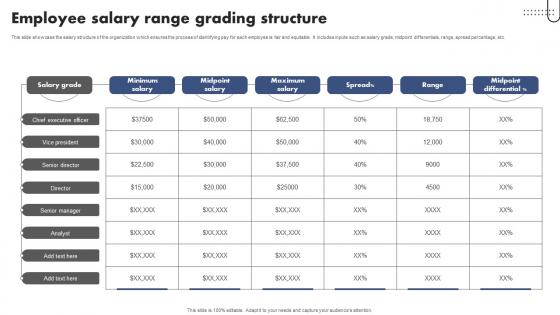
Employee Salary Range Grading Structure




Try Before you Buy Download Free Sample Product
 Impress Your
 Audience
 100%
100% Editable
 Save Hours
 of Time


This slide showcase the salary structure of the organization which ensures the process of identifying pay for each employee is fair and equitable. It includes inputs such as salary grade, midpoint differentials, range, spread percentage, etc.
People who downloaded this PowerPoint presentation also viewed the following :
Employee Salary Range Grading Structure with all 6 slides:
Use our Employee Salary Range Grading Structure to effectively help you save your valuable time. They are readymade to fit into any presentation structure.





FAQs for Employee Salary
You'll need job levels with salary ranges for each one, plus clear criteria for moving up between grades. Market data helps too. Overlapping ranges between levels is key - otherwise people hit walls and get stuck. Honestly? Job evaluation criteria will probably drive you nuts. That's what decides which roles go where, and it's weirdly hard to nail down. Be transparent about how it all works so employees actually get what they need to do for promotions. I'd start by mapping what you have now - you'll see the gaps pretty quickly. Makes the whole thing less overwhelming.
Start with salary surveys from Radford or Mercer - they'll show you what similar roles actually pay in your area. Benchmark against maybe 3-5 companies if you can find the data. Figure out your pay philosophy first though. Are you targeting 50th percentile or going higher like 75th? Company size and growth stage matter too, obviously. The spreadsheet work is honestly tedious but super critical. For ranges, do about 40-50% spread between min and max for each grade. Make sure adjacent levels overlap a bit - nobody wants to hit a pay ceiling and feel totally stuck. Also factor in your total comp package, not just base salary.
First thing - grab some market data and see what similar companies are paying for those roles. Job complexity matters too, plus the skills and experience you're asking for. Here's where it gets tricky though - internal equity is huge. Can't have two people doing basically the same job with totally different pay ranges, that's a recipe for drama. Budget reality check comes next, obviously, and location makes a difference (SF vs. Kansas City, you know?). Company size plays into it as well. Honestly? Keep it simple at first with broad salary bands. You can always get fancy later as you figure out what works.
Look, you gotta check what everyone else is paying or good people will just leave. Most companies do this benchmarking thing annually - comparing their pay bands to market data, especially for hot roles. It's kinda like pricing a house, you know? You need to know your neighborhood. The real question is whether you want to pay above, at, or below market for different jobs. Honestly, market rates shift way more than anyone expects, so your salary structure needs wiggle room. I learned this the hard way when tech salaries went crazy during COVID. Just make sure you're reviewing that market data every year and tweaking your ranges when needed.
So basically, your experience is what puts you at different spots within your pay grade. More experience = higher pay in that same level. It's like - you're not jumping to a new rung, but you're climbing higher on your current one, you know? Your specialized skills, years doing relevant work, and honestly just proving you're good at your job all play into where you land. When review time comes around (or if you're negotiating), definitely talk up everything you've learned and done. That's really your best shot at getting bumped up within your grade.
So basically, salary grading sets up clear pay bands for different jobs and experience levels. No more random salary decisions that make zero sense - you know how awkward it gets when two people doing the same work have totally different pay? Yeah, this fixes that. Your team will actually understand their career path and what they can earn as they move up. Plus you're making fair decisions based on real criteria instead of whoever's the best negotiator (which honestly never works out well). I'd start by looking at what you're paying people now and see where the gaps are.
Don't rush the evaluation process - that's where most people mess up. Also, you've gotta explain to employees why they got the grade they did, otherwise they'll just be confused and annoyed. Make your salary bands wide enough so people don't hit the top too fast (learned that one the hard way). Get market data from like 3-4 different sources, not just one. Bring managers into this early or they'll fight you on everything later. Oh, and leave room for growth in each grade. Nobody wants to redesign the whole system in two years because it's too rigid.
Honestly, once a year minimum - but if you're in tech or something that moves super fast, maybe every 6 months? Most companies just sync it with budget planning anyway since pay bumps cost money. You don't want to lose your best people because they found out they're underpaid elsewhere. That's always awkward. Keep tabs on what competitors are paying and definitely factor in inflation - prices for everything have been nuts lately. Short sentences work. Longer ones help you sound more natural when explaining the reasoning behind timing reviews. Set a reminder now though, seriously. These reviews have a way of sneaking up when you're swamped with other stuff.
Honestly, a good salary structure is like giving people a GPS for their career instead of just hoping they'll figure it out. Your employees can actually see what skills they need and what each level pays. That keeps your best people around because they're not guessing about advancement. Short sentences work. But you also want some flow when explaining the bigger picture. Without clear grades, talented folks get annoyed and bail for companies that have their act together. Just make sure the whole thing actually makes sense - I've seen places where the structure was so confusing it backfired completely. Nobody wants another pointless corporate maze to navigate.
Oh man, salary grading used to be such a pain until I discovered how much tech can help. HRIS systems like Workday or BambooHR are game changers - they'll automatically track promotions, send alerts when someone's due for review, and pull market benchmarking data without you having to dig through endless spreadsheets. You can even link performance reviews directly to grade changes, which is honestly brilliant. I'd say start by looking at whatever manual stuff you're doing now. There's probably some tool that could cut your workload in half - or at least make it way less tedious.
Equal pay laws are huge - watch out for any disparities by gender, race, all that. Pay transparency is getting crazy strict too, some states make you post salary ranges now which is wild. Document how you built the whole structure because if anyone challenges it later, you'll need proof your methodology was solid and job-related. Also check it hits minimum wage requirements and overtime stuff. The legal landscape moves so fast I can barely keep track anymore! Definitely get your legal team to look it over before you launch anything.
Yeah, so most places tie your salary grade movement directly to how you perform on reviews. Hit "exceeds expectations" and you'll probably get a better bump within your current range. Performance scores basically determine your merit increases - though honestly, some companies are way more rigid about this than others. The tricky part is figuring out how much your company weighs actual performance versus just market adjustments and budget stuff. I'd definitely ask HR what their specific policy looks like. That way you'll know exactly what rating you need to actually move up a grade.
Honestly, I'd go with market-based as your starting point - it's just way simpler to explain to people and you'll actually be competitive for talent. Yeah, it can get pricey if you're in like tech or something, but at least you won't lose good people to better offers. Competency stuff is cool in theory because you can reward your stars, but man, it's a pain to set up properly. Plus people get weird about it when they find out their teammate makes more. My take? Start with market rates, then maybe add some performance bonuses on top for your critical roles. Best of both worlds without the headache.
Start with a solid job evaluation - use a point system or ranking method, not just whatever feels right (learned that the hard way). Compare roles with similar skills and complexity to group them properly. Document everything clearly so managers can't randomly promote their buddies. Market data's useful but honestly, internal fairness matters more. Oh, and set up yearly reviews of the whole structure. Jobs evolve and you don't want things getting messy over time. The key is staying consistent with your criteria across all departments.
So benchmarking is just comparing your salary ranges to what other companies pay - industry surveys, competitor data, all that stuff. You're basically checking if you're wildly off-base. Like imagine charging $30 for a burger when everyone else does $15... yeah, that's not gonna work. Markets change pretty fast too, so you've got to stay on top of it or you'll end up underpaying people by like 20% without realizing it. Most places do this yearly. The whole point is staying competitive enough to actually hire people without completely destroying your budget in the process.
-
Awesome presentation, really professional and easy to edit.
-
This visual representation is stunning and easy to understand. I like how organized it is and informative it is.