

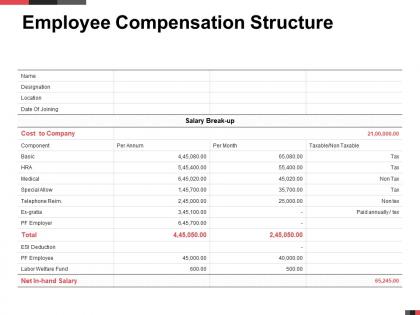
Employee compensation structure salary ppt powerpoint presentation show




Try Before you Buy Download Free Sample Product
 Impress Your
 Audience
 100%
100% Editable
 Save Hours
 of Time


Coax your team along with our Employee Compensation Structure Salary Ppt Powerpoint Presentation Show. Encourage them with positive inputs.
People who downloaded this PowerPoint presentation also viewed the following :
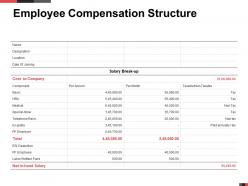
Employee compensation structure salary ppt powerpoint presentation show with all 5 slides:
Coast along with our Employee Compensation Structure Salary Ppt Powerpoint Presentation Show. Your thoughts will move along steadily.


FAQs for Employee compensation structure salary ppt
So there's basically four things you need to nail down. Start with base salary - and honestly, don't cheap out here because that's where most companies shoot themselves in the foot. Then add performance bonuses or commissions that actually make sense. Health insurance, retirement stuff, all the standard benefits come next. Oh, and throw in some nice-to-haves like remote work options or training budgets. The trick is matching everything to what your industry pays - like, actually research what competitors offer instead of just guessing. Make sure it all connects back to what you're trying to achieve as a business too.
So I'd go with like 70-80% base salary, then 20-30% variable stuff. That way people aren't freaking out about paying bills but still have reason to hustle. Just make sure the bonus part connects to things they can actually control - not some random company metric they have zero impact on. That's honestly just annoying. Senior people can handle more variable pay since they move the needle more. Oh and definitely make your base competitive first, then layer on the fun incentive pieces. I'd start by looking at what you're doing now and straight up asking people what gets them fired up. Works way better than guessing.
So you basically need to reality-check yourself with actual salary data. Hit up job boards, salary surveys, industry reports - whatever you can find for similar roles in your area. I swear, the numbers will surprise you sometimes because we're all just guessing half the time. Look for 3-5 companies that are actually comparable to yours and see what they're posting. You're aiming for somewhere between the 25th and 75th percentile usually. This whole process helps you avoid the awkwardness of either lowballing good candidates or accidentally breaking your budget on someone.
Honestly, you need at least 3-5% pay gaps between tiers or it's just insulting. Define what "high performer" actually means first - like real metrics, not vague BS. The hard part? Getting all your managers to evaluate people fairly. We both know how inconsistent that gets. I'd test it with just one team initially to see what breaks. Oh, and be super transparent about the criteria upfront - people deserve to know exactly what they're working toward. Performance-based pay sounds great in theory but the execution is where most companies mess it up.
Honestly, pay-for-performance sounds great in theory - your best people get rewarded and stay motivated. The catch? You need bulletproof metrics that actually matter, not just whatever's easiest to measure. I've seen it backfire when people start competing against teammates instead of collaborating. Also creates this weird pressure to chase quick wins over stuff that takes time to pay off. The paperwork alone is a nightmare. My advice? Test it with just one team first, somewhere you can clearly define success. See how it goes before rolling it out everywhere.
Look, start by running regular pay audits - check compensation across different demographics so you catch gaps early. Set up structured pay bands for each role because that's where bias sneaks in during negotiations. Some people just aren't comfortable asking for more money, you know? Train your hiring managers on unconscious bias stuff and ditch those salary history questions completely. The whole thing works better when you're getting ahead of problems instead of scrambling to fix them later. Do quarterly compensation reviews and fix any weirdness immediately when it pops up.
Benefits are like 25-30% of your total comp, which is honestly pretty massive. So when you're putting together pay packages, there's this constant balancing act between base salary and what you're spending on health insurance, 401k matching, all that stuff. The tricky part? Employees don't always get how valuable their benefits actually are. I've seen people focus only on salary and totally ignore that their company's covering like $800/month in health premiums. Being upfront about the total package value during hiring and reviews really helps though - people need to see the full picture of what they're getting.
Honestly, compensation software is a game changer - it handles all that tedious manual stuff you're probably drowning in right now. Real-time market data and automated benchmarking? Yes please. It'll analyze pay equity across your whole company and help you track budgets without those Excel spreadsheets from hell (you know the ones I mean). The scenario modeling is pretty sweet too. Best part is you'll make way faster decisions and cut down on mistakes. I'd figure out what's driving you most crazy about your current process first, then find something that tackles those specific headaches.
Honestly, geographic pay is where you'll get tripped up first. Are you paying based on where they live or where your company is? That decision alone will save you tons of headaches later. After that, look at what the role actually pays in different markets. Remote workers also care way more about flexibility perks than office people - learned that the hard way. Your budget obviously matters too, but don't forget equity and benefits in the mix. I'd start with salary research for your specific roles across different cities, nail down your geographic approach, then build everything else around that.
Honestly, most companies are terrible at this. You've gotta make compensation info actually accessible - not just some buried PDF that nobody reads. Train your managers so they don't get all awkward when people ask about pay during one-on-ones. Regular all-hands meetings help too, where leadership can explain how bands and bonuses actually work. The trick is ditching the HR speak and being genuinely open about it. I'd start by figuring out what employees can currently find about compensation... you'll probably discover they know way less than you think. Make it findable and understandable, that's really what matters.
Dude, pay transparency laws are everywhere now - companies have to post actual salary ranges which is wild. Remote work totally flipped everything too. Some places still do location-based pay, others don't, it's honestly all over the place. Benefits packages are getting crazy elaborate though. Like equity, flexible perks, performance bonuses on top of base salary. I swear HR departments are having a field day with this stuff. But here's the thing - when you're looking at offers, don't just fixate on the base number. Compare the whole package against market rates because that's where the real money might be hiding.
Honestly, I'd start by checking if you're losing people to competitors over money - that's usually the biggest red flag. Your retention rates will tell you a lot. Also look at how tough it is to fill open positions at your current pay ranges. Employee satisfaction surveys are clutch here, especially around compensation stuff. And definitely do internal equity checks because nothing kills morale faster than finding out your coworker makes 20% more for identical work. See if your pay structure actually drives the performance you want. Oh, and benchmark against similar companies in your area - you might be surprised where you stand compared to the competition.
So minimum wage laws basically set the floor - nobody can get paid less than that. But here's the thing that catches people off guard: when entry-level pay gets bumped up, you have to squish your whole pay structure. Suddenly your experienced workers are making barely more than brand new hires, which is honestly pretty awkward. You'll probably end up focusing more on benefits instead of base pay to make packages feel different. Oh, and definitely check your pay structure whenever these laws change - I've seen companies create total mess situations internally because they didn't adjust everything else.
Yeah, this is so true - compensation expectations are wildly different depending on where your team is. Asian employees often care way more about job security and long-term benefits than just getting a fat paycheck right now. Americans? They usually want that direct cash. Europeans expect crazy amounts of vacation time compared to what we're used to here, plus all those social benefits. Some cultures actually prefer flexible work or training opportunities over more money, which honestly surprised me when I first learned that. You really need to survey your international teams regularly and research local norms instead of assuming everyone's motivated by the same stuff.
Start with a market analysis to see how you stack up against competitors. Then do internal pay audits - you'll probably find some weird inconsistencies you didn't know about. Survey your people about compensation and career stuff too. Don't overhaul everything at once though, that's a recipe for chaos and budget shock. I'd standardize job levels first, then build clear advancement paths. Getting leadership on board early is huge. Oh, and be transparent with employees throughout - people hate being kept in the dark about pay changes. Phase it out over time instead of going nuclear.
No Reviews