


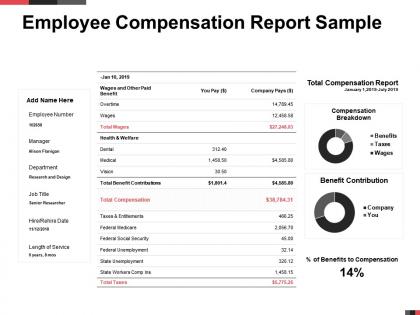
Employee compensation report sample breakdown powerpoint presentation example




Try Before you Buy Download Free Sample Product
 Impress Your
 Audience
 100%
100% Editable
 Save Hours
 of Time


Our Employee Compensation Report Sample Breakdown Powerpoint Presentation Example work in all conditions. They possess a very adjustable nature.
People who downloaded this PowerPoint presentation also viewed the following :
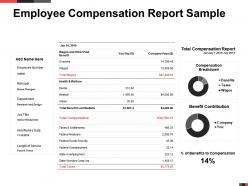
Employee compensation report sample breakdown powerpoint presentation example with all 5 slides:
Lighten up with our Employee Compensation Report Sample Breakdown Powerpoint Presentation Example. They will take up some of the burden.

FAQs for Employee compensation report sample breakdown
**INPUT**: What key components should an employee compensation report include to ensure comprehensive coverage? **OUTPUT**: A comprehensive employee compensation report should include base salary analysis, bonus structures, benefits packages, equity compensation, performance metrics, and market benchmarking data. These components enable organizations to assess compensation equity, identify pay gaps, and ensure competitive positioning, with many companies finding that detailed reporting enhances transparency, improves retention strategies, and ultimately delivers stronger talent acquisition outcomes. [Word count: 58 words]
The local labor market significantly influences compensation structures through prevailing wage rates, talent availability, cost of living variations, and competitive pressures from neighboring organizations. Companies operating in high-demand markets, particularly in tech hubs like Silicon Valley or financial centers, often find themselves offering premium salaries, enhanced benefits packages, and flexible work arrangements to attract scarce talent, ultimately driving regional compensation benchmarks higher across industries.
Employee performance plays a central role in determining compensation packages through merit-based salary increases, performance bonuses, stock options, promotion opportunities, and incentive pay structures. High-performing employees in sectors like technology, finance, and sales typically receive higher base salaries, variable compensation, and advancement opportunities, ultimately enabling organizations to retain top talent while driving productivity and competitive advantage.
Organizations use employee compensation reports to identify pay gaps, benchmark against industry standards, and develop competitive retention strategies that address specific compensation concerns. Through data-driven insights, companies can proactively adjust salaries, implement targeted bonuses, and create transparent advancement pathways, ultimately reducing turnover costs while enhancing employee satisfaction and organizational competitiveness.
Compensation equity metrics include pay gap ratios by gender and ethnicity, salary range penetrations, compa-ratios, and promotion rate comparisons across demographic groups. These analytics enable organizations to identify disparities, benchmark against industry standards, and implement strategic adjustments, with many companies finding that transparent tracking ultimately enhances retention and competitive positioning.
Technology streamlines compensation report preparation through automated data collection, real-time analytics, cloud-based platforms, and integrated payroll systems. These solutions enhance accuracy by eliminating manual errors, reducing processing time, and enabling dynamic benchmarking against industry standards, with many HR departments finding that automated reporting delivers faster insights and strategic compensation planning capabilities.
Legal considerations include compliance with equal pay legislation, wage and hour laws, data privacy regulations, anti-discrimination statutes, and reporting requirements for publicly traded companies. These frameworks ensure transparency and fairness by mandating accurate wage documentation, protecting employee confidentiality, and requiring disclosure of pay equity metrics, with many organizations finding that proactive compliance ultimately delivers reduced legal risk and enhanced workforce trust.
Employee compensation reports should categorize base salary as fixed annual wages, bonuses as performance-linked variable pay, and benefits as non-cash compensation including health insurance, retirement contributions, and paid time off. This strategic segmentation enables organizations to analyze cost structures, benchmark against industry standards, and optimize total compensation packages, with many companies finding that clear differentiation enhances budget planning and employee transparency.
Compensation benchmarks include salary surveys from firms like Mercer and PayScale, industry association reports, government labor statistics, peer company data, and regional market studies. These resources enable organizations to evaluate base salaries, bonuses, benefits, and total compensation across similar roles and industries, with many companies finding that regular benchmarking enhances talent retention and competitive positioning.
Organizations ensure transparency and fairness in compensation reports by implementing standardized pay scales, conducting regular salary audits, clearly defining role expectations, and establishing consistent performance metrics across all departments. Through these systematic approaches, companies can minimize wage gaps, enhance employee trust, and demonstrate equitable practices, with many finding that transparent compensation ultimately reduces turnover and strengthens organizational culture.
Economic trends significantly influence employee compensation strategies by driving adjustments in salary benchmarks, benefit allocations, inflation considerations, market competitiveness assessments, and budget planning priorities. During economic shifts, organizations increasingly rely on comprehensive compensation reports to navigate talent retention challenges, optimize resource allocation, and maintain competitive positioning, with many companies finding that data-driven compensation strategies enable sustained growth while managing operational costs effectively.
Employee compensation reports address diversity, equity, and inclusion by analyzing pay gaps across demographic groups, identifying disparities in promotion rates and salary progressions, and benchmarking compensation practices against industry standards for underrepresented populations. These comprehensive analyses enable organizations to implement targeted corrective measures, establish transparent pay equity frameworks, and demonstrate measurable progress toward inclusive workplace cultures, ultimately enhancing talent retention and organizational reputation.
Employee compensation feedback can be gathered through anonymous surveys, focus groups, one-on-one meetings, exit interviews, and digital feedback platforms. These methods enable organizations to assess satisfaction levels, identify compensation gaps, and understand employee perspectives on benefits packages, with many companies finding that regular feedback collection enhances retention and competitive positioning.
Employee compensation reports should be updated quarterly to maintain relevance, with comprehensive annual reviews incorporating market data, performance metrics, and industry benchmarks. This frequency enables organizations to respond to market fluctuations, address pay equity issues, and retain top talent, while many companies find that quarterly updates provide the agility needed for competitive positioning in today's dynamic employment landscape.
**INPUT**: What are the implications of not addressing discrepancies found in compensation reports? **OUTPUT**: Unaddressed compensation discrepancies can lead to decreased employee morale, increased turnover, potential legal compliance issues, and damaged organizational reputation. These gaps often result in talent flight to competitors, reduced productivity across teams, and costly litigation risks, with many companies finding that proactive compensation corrections ultimately deliver stronger retention rates and enhanced workplace equity. **Word count: 55 words**
No Reviews