


Retail In Store Sales Action Plan





Try Before you Buy Download Free Sample Product
 Impress Your
 Audience
 100%
100% Editable
 Save Hours
 of Time


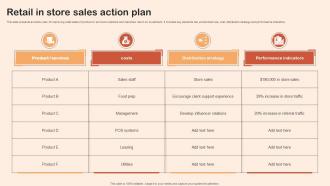
This slide presents an action plan for improving retail sales of product or service to optimize and maximize return on investment. It includes key elements like product or service, cost, distribution strategy and performance indicators.
People who downloaded this PowerPoint presentation also viewed the following :
Retail In Store Sales Action Plan with all 6 slides:
Use our Retail In Store Sales Action Plan to effectively help you save your valuable time. They are readymade to fit into any presentation structure.





FAQs for Retail In Store
Key elements include customer segmentation, competitive pricing, strategic product placement, omnichannel integration, and data-driven inventory management. These approaches streamline operations by enhancing customer experiences, optimizing resource allocation, and maximizing conversion rates, with many retailers finding that this strategic combination ultimately delivers increased revenue and sustainable competitive advantage.
Retailers leverage data analytics to enhance sales performance by analyzing customer behavior patterns, optimizing inventory management, personalizing marketing campaigns, and predicting demand trends. Through advanced analytics tools, retail organizations streamline product recommendations, minimize stockouts, and deliver targeted promotions, with many finding that data-driven strategies significantly increase conversion rates and customer lifetime value.
Customer experience serves as the foundation of retail sales strategy, directly influencing purchase decisions, brand loyalty, customer retention, and revenue growth. Through personalized interactions, seamless omnichannel integration, and responsive service delivery, retailers create competitive differentiation while building long-term relationships, with many retail organizations finding that superior customer experiences drive higher conversion rates and increased customer lifetime value.
Retailers should adapt by integrating omnichannel experiences, personalizing customer interactions through data analytics, optimizing mobile platforms, and streamlining fulfillment with same-day delivery options. Through AI-driven recommendations and seamless inventory management, businesses enhance customer satisfaction, reduce cart abandonment rates, and ultimately deliver competitive advantages in an increasingly digital marketplace.
Visual merchandising techniques include strategic product placement, eye-level positioning of high-margin items, color coordination, seasonal displays, and cross-merchandising complementary products. These approaches enhance customer flow by creating compelling focal points, encouraging impulse purchases, and maximizing space utilization, with many retailers finding that effective visual strategies increase average transaction values and improve overall shopping experiences.
Target audience segmentation improves retail sales outcomes by enabling personalized marketing campaigns, optimizing product placement, and enhancing customer experience strategies. Through advanced analytics and customer data platforms, retailers streamline inventory management, increase conversion rates, and boost customer lifetime value, with fashion and electronics brands finding that targeted approaches deliver significantly higher ROI and competitive advantage.
Loyalty programs significantly increase repeat sales by offering rewards for continued purchases, creating emotional connections with brands, and providing personalized experiences based on customer data. Through points systems, exclusive discounts, and tiered benefits, retailers like Starbucks and Sephora enhance customer retention while gathering valuable insights, ultimately delivering higher lifetime value and sustained revenue growth.
Retailers successfully integrate omnichannel strategies by unifying inventory systems, synchronizing customer data across touchpoints, and ensuring consistent pricing and promotions. Through seamless technology integration, companies like Target and Sephora deliver personalized experiences whether customers shop online, in-store, or via mobile apps, ultimately driving higher customer satisfaction and increased sales conversion rates.
Best practices for training retail staff include product knowledge mastery, customer service excellence, sales technique development, digital tool proficiency, and upselling strategies. These training approaches enhance performance by building confidence, improving customer interactions, and increasing conversion rates, with many retail organizations finding that well-trained staff deliver significantly higher sales per customer and improved store profitability.
Retailers can enhance sales strategies through social media by implementing targeted advertising, influencer partnerships, user-generated content campaigns, social commerce integration, and real-time customer engagement. These approaches streamline brand visibility, product discovery, and purchase processes, with many fashion and electronics retailers finding that social platforms ultimately deliver higher conversion rates and enhanced customer loyalty.
Effective upselling and cross-selling strategies include product bundling, personalized recommendations based on purchase history, strategic merchandise placement, staff training on customer needs assessment, and loyalty program incentives. These approaches enhance customer experience by suggesting complementary items, with many retailers finding that targeted recommendations during checkout and seasonal promotions significantly increase average transaction values while building stronger customer relationships.
Seasonal planning significantly impacts retail sales strategies by enabling demand forecasting, promotional timing, staffing adjustments, and strategic inventory allocation across peak and off-peak periods. Retailers like fashion brands and home improvement stores leverage seasonal data to optimize stock levels, minimize markdowns, and maximize revenue opportunities, ultimately delivering improved cash flow and customer satisfaction while reducing excess inventory costs.
Retailers should track conversion rates, average transaction value, customer acquisition cost, inventory turnover, customer lifetime value, and sales per square foot. These metrics enable comprehensive performance evaluation by measuring customer behavior, operational efficiency, and profitability across channels, with many retail organizations finding that integrated tracking delivers enhanced strategic decision-making and competitive advantage.
Partnerships and collaborations enhance retail sales strategies by expanding market reach, sharing resources and expertise, accessing new customer segments, and creating innovative product offerings. Through strategic alliances with complementary brands, technology providers, and distribution channels, retailers streamline operations, reduce costs, and deliver enhanced customer experiences, ultimately gaining competitive advantage in increasingly crowded markets.
Retailers maximize peak season sales by implementing dynamic pricing strategies, expanding inventory management systems, enhancing customer experience through personalized marketing, and optimizing omnichannel fulfillment capabilities. These approaches streamline operations while delivering faster checkout processes, targeted promotions, and seamless online-to-store experiences, with many retail organizations finding that strategic preparation ultimately drives significantly higher conversion rates and customer loyalty.
-
Time saving slide with creative ideas. Help a lot in quick presentations..
-
I am so thankful for all of the templates I've found on your site. They have saved me hours every week and helped make my presentations come alive. Keep up with these amazing product releases!