

Retail Sales Employee Training Plan





Try Before you Buy Download Free Sample Product
 Impress Your
 Audience
 100%
100% Editable
 Save Hours
 of Time


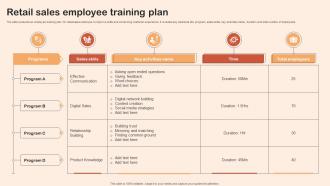
The slide presents an employee training plan for retail sales employee to improve skills and enhancing customer experience. It includes key elements like program, sales skills, key activities name, duration and total number of employees.
People who downloaded this PowerPoint presentation also viewed the following :
Retail Sales Employee Training Plan with all 6 slides:
Use our Retail Sales Employee Training Plan to effectively help you save your valuable time. They are readymade to fit into any presentation structure.





FAQs for Retail Sales
Focus on product knowledge first - your team can't sell what they don't understand. Then hit sales basics like listening to customers and handling those weird objections people throw out. Customer service training matters too since that's literally what brings people back. Honestly, skip the boring PowerPoint stuff. Role-playing awkward situations works way better - trust me on this one. Make sure they get hands-on practice with your POS system too, otherwise you'll have confused employees fumbling around during rush hours. Real scenarios beat lectures every time.
Honestly? Role-playing is where it's at. Your team gets to practice the messy stuff - angry customers, weird return situations, all that fun drama - without real people judging them. I'd keep scenarios super realistic though, like stuff they'll actually deal with. The beauty is they can totally bomb and it doesn't matter! They'll build confidence way faster. Oh, and switch up who plays what - sometimes being the difficult customer teaches you just as much. One scenario per session works best, trust me on that one.
Honestly, you'll want to mix performance stuff with engagement tracking. Sales conversion rates and revenue per employee are obvious ones to watch. Customer satisfaction scores tell you if your team's actually connecting better with people. But here's the thing - employee metrics matter just as much. Track training completion rates and their feedback, because if the content sucks, nobody's learning anyway. Retention rates are huge too since good training keeps people around longer. Pick maybe 3-4 metrics that match your main goals and check them monthly. Don't overcomplicate it.
Honestly, customer psychology is everything in retail sales training. You're basically learning to read how people's minds work when they're deciding to buy something. Most programs teach you about emotional triggers and decision-making patterns - which makes sense because nobody really buys stuff based on pure logic. There's practical techniques like mirroring body language, figuring out personality types, and timing your pitch right. All that objection-handling stuff? It's rooted in psychology. Here's what I'd do though - just watch how different customers react to the same approach. You'll see pretty fast why generic sales tactics don't work for everyone.
Start them off with product knowledge and POS training before any customer stuff - seriously, watching someone panic at checkout is painful for everyone. Have them shadow someone good for a week, then slowly add more interactions. Role-play the tricky situations like angry customers or pushing add-ons. Don't just say "ask anyone" - give them one specific person as their go-to. Oh, and check in with them every day for the first couple weeks. You'll catch problems way earlier that way. Most new hires appreciate the structure anyway.
Dude, mobile training apps are a game changer for retail teams. Your staff can knock out modules whenever they have downtime - between customers or at home. Interactive stuff like quizzes and videos actually stick way better than boring lectures (remember those awful training binders?). You'll track everyone's progress in real-time and spot who needs help. When products or policies change, you can update everything instantly instead of reprinting materials. I'd test one app with a few people first to see what clicks with your team's style and schedule.
Dude, ongoing training makes a massive difference for keeping retail staff around. When people get regular skill development, turnover drops like crazy. They feel way more confident with difficult customers and can actually see where their career might go next. Makes them feel valued too, you know? Better training = better performance = more commission money in their pockets. Don't do the boring compliance crap though - focus on real situations they deal with every day. I'd start with monthly sessions where you work through actual scenarios. Even something small like handling returns or upselling techniques. Trust me, it pays off big time.
Honestly, it's like training two completely different jobs. Your luxury people need to be relationship builders - they're basically consultants who justify those crazy high prices through expertise and service. But discount retail? Total opposite energy. Speed matters there, you're moving volume and helping people find deals fast. I mean, both need solid sales fundamentals, but luxury teams should actually slow conversations down while discount crews need to hustle through transactions. Kinda weird how that works, right? Start by figuring out what winning looks like in each spot, then build everything around those goals. The execution is honestly night and day between them.
Honestly, the biggest pain is just finding time when everyone's swamped with customers. Your team's already running around like crazy. Then you've got the whole consistency thing - what kills it at one location totally flops at another, which is so frustrating. Don't even get me started on turnover, you're basically training someone new every week. Oh, and good luck figuring out if your training actually boosted sales or not. Start super small though - pick one thing and do quick little sessions. Way better than dumping everything on them at once and watching their eyes glaze over.
Try the SBI thing - Situation, Behavior, Impact. So like, describe what you saw happen with the customer, tell them what they did right or wrong, then explain how it actually affects sales. Don't make these sessions super long though, maybe 10-15 minutes tops? People zone out if you pile on too much feedback at once. I always do mine right after watching the interaction since everything's still fresh. Oh and here's what really works - have them practice the better approach with you before they deal with their next customer. Makes a huge difference.
Role-play with actual customer objections - that's what builds real confidence. Get them using "feel, felt, found" until it flows naturally. Honestly, I've sat through way too many boring PowerPoint sessions about product specs. Instead, make them figure out what the customer actually needs first, then suggest add-ons. Throw in some friendly competition with small prizes. Short wins keep people engaged, you know? Most importantly, they need to listen for buying signals instead of just pushing stuff. Let them mess up during practice so they won't freeze up with real customers.
Honestly, product knowledge makes or breaks everything. Your team needs to know that stuff cold - otherwise customers smell the uncertainty from a mile away. I've watched deals crash just because someone couldn't explain basic features, which is painful to see. Skip the boring PowerPoint sessions though. Get them actually using the products, maybe create some comparison sheets, do mock sales calls. That hands-on stuff sticks way better. Oh and do monthly spotlights on different products to keep things fresh. When salespeople really understand what they're selling, they can pivot smoothly and handle whatever curveballs customers throw at them.
Dude, emotional intelligence is everything in retail sales. You've gotta read people - like, is this customer stressed out or actually excited to shop? Match their vibe instead of using the same pitch on everyone. I swear, some salespeople just can't pick up on social cues and it's painful to watch. Focus your training on spotting body language and emotional signals. Also teach them how to stay calm with difficult customers - that's harder than it sounds. Build real connections instead of just trying to sell stuff. Practice listening more than talking and watch how people's posture changes mid-conversation.
Make learning feel like a win, not a chore - celebrate when people try new stuff or share what they picked up. Regular feedback sessions help a ton, but make sure it's team members talking to each other, not just managers lecturing down. Honestly, the best results I've seen happen when managers actually jump in instead of just watching from the sidelines. Peer mentoring works great, and you can rotate who runs the mini sessions. Even just 10 minutes in team meetings to cover one improvement makes a difference. Consistency beats perfection - don't make it this big special event, just build it into what you're already doing.
Honestly, urgency messaging is your best friend here - "limited time" and "while supplies last" just work. Your team should definitely push bundles and cross-sells since customers are already ready to spend. But here's the thing - skip the feature dumps. People want solutions, not specs. Train everyone to ask what they're planning or what event they're shopping for. You know what kills deals though? Price objections. Role-play those conversations beforehand because everyone expects discounts during promos. Oh, and make sure staff can handle the "is this your best price" question without panicking.
-
Thank you for offering such fantastic custom design services. The team is really helpful and innovative. In a very short time, I received my personalized template.
-
Huge collection of high-quality templates. Worth each penny.