


Retail Store Employee Management Process Flowchart




Try Before you Buy Download Free Sample Product
 Impress Your
 Audience
 100%
100% Editable
 Save Hours
 of Time


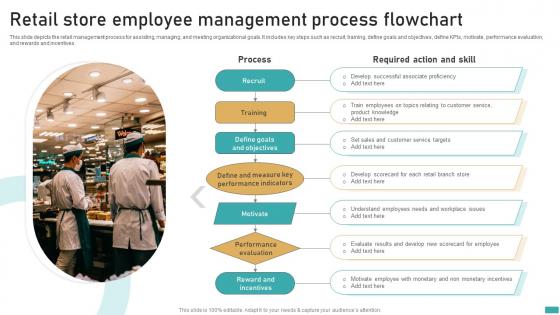
This slide depicts the retail management process for assisting, managing, and meeting organizational goals. It includes key steps such as recruit, training, define goals and objectives, define KPIs, motivate, performance evaluation, and rewards and incentives.
People who downloaded this PowerPoint presentation also viewed the following :
Retail Store Employee Management Process Flowchart with all 6 slides:
Use our Retail Store Employee Management Process Flowchart to effectively help you save your valuable time. They are readymade to fit into any presentation structure.





FAQs for Retail Store Employee
Key challenges include high turnover rates, irregular scheduling demands, seasonal staffing fluctuations, maintaining consistent customer service standards, and managing diverse skill levels across locations. These workforce complexities require strategic approaches combining flexible scheduling systems, comprehensive training programs, and performance incentives, with many retail organizations finding that technology-enabled solutions streamline operations while enhancing employee satisfaction and retention.
Retail managers can improve employee engagement through clear career advancement paths, regular performance feedback, competitive compensation packages, flexible scheduling options, and meaningful recognition programs. These strategies enhance retention by creating positive work environments, reducing turnover costs, and ultimately delivering better customer experiences, with many retail organizations finding that engaged employees drive significantly higher sales performance.
Technology revolutionizes retail employee management through automated scheduling software, digital time tracking systems, performance analytics platforms, mobile communication apps, and integrated payroll solutions. These tools streamline operations by reducing administrative burden, improving shift coordination, and enhancing workforce visibility, with many retail chains finding that automated systems deliver faster scheduling, better compliance, and ultimately improved operational efficiency.
Training programs can be tailored through personalized learning paths, multi-format content delivery, cultural sensitivity modules, role-specific skill development, and flexible scheduling options. Retail organizations increasingly use adaptive learning technologies and diverse training methods, from interactive workshops to mobile-friendly modules, ensuring employees across different backgrounds, experience levels, and learning preferences receive relevant development while enhancing customer service capabilities.
Effective turnover reduction strategies include competitive compensation packages, flexible scheduling systems, comprehensive training programs, clear career advancement pathways, and regular performance recognition initiatives. These approaches enhance employee satisfaction by addressing work-life balance concerns, skill development needs, and professional growth aspirations, with many retail organizations finding that strategic investment in workforce development ultimately delivers improved customer service and reduced recruitment costs.
Performance metrics effectively assess retail employee productivity through sales conversion rates, average transaction values, customer satisfaction scores, inventory accuracy rates, and attendance records. These measurements enable managers to identify top performers, provide targeted coaching for improvement areas, and create incentive programs that drive results, with many retail organizations finding that data-driven performance evaluations ultimately enhance both employee engagement and overall store profitability.
Best practices for retail performance reviews include setting clear sales and customer service metrics, conducting regular check-ins beyond annual evaluations, providing specific feedback on floor performance, recognizing achievements publicly, and creating development plans for career advancement. These practices enhance employee engagement, reduce turnover, and improve customer experiences, with many retail organizations finding that structured, frequent feedback ultimately delivers stronger sales performance and operational efficiency.
Cross-training is essential for retail operations, enabling workforce flexibility, reducing scheduling gaps, and enhancing customer service capabilities across departments like sales, inventory, and customer support. Through structured rotation programs, mentorship pairings, and hands-on learning modules, retailers can develop versatile teams that adapt seamlessly to peak seasons and staffing changes, ultimately delivering improved operational efficiency and enhanced customer experiences.
Employee morale significantly impacts customer satisfaction through improved service quality, increased engagement levels, and reduced turnover rates that ensure consistent experiences. Happy retail employees deliver more personalized assistance, demonstrate greater product knowledge, and create welcoming environments, with many retailers finding that high-morale teams generate measurably higher customer loyalty and repeat business.
Retail companies can foster recognition culture through peer-to-peer appreciation programs, performance-based incentives, public acknowledgment systems, flexible rewards, and regular feedback mechanisms. These approaches enhance employee engagement and reduce turnover by creating meaningful connections, celebrating achievements both big and small, and ultimately delivering improved customer service experiences while building stronger team cohesion across retail locations.
Retail managers must navigate employment law compliance, wage and hour regulations, workplace safety requirements, anti-discrimination policies, and scheduling fairness standards. These legal frameworks protect both employees and businesses by ensuring proper documentation, fair compensation practices, and safe working environments, with many retailers finding that proactive compliance ultimately reduces liability risks while enhancing employee satisfaction and retention.
Retail recruitment strategies can be optimized through targeted job descriptions, competitive compensation packages, social media recruiting, employee referral programs, and partnering with retail-focused training institutions. These approaches streamline talent acquisition by highlighting growth opportunities, emphasizing flexible scheduling benefits, and showcasing company culture, with many retailers finding that emphasizing career development paths significantly improves candidate quality and retention rates.
Flexible scheduling systems deliver improved employee satisfaction, reduced turnover, enhanced work-life balance, increased productivity, and better shift coverage during peak periods. These systems enable retailers to optimize labor costs, accommodate diverse employee needs, and maintain consistent customer service levels, with many retail chains finding that flexible approaches ultimately boost both employee retention and operational efficiency.
Effective communication within large retail teams can be maintained through digital messaging platforms, regular team huddles, clear escalation protocols, structured shift handovers, and visual management boards. These systems enable seamless information flow across departments and shifts, with many retail organizations finding that centralized communication tools reduce miscommunication, improve operational coordination, and ultimately enhance customer service delivery.
Diversity and inclusion enhance retail employee performance by bringing varied perspectives, improving customer relations, and fostering innovation within teams. Diverse retail workforces better understand multicultural customer bases, leading to enhanced service delivery, while inclusive environments increase employee engagement, reduce turnover, and ultimately deliver stronger sales performance and competitive advantage.
-
What a stunning collection of customizable templates! Really a time-saver..
-
Excellent Designs.