

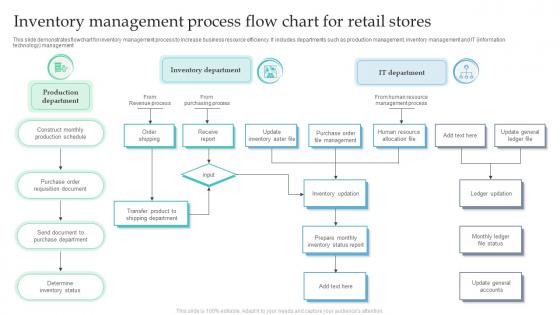
Inventory Management Process Flow Chart For Retail Stores




Try Before you Buy Download Free Sample Product
 Impress Your
 Audience
 100%
100% Editable
 Save Hours
 of Time


This slide demonstrates flowchart for inventory management process to increase business resource efficiency. It includes departments such as production management, inventory management and IT information technology management.
People who downloaded this PowerPoint presentation also viewed the following :
Inventory Management Process Flow Chart For Retail Stores with all 6 slides:
Use our Inventory Management Process Flow Chart For Retail Stores to effectively help you save your valuable time. They are readymade to fit into any presentation structure.





FAQs for Inventory Management Process Flow Chart
So you'll want to focus on inventory turnover ratio first - basically how fast you're moving stuff. Stockout frequency matters too because nobody likes telling customers "sorry, we're out." Carrying costs show what it's actually costing you to sit on inventory (sometimes more than you'd think). Order fulfillment rates are huge obviously. Honestly though? Start with just 2-3 metrics that match whatever's driving you crazy right now. I made the mistake of tracking everything at once and it was overwhelming. You can always add more later once you've got a handle on the basics.
So JIT basically stops your cash from getting stuck in inventory that just sits around forever. You order smaller batches more often instead of buying massive amounts upfront. Way less money tied up in products collecting dust - plus you save on storage and won't have stuff expiring on you. The tricky part is finding suppliers you can actually count on. I'd start small though, maybe pick your most predictable products and try it there first. Once you get the hang of it, your cash flow will thank you. Much better than having thousands sitting in boxes.
Honestly, tech changes everything with inventory stuff. Barcode scanners and RFID give you real-time tracking instead of that nightmare spreadsheet situation. Auto-reordering kicks in when you hit low stock levels. Dashboards show what's actually selling vs what's just taking up space - super helpful. The AI demand forecasting thing still trips me out, but it works. Oh, and cloud systems mean everyone can check inventory from their phone or whatever. I'd say start small with automated low-stock alerts. Once you try it, going back to manual tracking feels like using a flip phone.
So you'll want to pull your last 12-18 months of sales data and mix that with seasonal stuff and market trends. Factor in any promos you've got coming up too. Honestly, Excel gets super messy with this - I'd look into demand forecasting software if you're growing. The biggest thing? Don't just build it once and walk away. Update monthly or quarterly depending how fast your business moves. Track how close your predictions were to actual sales, then tweak whatever keeps being wrong. It's kinda like calibrating - you get better at it over time.
Small businesses usually get stuck with cash tied up in inventory and tracking everything by hand. Honestly, forecasting is a nightmare when you barely have sales history to work with. Plus you're juggling ten different jobs, so inventory becomes this thing you deal with when stuff runs out. Big companies? Totally different headache. They're managing warehouses everywhere, thousands of products, and departments that hate talking to each other. For them it's less about survival, more about making their massive operations actually efficient. Either way though - fix your data first. Can't solve what you can't see clearly.
So basically, faster inventory turnover = more money in your pocket. You're turning stock into cash quicker, which frees up capital that would otherwise just sit there collecting dust. Storage costs drop too. The real win? You can reinvest that cash into better opportunities instead of having it tied up in products that might go bad or become outdated. Honestly, it's one of those metrics that sounds boring but actually makes a huge difference. Check yours monthly and see how you stack up against competitors - that'll show you where you can improve. Just don't go so lean that you run out of popular items.
Honestly, start with your demand forecasting - that's where most people screw up. Set reorder points based on lead times and keep some safety stock around. ABC analysis helps you focus on the expensive stuff first. Just-in-time ordering works great if your suppliers are reliable (big if there). Do regular inventory counts because I swear, the numbers are always off somewhere. Automated reorder systems cut down on mistakes too. Oh, and see if your main suppliers will do vendor-managed inventory - saves you a headache. Check which items are causing you the most stress right now and tackle those turnover rates first.
Look at your sales history first - it'll show you what's actually selling vs what's just taking up space. I'd start with tracking turnover rates since that's pretty straightforward. Once you get the hang of it, you can set up automatic reorder points based on real numbers instead of guessing. Seasonal stuff is huge too - like December always being crazy or whatever your busy months are. Oh, and definitely track how long suppliers take to deliver because running out of stock is the worst. Honestly though? Don't try to analyze everything right away or you'll get overwhelmed.
FIFO is your best friend here - first in, first out, every single time. Set up alerts for stuff that's about to expire because honestly, manually checking is where most places screw themselves over. Get temperature sensors that actually log everything automatically. Smaller deliveries work way better than huge bulk orders that just sit there going bad. Oh, and track your waste weekly at first - you need real numbers to see if you're actually improving or just thinking you are. Trust me on the supplier relationships thing, it makes a huge difference.
So it really depends on what you're selling. Retail guys are all about turnover and seasonal stuff - like the crazy rush before holidays. Manufacturing is more focused on getting raw materials when they need them so production doesn't stop. Food companies? They're constantly stressing about expiration dates and keeping things cold. Tech is weird because everything becomes outdated so fast, plus there's always some chip shortage happening. Healthcare can't mess around - they need strict tracking and can never run out of critical stuff. You've got to figure out what makes your industry tick first, then build around those specific headaches.
Dude, e-commerce is wild compared to regular inventory stuff. You're suddenly juggling way more products and everyone wants their order yesterday. Plus you're shipping individual packages all over instead of just sending bulk to stores - honestly feels chaotic at first. The good news? You actually see what people buy in real-time, not just what some buyer guessed would work. You'll need decent forecasting software and probably a few warehouses scattered around. Oh, and get inventory software that handles everything - online, stores, whatever. Trust me on that one.
Honestly, you need one system that talks to everything - your website, Amazon, physical store, whatever. Real-time syncing is crucial or you'll oversell and piss people off (learned that the hard way). Most inventory software connects through APIs to your different platforms. Set up automatic reorder points for each channel based on how fast stuff moves there. Oh, and don't forget safety stock levels - some channels are way more unpredictable than others. First step though? Figure out where your current setup is breaking down. That'll show you exactly what needs fixing.
Honestly, manual tracking is a nightmare waiting to happen. You're gonna get human errors, wrong counts, data entry screwups - the whole thing just snowballs. I've watched people waste entire days just counting inventory, which is insane. Automated systems give you real-time updates and send alerts when you need to reorder stuff. Barcode scanning cuts down mistakes big time. The software can actually spot demand patterns instead of you just winging it. My advice? Start with something basic like barcode scanners - even that small change will make a huge difference in your accuracy rates.
Dude, you gotta get a solid system down for returns and overstock before it bites you. First thing - inspect all returns, then sort them into buckets: resell as-is, discount, fix up, or just dump. This crap accumulates way faster than you'd expect, trust me. Bundle your slow sellers with hot items, give your employees first dibs at a discount, or find some discount partners. Speed matters here because once stuff sits too long it's basically worthless. Oh, and do monthly inventory checks - way better than dealing with a massive pile later when you're stressed out of your mind.
Honestly, start with what you're already using - does it play nice with your accounting software and online store? The interface is huge too. I've watched entire teams basically boycott terrible software, so demo a few with real data first. Budget obviously matters, but don't cheap out if you'll outgrow it in six months. Real-time tracking and decent reporting are pretty standard now. Oh, and scalability - sounds boring but you don't want to do this whole search again next year. Try 2-3 options max so you don't overthink it.
-
Happy to found you SlideTeam. You guys are value for money. Amazing slides.
-
Their templates are super easy to edit and use even for the one like me who is not familiar with PowerPoint. Great customer support.