

Process flow chart of inventory management




Try Before you Buy Download Free Sample Product
 Impress Your
 Audience
 100%
100% Editable
 Save Hours
 of Time


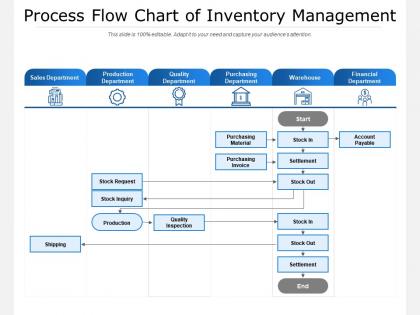
Introducing our Process Flow Chart Of Inventory Management PowerPoint Presentation Slide. Grab the attention of the viewers with an attention-grabbing graphical representation of your business process with this PPT template. Clearly demarcate the functioning of various departments like sales, production, quality, purchasing, warehouse, and financial department through this PPT layout. Explain the entire process of inventory management, starting from stocking to settlement, by taking the aid of this PPT design. Create a report of all the crucial information and data with the assistance of this PPT visual. This PPT design is professionally curated to display the statistics and logistics in an organized and well-structured format. Elaborate on the benefits of automating the operational process with the help of this PPT graphic. Gain an understanding of the entire inventory control process by employing this PPT slide. Download this completely customizable PPT presentation to create an informative visual treat for your audiences.
People who downloaded this PowerPoint presentation also viewed the following :
Content of this Powerpoint Presentation
For any business, efficient operations can come about only when there is scientific and competent inventory management. Essentially, the action that needs to be taken is watch out for the flow of goods from procurement to storage to distribution.
Inventory management requires a well-defined process flow chart. This could include the time of order, the transport and the final delivery. The aim is to ensure the product or service is there, when the customer demands it.
Process flow chart templates for inventory management ensure that businesses have a structured approach to doing this. This serves three functions for businesses:
-
Ensures that enterprises can maintain optimal stock levels
-
Reduce holding costs
-
Meet customer demands effectively.
The inventory management Process flow chart PPT Presentation by SlideTeam helps businesses be more efficient. Using this PPT, businesses can enhance reporting standards.
Here is how you can transform your inventory management with our 100% editable and customizable PowerPoint Templates, which offers a structured approach to inventory analysis, purchase orders, and inventory audits.
Let’s explore!
Template 1: Process Flow Chart of Inventory Management
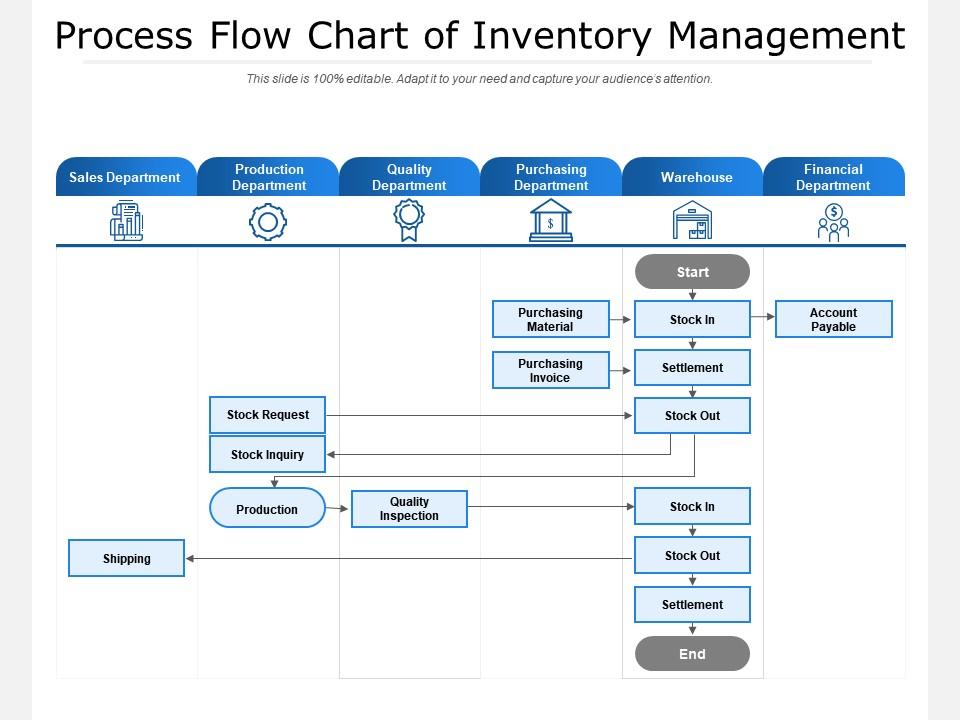
If you're looking to increase the efficiency of operations of your company, this PowerPoint Slide is the one guidebook you need. Use this PPT Template to get a complete view of your inventory management process with its visual mapping of each step. From stock numbers to settlement status, we cover it all for your convenience. This PPT Deck conveys our business processes with a plan and system, focusing on all departments. Sales, manufacturing and accounting benefit from inventory control.
Users will find new information on stocking, settlement and other tactics for project execution. Enhance your understanding of inventory control by leveraging this slide, covering stages like stock in, settlement, stock out, purchasing, inspection, and more. The use-cases of this slide are removing bottlenecks and optimizing resource allocation. This is manifested in better sales and even better customer service. Better inventory control also helps you expand your market share, as availability is an important factor for customers. Use this PPT Theme to showcase your commitment to transparency and efficiency.
TAKE THAT SMART STEP TOWARDS OPERATIONAL EXCELLENCE
SlideTeam simplifies complicated inventory management and departmental responsibilities. Its capacity to simplify data display, increase transparency, and boost operational efficiency makes it important for inventory management optimization.
Get this process flow chart for inventory management and take a smart step toward operational excellence and sustained success.
WHAT’s MORE?
Want to optimize inventory control? Access this Inventory Control Pipeline Flow Chart now.
Explore the Digital Inventory Management Process Flow for a cutting-edge approach to optimizing your business processes.
Click here to explore the Inventory Management Process tailored for small businesses.
Process flow chart of inventory management with all 2 slides:
Use our Process Flow Chart Of Inventory Management to effectively help you save your valuable time. They are readymade to fit into any presentation structure.
FAQs for Process flow chart
Look, it all comes down to balance and actually knowing what you've got. Don't tie up cash in stuff sitting on shelves forever, but keep enough so you're not scrambling when orders come in. ABC analysis is solid - rank your items by how much they're worth to you. Track everything in real time because honestly, way too many places are just guessing at their inventory levels. Set reorder points that trigger automatically. Review how fast things move regularly. Use your sales history to predict what's coming - though sometimes trends surprise you anyway. First step though? Get a proper tracking system if you don't have one.
Honestly, tech turns inventory from pure chaos into something you can actually manage. RFID tags and barcode scanners give you real-time tracking - no more wandering around like "I swear we had 50 of these yesterday." Cloud systems let you see stock levels everywhere at once, plus they'll ping you when stuff's running low. The data helps you figure out buying patterns too. Oh, and if you're still counting by hand (why though?), start with basic barcode scanning. Saves me like 3 hours every week, no joke.
So there's basically three ways to handle this - FIFO, LIFO, and weighted average. FIFO makes the most sense for stuff that goes bad or expires since you're moving older inventory first. Weighted average is solid when your costs jump around a lot, like with commodities. LIFO? Honestly it's mostly just an accounting trick, don't see it much in real warehouses. Your product type matters here. Also depends if you care more about cash flow or tax stuff. I'd just go with FIFO to start - way easier to wrap your head around and most people get it.
So basically you want to match your inventory to what you're actually selling - don't hoard stuff "just in case." Demand forecasting helps you nail the timing. Your cash flow improves because you're not tying up money in dead stock sitting around forever. Storage costs drop too, obviously. Just-in-time delivery becomes your best friend here. When products move faster, you can pivot quicker if market trends shift. I'd start by looking at what's been collecting dust in your warehouse - those slow movers are the easiest wins. Way better than playing guessing games with how much to order.
Okay so demand forecasting is like trying to predict how much stuff you'll need before you actually need it. You look at your past sales data, what's trending in the market, seasonal patterns - that kind of thing. Honestly, it beats just winging it and hoping for the best. Sure, you might still end up with too much inventory sometimes or run out of popular items, but at least you're making educated guesses instead of random ones. I'd say start with whatever sells the most for you and don't overthink it at first. Just update your predictions regularly and you'll get better at it.
Check your inventory turnover rates - it's just cost of goods sold divided by average inventory value. Higher turnover usually means better cash flow. Got stuff collecting dust? Either discount it to move it or quit ordering so much of it (honestly, we all overstock sometimes). Put your money into fast-moving items instead. Monthly reviews help you catch problems early. The goal is having enough stock to meet demand without your warehouse becoming a graveyard. Quick wins come from adjusting order quantities based on what's actually selling versus what you think should sell.
Honestly, the worst part is trying to track inventory when you're selling everywhere at once - your website, physical stores, Amazon, the whole mess. Different channels move at different speeds, so you'll oversell hot items while dead stock sits in the wrong spot. The systems never play nice together either (integration is such a pain). What works in-store might bomb online too, which makes planning tricky. Oh, and don't even get me started on customer expectations being totally different per channel. Real-time visibility across everything should be your first move. Without that, you're basically flying blind.
Honestly, JIT is a game changer for cash flow. Instead of having money just sitting there in inventory, you order stuff right when you need it. Frees up cash for other things and cuts storage costs too. The best part? You won't get stuck with products that go out of style - I've seen that mess happen to so many businesses. It does mean you'll need tighter relationships with suppliers since timing becomes everything. Oh, and definitely start with your best-selling items first to see how it works before going all-in.
Honestly, ditch the spreadsheets first - they're a nightmare to keep updated. Get some basic inventory software instead, even a cheap one beats Excel hell. ABC categorization is clutch - focus on your expensive stuff and let the cheap items coast a bit. Weekly mini-counts work way better than those soul-crushing full inventory days we all hate. Automatic reorder points will save your sanity too. Pick ONE approach though and actually use it consistently before you get all fancy with extra features. Oh, and cycle counting small sections beats doing everything at once - learned that the hard way.
You can't just order the same stuff year-round when demand swings like crazy. Stock up heavy before your busy seasons - think how stores jam their shelves before Christmas. Then dial it way back when things get slow or you'll have cash stuck in products nobody wants. Honestly, predicting the exact timing and volume is the hardest part. Last year's numbers help but they're not perfect. Track your patterns starting now so you can figure out your buffer levels and when to reorder for next season.
Honestly, the accuracy boost alone is worth it - no more "wait, didn't we have 50 of these?" moments. Real-time tracking means you actually know what's in stock instead of guessing based on some outdated spreadsheet. Your team won't be stuck doing mind-numbing counts all day either. The systems can predict when you're running low, which saves you from those last-minute scrambles to reorder stuff. You'll also spot trends faster - like what's flying off shelves vs what's just collecting dust. I'd figure out what's driving you crazy first, then find something that tackles those specific problems.
Honestly, inventory audits are lifesavers - they catch those little mistakes before everything goes to hell. Don't wait for those nightmare annual audits (learned that the hard way). Do cycle counts instead, like pick a section each week and actually stick to it. You'll start seeing patterns pretty quick - maybe it's damaged stuff not getting recorded, theft, or Bob in receiving who can't count to save his life. Focus on your expensive inventory first since that's where screw-ups hurt most. Once you figure out your problem spots, you can fix those processes and retrain people on whatever they keep messing up.
Ugh, bad inventory management is such a cash flow killer. You're basically parking money in stuff that just sits there doing nothing. Stock too much? That's cash you can't use anywhere else. Stock too little and you're literally watching potential sales disappear - super frustrating. Then there's all the extra costs piling up: storage, carrying fees, plus you might have to write off things that expire or become obsolete. I learned this the hard way honestly. The trick is hitting that balance where you've got enough to cover demand without your cash getting trapped in excess inventory.
Honestly, catch those slow movers early or you'll get burned. I do ABC analysis every month to see what's sitting there collecting dust. Fidget spinners taught me that lesson the hard way - had a whole warehouse full nobody wanted! Get ruthless about clearing stuff out. Mark it down, bundle it with hot sellers, whatever works. My rule is 90 days max before something hits clearance mode. Don't get emotionally attached to products just because you think they're cool. Sometimes liquidators are your best friend, even if it stings a bit.
Okay so the big ones you'll want to watch are inventory turnover ratio - basically how fast you're moving stuff off the shelves. Stockout frequency matters too because customers get pissed when you don't have what they want. Track your carrying costs as a percentage of inventory value, plus order accuracy and fill rates. Days sales outstanding is another good one. Oh, and definitely monitor safety stock levels and supplier lead times - learned that one the hard way! The whole thing's about finding balance. You don't want cash tied up in dead inventory, but running out of products is worse. I'd start with turnover ratio and stockouts since those hit your profits and customers directly.
No Reviews