


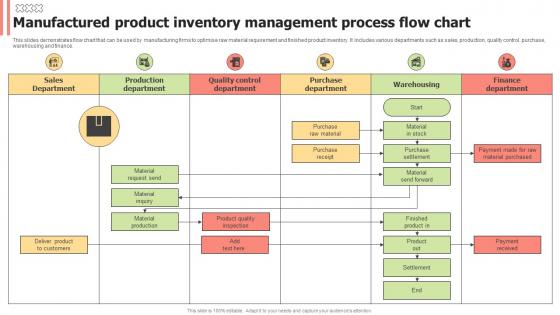
Manufactured Product Inventory Management Process Flow Chart




Try Before you Buy Download Free Sample Product
 Impress Your
 Audience
 100%
100% Editable
 Save Hours
 of Time


This slides demonstrates flow chart that can be used by manufacturing firms to optimise raw material requirement and finished product inventory. It includes various departments such as sales, production, quality control, purchase, warehousing and finance.
People who downloaded this PowerPoint presentation also viewed the following :
Manufactured Product Inventory Management Process Flow Chart with all 6 slides:
Use our Manufactured Product Inventory Management Process Flow Chart to effectively help you save your valuable time. They are readymade to fit into any presentation structure.





FAQs for Manufactured Product Inventory Management
Honestly, the cash flow improvement alone makes it worth it. You'll actually know what's sitting on your shelves and when stuff needs reordering. No more guessing games or scrambling when you're suddenly out of your best seller. The reporting side is pretty sick too - you start seeing patterns you never noticed before. Dead inventory just sitting there? Gone. Money tied up in random products that don't move? Not anymore. Most decent systems will ping you with reorder alerts and sync with whatever accounting software you're using. Don't overthink it though - grab something basic now rather than waiting for the perfect setup.
So JIT is pretty sweet - materials show up right when you need them, no sooner. No more warehouses packed with stuff you won't use for months. Cash flow gets way better since you're not buying inventory ages before production. Storage costs drop too, plus you won't get stuck with expired or outdated stock sitting around. Honestly the hardest part is nailing down your supplier relationships and getting good at predicting demand. I'd probably start with those two things if you're considering it. Once that's dialed in, it runs like clockwork.
You really can't manage inventory well anymore without decent tech backing you up. Real-time tracking and automated reordering will save your sanity - plus predictive analytics help you dodge those nightmare stockout situations. I honestly have no clue how my dad's generation survived with just Excel spreadsheets! Your software should connect with POS, accounting, maybe even supplier systems so everything flows together. Dashboards and alerts are clutch for catching problems early. Oh, and you'll spot trends way faster than manually crunching numbers. I'd start by figuring out what tech gaps you've got right now.
Get a barcode or RFID system set up first - that's gonna be your backbone for tracking everything in real time. Your staff needs to scan items every time they move stuff around, and honestly, this is where most people mess up because they get lazy with the scanning. Connect it to your POS so sales automatically update your counts. I'd check out cloud options like TradeGecko or Fishbowl since you can monitor inventory from your phone (saved my butt so many times when I'm out but need to check stock levels). Just make sure everyone's actually using the scanners consistently or your data turns into a nightmare pretty quick.
Watch these four metrics to see how your inventory's really doing. Inventory turnover shows how fast you're moving stuff - super important. Days sales outstanding tracks how long things sit around before selling. Carrying costs are tricky though - they say keep them under 25% of inventory value, but honestly that's pretty tough right now with everything being so expensive. Also check your stockout frequency and fill rates so you don't run out of popular items or get stuck with too much random inventory. I'd start with just two metrics that match your biggest headaches first.
So demand forecasting is basically predicting how much product you'll need and when. Look at your past sales data first - seasonal patterns are huge here. Higher demand next quarter? You'll want more safety stock and bigger orders placed early. Think of it like checking weather before packing for a trip, honestly. The whole point is balancing customer demand without having too much cash tied up in inventory sitting around. Short bursts work better than trying to predict everything months out. It keeps you from both stockouts and overbuying.
Honestly, the worst part is you'll never know where your stuff actually is. One warehouse is overflowing while another's completely empty - it's maddening. Different systems that don't sync up make everything ten times harder (learned that the hard way). Moving inventory between locations gets messy fast, especially when demand keeps shifting. Oh, and dealing with multiple suppliers just adds another layer of chaos. Get a centralized system ASAP - seriously, it's the only thing that kept me from losing my mind. Those "oops we're out of stock" moments with customers? Yeah, you want to avoid those at all costs.
Honestly, demand forecasting is your best friend here - look at your actual sales patterns instead of just winging it. ABC analysis helps too - categorize stuff by value and how fast it moves, then stock accordingly. Just-in-time ordering rocks for popular items, but man, supply chain issues can really mess with you. Set automatic reorder points based on lead times. Vendor-managed inventory is clutch for your main suppliers - basically they handle keeping you stocked. Don't forget regular audits to spot slow movers early and dump them before carrying costs kill your margins.
Honestly, ditch those awful annual audits and start doing cycle counts instead. Count your expensive stuff monthly, mid-tier items quarterly, and cheap things once a year - that's basic ABC analysis. Always get two people to double-check the numbers and write down any weirdness right away. Your inventory system should track these variances so you can spot patterns. Like maybe one warehouse section is always off, or certain products keep going missing. Set up alerts when stock levels look funky. Seriously though, if you're not doing this already, start next week - it'll save you so much headache later.
Dude, seasonality is a total game-changer for inventory. Start building stock 2-3 months early and beef up safety levels for your hot items. The annoying part? Last year's winner might totally bomb this time - it's honestly such a gamble. You need exit plans for stuff that won't move. Mark things down early, and try to get supplier deals where you can tweak orders mid-season if needed. Oh, and start digging into your sales data now instead of panicking later when everything's crazy.
Honestly, high inventory turnover is your best friend - you're moving products fast and not drowning in unsold stock. Cash flows way better when stuff actually sells, plus you can reinvest that money or tackle debt. But low turnover? Total nightmare. Usually means people aren't buying, you ordered way too much, or you're stuck with outdated crap nobody wants. Storage costs alone will kill you. I'd check those ratios every month and see how you stack up against competitors - catches problems before they get ugly.
Dude, get yourself some inventory software that tracks everything automatically. Real-time stock levels, auto-reordering when you hit minimums - the whole deal. Barcode scanners or RFID tags basically eliminate those annoying counting mistakes. What I love most? You'll get alerts before running out of your bestsellers, plus solid data for predicting what people actually want. Oh, and it syncs across all your sales channels which is clutch. Start with just automating reorders for your top products. You can always add more features later once you see how much time it saves you.
Honestly, both are terrible for different reasons. Overstocking means your cash is just sitting there in boxes while you're paying for storage - and good luck moving last season's stuff. Understocking is worse though because you're literally turning customers away. I learned this the hard way when I couldn't restock fast enough during the holidays. You need to look at your sales patterns and figure out lead times. Set reorder points that actually make sense for your business. It's all about hitting that balance where you're not drowning in inventory but also not disappointing customers.
Honestly, start with your top 20% of products - that's where you'll see the biggest bang for your buck. Look at your historical sales data and seasonal patterns to actually predict what you need instead of just guessing. I've watched companies slash their carrying costs by like 20-30% once they got their forecasting dialed in. Track customer behavior too - it helps spot which inventory will sit around collecting dust. Oh, and set up automated reorder points based on real numbers. Way better than the old "this feels about right" approach most people use.
Dude, good supplier relationships are seriously a game changer for inventory. You get way better info on lead times and when stuff might go sideways with supply. Plus you can actually negotiate flexible terms when you're tight with them. I've seen companies cut their safety stock by like 30% just from better partnerships - wild, right? The trick is treating them as actual partners instead of just people you buy from. Share info both ways and schedule regular calls with your main suppliers about what's coming up. Honestly beats scrambling when problems hit.
-
The designs by SlideTeam are honestly the best I have seen so far. Will be definitely coming back for more.
-
The templates are the best in class. Very clear and innovative graphics! I am excited to explore and download more presentations.