


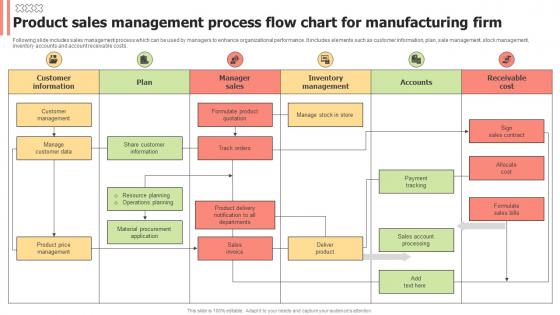
Product Sales Management Process Flow Chart For Manufacturing Firm




Try Before you Buy Download Free Sample Product
 Impress Your
 Audience
 100%
100% Editable
 Save Hours
 of Time


Following slide includes sales management process which can be used by managers to enhance organizational performance. It includes elements such as customer information, plan, sale management, stock management, inventory accounts and account receivable costs.
People who downloaded this PowerPoint presentation also viewed the following :
Product Sales Management Process Flow Chart For Manufacturing Firm with all 6 slides:
Use our Product Sales Management Process Flow Chart For Manufacturing Firm to effectively help you save your valuable time. They are readymade to fit into any presentation structure.





FAQs for Product Sales Management Process Flow Chart
Ok so first thing - do your homework on the market and figure out who you're actually selling to. Most people totally blow this off and wonder why nothing works. Get your pricing dialed in based on competitors. Your sales team needs proper training and a good CRM to track everything. Document your whole process so it's repeatable, not just random. Work closely with marketing for leads - that relationship matters more than people think. Oh and track your metrics religiously. I'd start by looking at what you're missing from this list, then tackle the worst gaps first.
Honestly, analytics is a game changer because you'll actually know what's working instead of throwing money at random stuff and hoping for the best. You can see which products are killing it, when your busy seasons hit, and catch trends early. The marketing spend thing is huge too - finally have real proof of what channels are worth it when your boss starts questioning every expense. Just don't get caught up in tracking everything. Pick maybe 3-4 metrics that actually move the revenue needle and build your dashboards around those first. Way less overwhelming that way.
Dude, customer feedback is literally your cheat sheet for sales. It shows you which features people actually care about and what keeps making them hesitate. Way more reliable than just winging it, honestly. Ask customers from recent deals: "What almost made you pick our competitor?" You'll spot patterns fast. Lost deals are goldmine feedback too - though those conversations can be awkward. Use what you learn to tweak your pitch or pricing. Sometimes you'll realize your messaging is totally off base. The systematic approach beats random guessing every time.
Start with your customer data - dig into who's actually buying from you, their backgrounds, what problems they're solving. Look at your best customers first (honestly, they're like cheat codes for finding more people to target). Break everyone into groups by company size, industry, budget, whatever makes sense for your business. Build detailed profiles for each group, then test your messaging on smaller audiences before you scale up. Oh, and don't try to be everything to everyone - that never works. Focus on maybe 2-3 segments max and really nail what you're offering each one. Way better to dominate a few niches than be mediocre across the board.
Track revenue and conversion rates first - those are your bread and butter. Deal size and sales cycle length matter too. Activity stuff like calls and demos help you see what's coming down the pipe. Customer acquisition cost is critical if you're doing any paid marketing (which, honestly, most people underestimate). I'd also watch customer lifetime value because closing deals that immediately bail isn't doing you any favors. Start with maybe 3-4 metrics your team can actually move the needle on. You can always add more later once you've got those dialed in.
Honestly, start with a CRM - it'll automate your lead tracking and follow-ups without you having to think about it. Pipeline tools are clutch for seeing where deals actually stand. For the boring stuff like email sequences and scheduling, sales automation platforms are a game changer. I spent way too much time on that crap before automating it. Analytics dashboards help you find the bottlenecks fast. Mobile apps keep everyone in the loop when they're out meeting clients. Here's the thing though - map out what you're doing now first, then just pick one thing to automate. Don't go crazy trying to fix everything.
Honestly, start with product training first - your team needs to know their stuff inside and out. Role-playing is super awkward but it actually works. Have them practice discovery questions, handling objections, the whole nine yards. Mock calls are clutch for this. Don't make it a one-and-done training thing though. I'd do monthly sessions where your best reps share what's crushing it for them lately. Maybe throw in some deal reviews too. The continuous practice is what separates good teams from great ones.
Honestly, you've gotta get brutal about what sales can actually promise versus what's still being built. Monthly check-ins between sales and product are clutch - way more effective than I thought they'd be when we first tried it. Share real timelines, not the optimistic ones floating around in your head. Build a roadmap showing quick wins for this quarter plus the longer stuff, then actually update people when things shift (because they will). Your sales folks need to know what they can sell today and what's maybe 6-12 months out. Otherwise you'll end up with angry customers and a support nightmare.
Honestly, pricing is make-or-break for sales. Too high and you scare people off. Go too low and customers think you're selling garbage - plus you're basically throwing away profit. Dynamic pricing works great when things get slow, and premium pricing makes your brand look better. Though I learned this the hard way with my cousin's bakery last year. Your sweet spot really depends on who you're selling to and what competitors charge. Test different prices with small groups first - that's the only way to know what actually works for your stuff. Market research only gets you so far.
Honestly, the biggest difference happens when marketing and sales stop being weird rivals and actually talk to each other. Your sales team hears customer complaints daily - marketing should be using that gold mine for campaigns. Data sharing is huge too. Nothing's worse than when marketing promises something and sales delivers totally different results. Customers see right through that disconnect. Weekly check-ins help a ton - just basic "here's what worked, here's what bombed" conversations. Once both teams align on messaging, everything clicks better.
Honestly, just focus on three things: identify a problem they actually have, show how you solve it, and back it up with real proof like numbers or customer stories. Don't waste time listing features - people only care about what's in it for them. Make it feel like a conversation, not some rehearsed monologue (I've sat through way too many of those). Oh, and here's the kicker - always end with a concrete next step. "I'll send you a demo link tomorrow" beats "let me know if you're interested" every single time.
First thing - actually listen to what they're saying and don't just wait for your turn to talk. Ask questions to figure out what's really bugging them. Like when someone says "it's too expensive," half the time they mean they don't get why it's worth it yet. Once you know the real issue, hit it head-on with examples or whatever data you've got. Honestly, sometimes people just aren't ready and there's nothing you can do about that. Stay curious instead of getting all defensive about it. Always wrap up by asking what it'd take to get them to yes, even if that's months from now.
Honestly, start building hype way earlier than you think - like 6-8 weeks out. Teasers and early access for your best customers work really well (those people are already sold on you anyway). Make sure your sales team actually knows how to talk about what makes this thing special and can handle pushback. Cross-promotion with other brands is huge too if you can swing it. Oh, and don't sleep on your current customers - they're the easiest sells you'll get. The whole sequence needs time to actually work, so yeah, plan ahead on this one.
Start by figuring out what could screw you over - market shifts, competitors doing something crazy, supply chain disasters, customers not paying up. Map your sales process and mark where stuff usually falls apart (trust me, there's more weak spots than you'd expect). Build backup plans for each scenario. Track your conversion rates and deal speed weekly - that's your early warning system. The key thing? Always pad your forecasts with extra time and have plan B ready. Oh, and do regular check-ins with your team so you can spot trouble before it kills your quarterly numbers.
Honestly, social media is like having your shop window and customer service all in one spot. You can show off products, chat directly with customers, build loyalty on Instagram or TikTok - wherever your people actually are. People make buying decisions right on these apps now, it's crazy! Pick maybe two platforms max to start (spreading thin never works). Beyond posting nice photos, you're getting instant feedback and running targeted ads. The trick is staying real - fake engagement is super obvious. Oh, and the data you get helps shape your whole sales approach too.
-
They saved me a lot of time because they had exactly what I was looking for. Couldn’t be happier!
-
Great product, helpful indeed!