


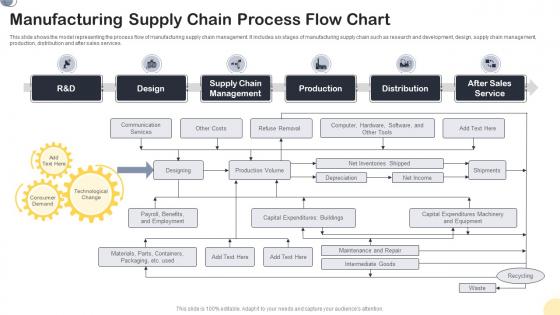
Manufacturing Supply Chain Process Flow Chart




Try Before you Buy Download Free Sample Product
 Impress Your
 Audience
 100%
100% Editable
 Save Hours
 of Time


This slide shows the model representing the process flow of manufacturing supply chain management.It includes six stages of manufacturing supply chain such as research and development, design, supply chain management, production, distribution and after sales services.
People who downloaded this PowerPoint presentation also viewed the following :
Manufacturing Supply Chain Process Flow Chart with all 6 slides:
Use our Manufacturing Supply Chain Process Flow Chart to effectively help you save your valuable time. They are readymade to fit into any presentation structure.





FAQs for Manufacturing Supply Chain
So you need suppliers, manufacturing spots, warehouses, distribution centers, and ways to move stuff around - that covers getting raw materials turned into products and shipped to customers. Don't skip the tech side though, like ERP systems and inventory software that keep everything talking to each other. Coordination is honestly where most companies screw up. Map out what you've got first, then figure out your weak spots. Your chain breaks at the weakest point, so build solid supplier relationships and always have backup plans ready. Oh, and real-time inventory tracking isn't optional anymore.
Honestly, once you get real-time tracking set up, it's like having superpowers. IoT sensors and RFID tags let you see exactly where everything is - inventory, shipments, production status, all on one screen. No more calling around trying to hunt down orders (which is the worst). The trick is making sure all your systems actually connect to each other so data moves automatically. I'd start by figuring out where you're most blind right now, then focus on tech that plays nice together. Cloud platforms are pretty solid for this stuff. Trust me, you won't know how you lived without it once everything's synced up.
Okay so inventory management is literally what keeps production moving without those nightmare delays or having way too much stuff sitting around. The tricky part? Getting materials when you actually need them, especially when suppliers are unpredictable and demand keeps shifting. A decent system will catch problems early and cut down on storage costs - trust me, it makes crazy busy times way more manageable. You want enough backup stock for surprise rushes but not so much that all your cash is tied up in inventory just collecting dust. I'd start by looking at how fast you're actually moving through your current stock.
Look, demand forecasting is like having a crystal ball for your supply chain. You'll actually know how much inventory to order instead of guessing and ending up with a warehouse full of stuff nobody wants (trust me, that sucks). It helps you nail down production schedules and supplier orders without the constant panic. Real data beats gut feelings every time - though honestly, some old-school managers still think they can wing it. Update your forecasts regularly because markets shift fast. When you get it right, everything flows better: warehouse space, shipping costs, the whole thing. Short version? It saves you from both stockouts and overstock headaches.
Honestly, start small with a pilot order before you do anything major. Check their certifications and get references from other clients - that stuff saves your ass when things go sideways. Financial stability matters too, obviously. I'd visit their facilities if you can swing it. Geographic location is huge for shipping costs and timing, trust me on that one. Make sure they can actually scale up with you... learned that lesson during our crazy holiday season when our "amazing" supplier basically disappeared. Oh and always have backup options lined up. Test their quality standards early because fixing that later is a nightmare.
Yeah, geopolitical stuff really screws with supply chains. Trade wars and sanctions can literally shut down your main routes overnight - remember when US-China tariffs messed up all that electronics manufacturing? The whole Russia-Ukraine thing totally wrecked grain and energy supplies too. Political chaos makes suppliers flaky, so you're stuck scrambling for backup options at way higher costs. It's honestly like supply chain jenga half the time. Best thing you can do is spread your suppliers across different regions and stay on top of what's happening politically in countries where you source stuff. Don't put all your eggs in one basket, basically.
Honestly, start by spreading your suppliers around - that whole "don't put all eggs in one basket" thing is real. Get multiple vendors for anything critical so you're not totally fucked if one bails. Better tracking tools are a must too so you can see what's actually happening upstream. Maybe bring some production closer to home instead of those crazy long international chains? Finance will probably whine about it, but stock up on buffer inventory for your most important parts. Oh and map out those tier-2 and tier-3 suppliers, not just the obvious direct ones.
Dude, you get complete visibility into your supply chain with real-time data - no more guessing games. Spot bottlenecks instantly, predict demand changes, optimize inventory before stuff goes sideways. The dashboards are honestly pretty sick once you see them working. You'll know exactly which suppliers are always late, forecast seasonal rushes way better, even predict equipment failures. My buddy's company started tracking just their inventory management and boom - immediate results. I'd say pick one problem area first though. Don't try to do everything at once or you'll just overwhelm yourself.
So the biggest thing is honestly transportation - that's where most companies mess up their carbon footprint. Look at carbon emissions, waste in your supply chain, and make sure you're sourcing stuff responsibly. Check if your suppliers are actually using renewable energy and not wasting water everywhere. Try to work with local suppliers when you can and figure out better shipping routes. Oh and push for that circular economy stuff - reusing materials, designing things so they can actually be recycled. I'd start with auditing where you're at now, then set some real targets to hit.
So lean is all about cutting waste across your whole supply chain, not just manufacturing. Map out your value stream first - you'll spot bottlenecks and places where inventory piles up unnecessarily. Pull-based systems work great because demand actually drives what gets produced upstream. Just-in-time used to be the holy grail, but honestly? After all the recent supply chain chaos, most companies keep a bit more buffer stock now. Makes sense. Strong supplier relationships are huge here - better communication means everyone can pivot faster when things change. Start by mapping what you've got and tackle the biggest waste areas first.
Honestly, automation is a game-changer for supply chains. Machines work 24/7 without calling in sick, so your lead times drop fast. Real-time data means you can actually predict what you need instead of guessing. Quality gets better too - no human error when you're tired or whatever. The catch is it costs a ton upfront and everyone needs new training. But here's the thing: your competition is probably already doing this. I'd start small though - find your worst bottlenecks first and see where you can get some quick wins before going all-in.
Look, working closely with suppliers gives you way more visibility into what's coming down the pipeline. You'll spot problems early instead of getting blindsided. Share forecasts with them, sync up production schedules - basically you're creating this network of intel across your whole operation. Costs drop, you respond faster, and honestly? The reduction in those "oh crap" moments alone makes it worth it. My advice though - don't go crazy trying to collaborate with everyone at once. Pick your most critical supplier first and start sharing real-time data with just them.
JIT is honestly like walking a tightrope. Works great when everything goes smoothly - you'll save tons on inventory costs and cash flow improves since money isn't stuck in warehouse stock. Plus your manufacturing gets really responsive to actual demand. But any supply chain mess can shut you down completely. COVID was brutal for this - companies with zero buffer stock got hammered when suppliers couldn't deliver on time. You're basically gambling that everything stays perfect. I'd go hybrid honestly. Keep small safety stock for critical stuff, use JIT for the rest.
So blockchain basically creates this permanent record of your entire supply chain that nobody can mess with. Each step gets logged as a block - raw materials, who touched what, timestamps, all of it. Honestly, the transparency is kind of wild. Customers can scan QR codes to see exactly where their stuff came from, which is huge for building trust. Though I'd definitely start small first - maybe test it with one product line or your most important supplier before going all in. The visibility you get is pretty incredible once it's running.
Companies are scrambling to diversify suppliers right now - nobody wants to get burned again by relying on one source. Production's moving closer to home markets too. Real-time tracking is huge, plus everyone's throwing money at AI for demand forecasting (some of it's probably overkill honestly). Sustainability isn't optional anymore, it's table stakes. Automation's the other big thing since labor shortages keep hitting. Oh, and digital twins are actually catching on for supply chain modeling. Seriously though, map out your tier-2 and tier-3 suppliers ASAP if you haven't. That's where companies get blindsided.
-
Awesome presentation, really professional and easy to edit.
-
I have been using SlideTeam for the past six months. Very happy and satisfied!