


Warehousing Process Flow Chart For Manufacturing Companies




Try Before you Buy Download Free Sample Product
 Impress Your
 Audience
 100%
100% Editable
 Save Hours
 of Time


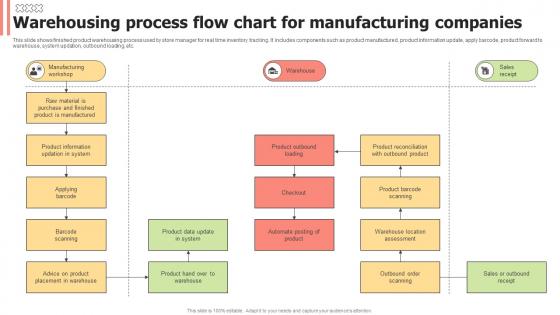
This slide shows finished product warehousing process used by store manager for real time inventory tracking. It includes components such as product manufactured, product information update, apply barcode, product forward to warehouse, system updation, outbound loading, etc.
People who downloaded this PowerPoint presentation also viewed the following :
Warehousing Process Flow Chart For Manufacturing Companies with all 6 slides:
Use our Warehousing Process Flow Chart For Manufacturing Companies to effectively help you save your valuable time. They are readymade to fit into any presentation structure.






FAQs for Warehousing Process Flow Chart
So most warehouse flow charts hit the basics: receiving, put-away, storage, picking, packing, shipping. It's like a relay race where each step passes things along. Don't forget inventory management and quality control - those need to be sprinkled throughout. Returns handling too, which honestly nobody likes dealing with but whatever. Cross-docking and kitting might apply depending on your setup. My advice? Map out what you're actually doing first. Then figure out which pieces fit instead of throwing everything at the chart. Some warehouses are way more complex than others.
Honestly, good warehouse layout is just about cutting down on all that walking around. Put your fast-moving stuff close to shipping - trust me, the time savings add up quick. Wide aisles are clutch so forklifts aren't constantly getting stuck. You'll want separate zones for receiving, picking, packing, shipping that don't mess with each other. Here's the thing though - don't just work with whatever space you've got. Actually map out how products move through your warehouse first, then build the layout around that flow. Way easier than trying to force everything into a bad setup later.
Honestly, start with a good WMS - that's your foundation right there. It'll track everything and optimize your picking routes. Barcode or RFID scanning is a must for real-time data. Conveyor belts and automated sorting will speed things up big time. Voice picking is actually pretty slick since workers can keep their hands free. Oh, and make sure whatever you get plays nice with your ERP system - nothing worse than systems that don't talk to each other. I'd say pick your biggest bottleneck first, then build from there based on your volume.
So here's the thing - inventory management literally controls your entire warehouse flow. Bad inventory practices? You'll get slammed with unexpected deliveries backing up receiving. Picking becomes hell when stock locations are wrong in your system. Stockouts happen constantly, or you're drowning in overstock. Real-time tracking fixes most of this mess, plus regular cycle counts so your data actually matches what's sitting on the shelves. I swear this solves like 80% of flow problems right there. When you reorder, where stuff gets stored, how fast you fulfill orders - it all comes back to having your inventory dialed in. Otherwise your whole operation turns into chaos pretty quickly.
So basically receiving and inspection are like your first line of defense when stuff comes into the warehouse. You're checking everything against purchase orders, counting quantities, looking for damage - all that fun stuff. Honestly, it's kinda tedious but you'll thank yourself later. If something's messed up and you catch it here, great. Miss it now and you're dealing with angry customers or missing inventory later, which sucks way more. Good stuff gets documented and heads to storage, damaged items get flagged for returns. Trust me, spending extra time upfront saves you so many headaches down the road.
So basically you map out every step in your warehouse and it shows you exactly where stuff gets backed up. Like, if picking always has a huge queue but packing workers are just sitting around waiting - boom, there's your problem. The visual makes it super obvious which parts are slowing everything down. Could be equipment that's too slow, not enough people, or just a crappy process. Honestly, it beats trying to figure out what's wrong by just walking around and guessing. Once you know where the real bottlenecks are, you can actually fix the right thing instead of wasting time on stuff that doesn't matter.
So for each warehouse step, you'll need different KPIs to catch problems early. Receiving should track dock-to-stock time and accuracy. Focus on travel time and location accuracy for putaway. Picking is honestly where most places struggle - measure pick rate per hour, errors, and how far people are walking around. Storage is simpler: space utilization and inventory turnover. On-time departures and damage rates for shipping. Oh, and don't go crazy with metrics at first. Start with maybe 2-3 per process or your team will just ignore the whole thing. Been there before.
So automation basically flips your whole warehouse flow on its head. Manual steps just disappear, and you get these new automated branches everywhere. Conveyors skip the old pick-walk routes entirely. Storage systems bring items straight to workers instead of the other way around. Your single packing line splits into multiple parallel streams - honestly, it sounds chaotic but actually makes things cleaner. Receiving can jump straight to putaway without anyone sorting first. The whole order process becomes this smooth line from computer ping to shipment. Just map out where you're getting jammed up now - that's where automation pays off the most.
Dude, you'll save yourself so much headache with a good process chart. New people won't bug you every five minutes asking what's next. Your receiving crew actually understands how their stuff connects to picking and packing - makes communication way less painful. Those "that's not how we do it" fights? Yeah, those disappear. Short sentences work great for spotting problems early too. I'd start by sitting down with your team leads and mapping what you're doing now. Then stick it somewhere people will actually look at it, not buried in some folder nobody checks.
Ugh, the worst part is getting straight answers from people about what they actually do. Everyone tells you something different! Walk around and watch people work for a few hours - you'll be shocked at how much stuff doesn't match the "official" process. Documentation is usually garbage or super outdated. Systems don't play nice together either. Honestly, I spent way too much time in meetings at first when I should've just been on the floor watching. Different shifts do things totally differently too. Shadow a few roles and you'll catch the real workflow, not whatever's written down somewhere.
Dude, safety rules are gonna hit literally every part of your warehouse process. During receiving you need PPE protocols, then safe lifting for putaway, clear aisle markings when people are picking orders. Storage areas need proper stacking methods - oh and the fire marshal will definitely have thoughts about how high your racks are! Honestly the trick is building safety checkpoints right into each stage from the start. Otherwise you're just creating bottlenecks later. Map out where safety intersects with your flow so everyone knows what they're supposed to do at each step.
Honestly, order picking is where everything either works or falls apart in your warehouse. It's literally the moment you grab what customers actually bought and start moving it toward the door. Mess this up and you're looking at shipping delays, wrong items going out, frustrated customers - the whole nine yards. Your pick paths matter way more than people think too. I've seen warehouses completely transform their numbers just by optimizing how pickers move through the aisles. Speed and accuracy here ripple through everything else downstream. Get your picking dialed in and you'll notice improvements everywhere.
Peak season's gonna mess with your whole operation - receiving gets slammed first, then picking and shipping turn into total nightmares. Cycle times drag everywhere. Here's what actually works: move your hot seasonal stuff way closer to the pick zones before things get crazy. Storage layout becomes make-or-break during this time. Quality control takes longer too since you're stuck with newbies who don't know the ropes yet. Build in extra time at every step - like, seriously pad those timelines. Oh, and pre-position inventory early or you'll hate yourself later.
Honestly, update that chart whenever you make big operational changes - new product lines, tech upgrades, layout shifts, that kind of stuff. Also when compliance rules change or if you're seeing bottlenecks in your metrics. I'd review it quarterly minimum, but really you should update it right when changes happen. Trust me on this one - I've watched warehouses run outdated charts and it's a total mess. Your team will actually follow processes when the documentation isn't garbage. Oh, and definitely update when you're scaling up operations too.
First thing - figure out where you're at now before trying to fix anything. Talk to everyone, especially the warehouse guys who actually do the work daily. They'll tell you stuff the managers have no clue about. Keep your flowchart clean and visual because nobody wants to squint at a bunch of tiny symbols everywhere. Stick to the big steps and decision points - you don't need every little detail mapped out. Use standard flowchart symbols so people can actually read it later. Then walk through some real examples with your team. If they're scratching their heads, you've overcomplicated it and need to simplify.
-
I can always count on your designs for my professional needs. I believe I found a one-stop-shop for PPTs.
-
I discovered some really original and instructive business slides here. I found that they suited me well.