


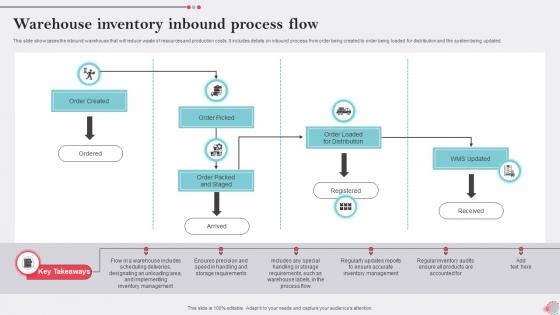
Warehouse Inventory Inbound Process Flow




Try Before you Buy Download Free Sample Product
 Impress Your
 Audience
 100%
100% Editable
 Save Hours
 of Time


This slide showcases the inbound warehouse that will reduce waste of resources and production costs. It includes details on inbound process from order being created to order being loaded for distribution and the system being updated.
People who downloaded this PowerPoint presentation also viewed the following :
Warehouse Inventory Inbound Process Flow with all 9 slides:
Use our Warehouse Inventory Inbound Process Flow to effectively help you save your valuable time. They are readymade to fit into any presentation structure.








FAQs for Warehouse Inventory
You really need automated receiving and real-time inventory tracking as your foundation. Demand forecasting tools help too, plus quality checkpoints when stuff comes in. Most systems totally crash on the tracking side though - fix that first and everything else gets way easier. Make sure your warehouse software talks to your ERP so data syncs without you babysitting it. The whole point is seeing what's coming, when it hits, and where it ends up. I'd start by sketching out your current workflow and finding your worst bottlenecks. Oh, and solid supplier coordination obviously matters too.
Honestly, automation is your best friend here. Get EDI set up with suppliers or at least make them send proper shipping notices - saves so much headache. Cross-docking is amazing if you can pull it off, stuff just flows right through without collecting dust in storage. Map out what you're doing now first though, find where things get stuck. A solid warehouse management system tracks everything automatically, way fewer screwups than doing it by hand. I'd focus on whatever's causing your biggest delays - that's where you'll see results fast. Oh and reducing those manual steps where people have to touch everything twice? Total game changer.
Honestly, good tech makes all the difference with inventory management. WMS systems track your shipments live and update stock automatically - no more manual data entry nightmare. AI helps predict what you'll actually need so you're not drowning in excess stock or scrambling for supplies. Barcode scanning alone cuts down on so many stupid mistakes. Most of this stuff plays nice with whatever ERP you're already using too. I'd start by figuring out what's driving you crazy right now - late deliveries, running out of stuff - then find tools that fix those specific problems. The integration part is usually smoother than you'd expect.
Check your receipt accuracy rate first - just compare what actually showed up versus your PO or ASN. Track damage rates and quantity variances too. For smaller ops, honestly just use a spreadsheet. Most WMS systems will calculate this stuff automatically though, which is nice. Do cycle counts on new inventory to catch receiving screwups early. You want 98%+ accuracy. Below 95% and something's seriously broken in your receiving process - time to figure out what's going sideways. SKU mismatches are another big one to watch.
Set up a solid receiving process - check everything against your POs and inspect quality before stuff goes on shelves. Trust me, I got burned leaving damaged inventory sitting around for months once! Your team needs to document problems right away and have a proper staging area for inspections. Train everyone on quality standards so they actually know what they're looking for. Way better to catch issues when shipments arrive than discover them later when you're scrambling to fill orders. Oh, and make sure someone's always designated to handle this - can't just wing it.
Dude, your vendors literally control everything. Good ones hit their delivery windows and send the right amounts - suddenly you can actually plan your dock schedule. Bad ones? Total chaos. Your team's swamped one day, twiddling thumbs the next. Late shipments screw up your whole put-away timeline, and when quantities are wrong, someone's gotta spend forever reconciling that mess. Don't even get me started on crappy packaging creating damaged goods everywhere. Track your worst vendors' on-time rates and accuracy, then call them out directly. Some suppliers honestly just need a reality check about what you expect.
Start with fixing your demand forecasting - that's where you'll see the biggest impact. Pull historical data and watch market trends to predict what's actually coming versus what you need. ABC analysis is clutch here: monitor high-value items closely but stay flexible with the small stuff. Honestly, don't get stuck chasing perfect numbers - 80% accuracy that you can act on beats overthinking every detail. Set up automated reorder points based on lead times, then review monthly. Oh, and this part's huge - get sales and ops talking regularly so everyone's working off the same playbook.
So basically, dig into your sales history and supplier data to spot patterns you'd never catch otherwise. Weather data, economic stuff - throw it all in there. Your existing data probably has way more insights than you think. I'd start with predictive analytics to catch stockouts early and set reorder points based on real consumption, not just guessing. The difference between data-driven decisions and gut feelings is honestly pretty crazy. Maybe pick one product category first and compare how it performs against your usual approach? That way you're not overhauling everything at once.
Honestly, the worst part is usually suppliers being completely unpredictable - they'll send stuff way early or super late with zero heads up. Then your forecasting gets thrown off and receiving becomes this total nightmare. I'd start by fixing supplier communication first since that mess affects literally everything downstream. Set up automated alerts so you actually know what's coming when. Cross-train your receiving team too - trust me, you'll need backup when things go sideways. Oh, and use your historical data to get better at demand planning. Dedicated receiving schedules during busy periods are a lifesaver.
So basically you bypass the warehouse completely - inbound stuff gets sorted and sent straight to outbound trucks. Real-time tracking is crucial so you can match incoming items to orders while they're still on the road. Honestly, it's pretty chaotic when you first start but the speed gains are worth it. Your receiving and shipping teams need to be totally in sync, plus you'll want decent WMS integration. Oh, and definitely start with your fastest-moving products - those are gonna give you the biggest wins right off the bat. Way less stressful than trying to do everything at once.
Honestly, lead times are everything when you're planning inventory. If your suppliers take forever, you're stuck ordering way earlier and keeping tons of safety stock around. Short lead times? You can actually react to what's happening instead of playing the guessing game. The tricky part is when lead times are all over the place - then you need solid forecasting or you're screwed. I always map out each supplier's timing first, then build my reorder points around that. Way less stressful than winging it and hoping you don't run out of stuff.
Oh man, first thing - grab your phone and document everything. Photos, counts, any damaged stuff. I learned this the hard way once. Call your supplier ASAP with all the details because the longer you wait, the messier it gets. Most vendors will work with you if you're on top of it. Don't forget to update your inventory with what actually showed up, not what you ordered - otherwise your numbers will be all screwed up. Then just stay on them about shipping the missing stuff or crediting you back.
So basically you get this real-time view of everything coming in - purchase orders, shipments, receiving, all in one spot instead of dealing with like 50 different spreadsheets. No more manual data entry screwups either, which honestly saves so much headache. Your suppliers can actually connect directly to update you when stuff gets delayed or quantities shift. The forecasting is pretty decent too, catches potential stockouts before you're scrambling. Oh and definitely start with the receiving module first - that's where you'll notice the biggest difference right away in terms of speed and accuracy.
Start with shipment consolidation - cuts down on emissions big time. Also try finding suppliers closer to your warehouses if you can swing it. Push hard for reusable packaging instead of all that single-use crap, though good luck getting some vendors to budge on that. Honestly, the trick is baking sustainability right into your vendor scorecards alongside cost and quality metrics. Don't just tack it on later as an afterthought. Makes the whole evaluation process way more effective when it's built in from the start.
Honestly, good supplier communication is like 90% of avoiding inventory headaches. You don't want trucks showing up randomly or with the wrong stuff - been there, it sucks. Set up weekly calls with your main suppliers to go over schedules and quantities. They'll actually prioritize you more when you're on top of things like that. Make sure you both can see changes in real-time too. I'd start with just your biggest suppliers first - don't overwhelm yourself trying to do everyone at once. Once you get that rhythm going, your receiving dock will thank you.
-
Professional and unique presentations.
-
They guys always go the extra mile to meet the expectations of their customers. Almost a year has been associated with them.