

Shipping Company Process Flow Chart




Try Before you Buy Download Free Sample Product
 Impress Your
 Audience
 100%
100% Editable
 Save Hours
 of Time


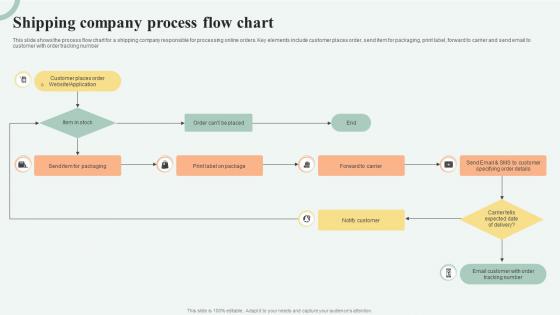
This slide shows the process flow chart for a shipping company responsible for processing online orders. Key elements include customer places order, send item for packaging, print label, forward to carrier and send email to customer with order tracking number
People who downloaded this PowerPoint presentation also viewed the following :
Shipping Company Process Flow Chart with all 6 slides:
Use our Shipping Company Process Flow Chart to effectively help you save your valuable time. They are readymade to fit into any presentation structure.





FAQs for Shipping Company
So you've got four main parts: processing the order, picking and packing stuff, shipping it out, and tracking. Your warehouse team grabs the items and boxes them up first. That's usually where things get messy if inventory's wrong or something's missing. After that, FedEx or whoever takes over and actually delivers it. Oh, and definitely give customers tracking numbers - saves you so many "where's my order?" emails. The biggest thing is being upfront about timing, especially the processing part before it even leaves your warehouse. That's what people don't get.
Ugh, international shipping is such a pain - there's like a million hoops to jump through before your stuff even leaves the warehouse. Every country has different rules for what you can send, how to label things, and what paperwork they want. Customs forms are annoying but you absolutely need them, plus commercial invoices and sometimes origin certificates too. The worst part? These regulations change constantly and half the shipping companies don't actually know what they're doing. My advice: give yourself way more time than you think you need and find a carrier that really knows their stuff, not just talks a good game.
Bubble wrap is your best friend - wrap each fragile thing separately. Get a box that actually fits your stuff, not some giant one where everything's gonna bounce around like a pinball machine. Pack any empty spots with peanuts or whatever you've got lying around. Don't cheap out on tape either, that flimsy stuff will split open halfway there. Oh, and here's what I always do - shake the box before you seal it up. Hear rattling? Add more padding. Trust me on this one, I learned the hard way when my mom's vintage teacups arrived looking like confetti.
Honestly, start with rate comparison software - that'll give you instant savings right off the bat. Negotiate volume discounts if you're shipping enough. Zone skipping is where you send bulk shipments to regional hubs instead of individual packages going cross-country. Sounds complicated but it's not really. Optimize your packaging too since dimensional weight charges are brutal. Oh and audit those invoices regularly - carriers mess up billing way more than you'd think. Consolidated shipping for customers helps too. The software thing though? Do that first, easiest win.
Dude, it's a game changer - all that manual tracking and label printing gets automated so you're not drowning in paperwork. Real-time updates mean customers stop blowing up your phone asking where their stuff is. Route optimization saves your drivers hours, and inventory syncs instantly across everything. The cool part? Everything actually talks to each other now - warehouse systems connect to shipping, which connects to customer notifications. Honestly, processing speeds up by like 60-70% and way fewer mistakes happen. Oh, and definitely start with tracking integration first if you haven't - your customers will actually love you for it.
Ugh, shipping is such a pain! You're gonna deal with delays, damaged stuff, lost packages, and random fees that come out of nowhere. Peak season is absolutely insane every single year. Weather screws everything up too. Get better packaging and mark fragile items super clearly - trust me on this one. Track everything obsessively and have backup carriers ready. For expensive stuff, always require signatures and keep detailed records. Oh, and set up automated tracking notifications so customers stop blowing up your phone asking where their order is. Saves your sanity.
Domestic stuff gets there in 1-5 days usually, pretty straightforward. International though? Total crapshoot. Standard takes 7-21 days but honestly customs can mess with that timeline however they want. Express international is 2-5 days if you don't mind dropping extra cash. I learned the hard way that some countries' postal systems are just... not great. Oh and customs inspections are completely random - sometimes your package sails through, other times it sits there for weeks. Always tell customers to expect longer than the estimate, trust me on this one.
Honestly, most customer complaints aren't even about actual delays - they're pissed because nobody told them what's happening! Send that tracking info right when you ship, then set up automated updates at the big milestones. Real-time tracking beats basic "your order shipped" emails every time. I'd also watch for delivery issues and reach out first before customers start calling you. Tell people upfront when to expect their stuff. Over-communicating is way better than leaving them in the dark, and definitely give them an easy way to check status themselves.
Honestly, you gotta look at what you're actually shipping first. Package sizes, weights, where they're going - that stuff determines everything. UPS is usually solid for business deliveries, but FedEx kills it when things need to get there fast. Cost obviously matters, but so does tracking and whether their customer service actually picks up the phone. Oh, and don't sleep on regional carriers! They can be way cheaper and sometimes better than the big names in certain areas. I'd test a few small orders before signing any big contracts though.
Start with your packaging - ditch the plastic for recycled stuff when you can. Honestly, people kinda expect eco-friendly shipping now anyway. Pick carriers that bundle deliveries together to cut down on emissions. Also, try to ship from warehouses closer to your customers - seems obvious but cuts down travel distance big time. Oh, and make your boxes smaller so more fit on each truck. Most carriers have those carbon-neutral options now too, which is pretty cool. The packaging thing is really where you'll see the biggest impact though - less waste, saves money, and makes your brand look good.
So customs clearance is just the government checking your stuff meets their import rules before letting it in. You'll need a commercial invoice, packing list, bill of lading - maybe extra certificates depending on what you're shipping. Timing's all over the place though, could be hours or days. Totally depends on how backed up the customs folks are that week. FDA approvals, origin certificates - some products need those too. Oh and definitely get a good freight forwarder who actually knows the destination country's requirements. Trust me, trying to figure it out yourself is a headache you don't want.
So basically you're giving up control of your shipping but getting their expertise and better rates. The cost savings are real - they've got networks and volume discounts you can't touch. Delivery times usually improve too. Downside? You lose that hands-on oversight, which honestly made me anxious when we first tried it. Communication gets trickier since there's another layer now. But here's the best part - your team stops dealing with shipping nightmares and can actually focus on growing the business. I'd test them out with like 20% of your orders first though.
Honestly, data analytics is a game-changer for shipping. Track your delivery times and routes for a few weeks first. You'll start seeing patterns - like which carriers are consistently late or what packaging keeps breaking. The best part? You can actually predict delays before customers start complaining. It saves you money too since you're not wasting fuel on bad routes. Regional demand stuff is huge - if everyone in Texas orders widget X, maybe stock more there, you know? Even basic analytics tools will show you the biggest problems. Oh, and customers definitely notice faster shipping, which is obvious but still worth mentioning.
So there's FOB, CIF, and DDP - they're the big three you'll run into. FOB means once stuff gets loaded at the origin, it's yours (you deal with shipping and all that risk). CIF covers cost, insurance, and freight to your port. DDP though? Seller handles literally everything until it hits your doorstep. Yeah, you pay more but honestly it's worth it when you're starting out - customs paperwork is such a pain. My buddy learned that the hard way on his first import. If you're new to this whole thing, go DDP first. You can always switch to FOB later once you know what you're doing.
Online shopping totally changed everything - now it's millions of tiny packages instead of big warehouse deliveries. Everyone expects crazy fast shipping because of Amazon, so companies are scrambling to build more local warehouses and automated systems. Honestly, the speed of this shift has been insane. Your shipping bills are probably higher now too since sending individual orders costs way more than bulk shipments. Oh, and same-day delivery is becoming normal somehow? Focus on better packaging and finding good carrier deals - that's really what'll keep you competitive in this mess.
-
Thank you for offering such fantastic custom design services. The team is really helpful and innovative. In a very short time, I received my personalized template.
-
Topic best represented with attractive design.