


 0 Comment
 Customer Reviews

Imagine a future where companies struggle to meet demand, online purchases are consistently delayed, and products fail to reach shop shelves on time. This is the harsh reality of a supply chain poorly managed in warehouses. Every seamless shopping experience, whether online or in a physical store, is the result of a complex web of logistics optimization, warehouse operations, and inventory control. This is why supply chain management (SCM) is the lifeblood of modern business, ensuring goods are efficiently transported from producers to customers. In a world where every second counts, the importance of an efficient warehouse supply chain cannot be overstated. It's not just advantageous but a necessity in a time where efficiency and speed are the determinants of success.
Contemporary warehouses are highly automated centers that use warehouse automation to improve speed and accuracy; they are no longer only places to store goods. Real-time inventory tracking via sophisticated warehouse management systems (WMS) lowers errors and boosts productivity. Orders are constructed quickly and with few errors thanks to automated methods that optimize picking and packing. Such accuracy is essential for companies using a just-in-time (JIT) inventory model, in which product is delivered only when needed. An efficient warehouse supply chain is not only advantageous but also necessary in a time where efficiency and speed are what determine success.
Template 1 - Supply Chain Warehouse Performance Measurement Template
Performing measurements is at the heart of supply chain efficiency. A well-working warehouse is not merely a store for goods. It plays a big part in turning supply chain functions like inventory management, logistic optimization, and order fulfillment into a well-oiled machine. However, one must ask, why is performance measurement so important? Because time and precise execution give the world of supply chain their cutting edge, every single second matters and inefficiencies can cascade down the entire chain, resulting in delays, increased expenses, and unhappy customers. Fundamentally, warehouse performance measurement collects numbers and develops a continuous improvement system. An efficiently managed warehouse will provide flexibility to adapt to changing demands, use available space better, and improve worker productivity. It creates unity in the supply chain, monitoring the supply of raw materials and the distribution of finished goods. Efficiency is key, and those pro-wrestlers get themselves quite an edge. This is a new competitive advantage in which rapid response and reliability come at the cost of work efficiency. If this is so, then the future of supply chain management is about not merely storing goods but strategically managing and moving them with precision.

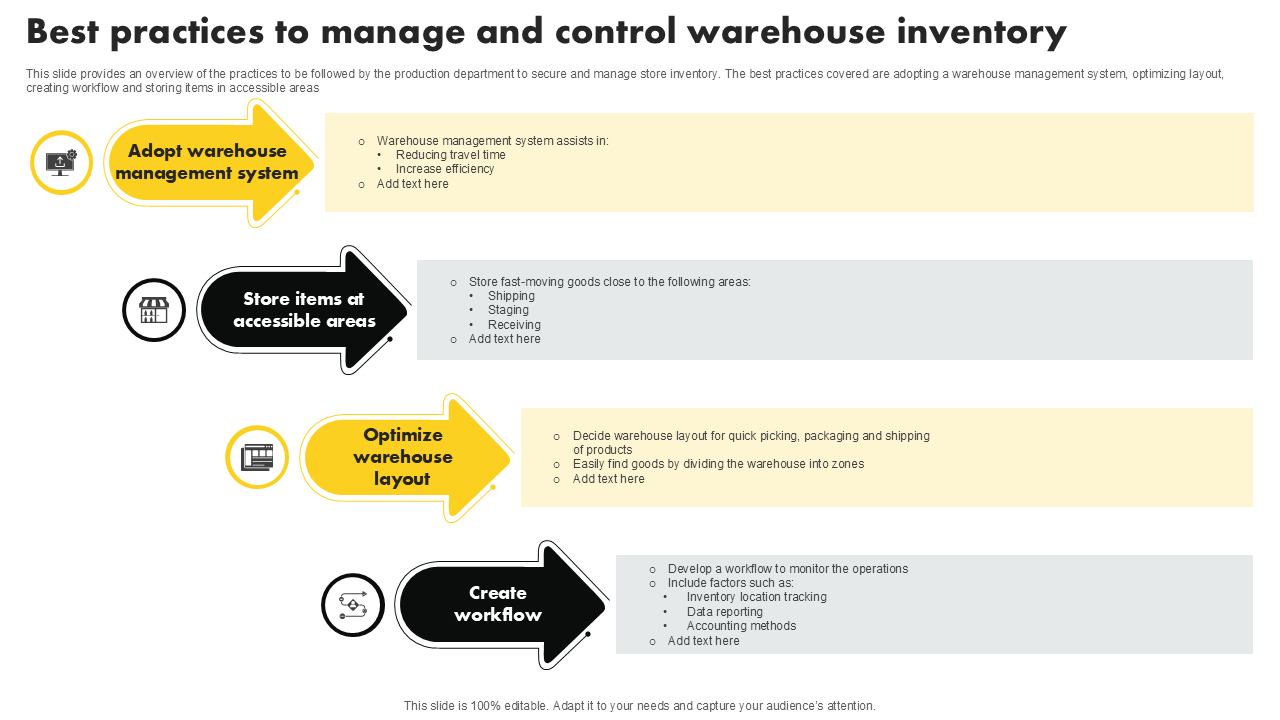
Template 2 - Supply Chain Management Best Practices to Manage and Control Warehouse Inventory Template
Effective warehouse inventory management is the binding essence of a healthy supply chain operation. On the other hand, lousy inventory management, poor stock assignment, and blunders will cause delays that might interfere with routine warehouse operations. Proper supply chain management ensures that the movements of goods from a distribution center to the final consumer are made smoothly, with as little bottleneck as possible, and with excellent order-filling speed. The idea is to combine technology, intelligent logistics, and innovative storage solutions to reduce complexity and increase warehouse efficiency. In the end, it is guaranteed that some holistic mixture of technology, mobility, and storage leads to the establishment of efficient warehouse management approaches. Attained through sophisticated WMS, a well-thought-out warehouse layout, or a flawless cross-docking operation are best practices to fortify businesses' supply chains. The aim is to design a more straightforward system that allows greater operational efficiency, assures continuous inventory movement, and guarantees timely customer order delivery. A well-managed warehouse is the core of a fine logistics booster for overall business success instead of merely being a place to store merchandise.
Template 3 - Supply Chain KPI Dashboard with Order and Warehouse Status Template
The Supply Chain KPI Dashboard is a game-changer, providing real-time visibility into order and warehouse status. In an efficiency-driven world, companies need complete visibility of operations to ensure adequate inventory management, faster order fulfillment, and better logistics control. This dashboard, with its automated, real-time tracking tools and strategic analytics, sets the pace in demand, minimizes operational costs, and enhances customer satisfaction. In an age when speed and precision become the benchmark for success, a KPI dashboard is not fancy but necessary.

Template 4 - Implementation of Goods-to-Person Strategy for Warehouse Logistics and Supply Chain Automation System Template
The dynamics of warehouse operations are changing, which requires a good deal of efficiency, accuracy, and speed. In this fast-moving environment, implementing a GTP system is not just a one-off technological upgrade but very different. Here, the manual labor approach depends much more on traditional warehouse setups. Workers traverse aisles for picking and packing goods. This way of operation is inefficient, time-consuming, and full of many risks of errors and logistic optimization difficulties. The GTP strategy will change all that, driving order fulfillment automation and letting robots deliver goods directly to the workers instead of the opposite. Thereby, productivity and accuracy could be enhanced dramatically. Therefore, extending the notion of Goods-to-Person strategy beyond mere efficiency into one that redefines warehouse logistics is achieved through an inclusive model based on technology. With this approach, organizations will fulfill orders for e-commerce, retail, and manufacturing faster and more accurately. The smart warehouse, resilient supply chain, and agile logistics of the future are a reality today, driven by automation, precision, and innovation.

Template 5 - Warehousing Process for Supply Chain Management Warehouse and Inventory Management Template
Warehousing acts as a pivot for supply chain management, providing efficiency in the flow of goods from manufacturers to consumers. A well-invoked warehousing process is not merely about storing goods; it builds an efficient system directing warehouse operations to minimize handling, affect inventory control, and speed up order fulfillment. In fast-paced times, businesses cannot permit any delays, stock discrepancies, or even inefficiencies, complementing their strategy in logistics optimization with an imperative that originates from the niche-inequity in real-time and service. An effective warehousing procedure guarantees operational excellence, cost optimization, and timely delivery. A company equipped to facilitate efficient warehousing strategies will gain a competitive edge in an environment that has set high expectations from the customer. With intelligent automation, strategic layouts, and real-time inventory tracking, warehouses are becoming an asset in building a resilient and agile supply chain management system.

Template 6 - Warehouse Supply Chain Performance Management Dashboard Template
Fetch a good performance dashboard for a warehouse supply chain; it will probably be the full nerve center of contemporary warehouse management. Integrating a system to provide data-driven insight into efficiency, accuracy, and productivity has become vital. It acts as an instant return on investment in this rapidly changing supply chain management environment, whereby success is tagged with precision and speed. The tremendous complexities around inventory management, logistics optimization, and order fulfillment made real-time visibility and proactive decision-making seamless. Finally, the Warehouse Supply Chain Performance Management Dashboard provides the foundation of an efficient and responsive supply chain. It improves operational processes and logistical optimization and renders seamless order fulfillment. Speed, accuracy, and adaptability give this business the edge; consequently, the concentration of the command center on one operational platform, in terms of data-driven initiatives, shifts the logistics of warehousing from a tactical issue into a strategic advantage.

Template 7 - Retail Warehouse Management Flowchart to Optimize Supply Chain Template
A well-organized retail warehouse management flowchart is the basis for effective supply chain management (SCM) systems. Imagine a busy warehouse where everything from fresh produce requiring cold storage logistics to high-demand electronics can seamlessly transition from receiving to shipping without any hitch. The real beauty of this is achieved through inventory management and the functioning of the warehouses by allowing workflows to be streamlined to clear out inefficiencies and boost productivity. Without a structured approach, warehouses can soon turn chaotic, with misplaced inventories, delayed shipments, and mounting operational costs. An exemplary flowchart gives a sweeping description of the retail warehouse management process; it integrates all aspects of the supply chain management cycle into a well-knit integrated system. The flow is designed to perform the task correctly for temperature-sensitive goods that must be kept in a cold environment while avoiding cross-docking for a high volume. Finally, advanced warehouse management systems open up productivity, cost minimization, and, in turn, an agile, responsive, and ready-for-growth supply chain.

Template 8 - IoT Enabled Supply Chain Warehouse Management IoT Enabled Template
The modern equilibrium of the supply chain lies in efficiency, which can be seen as indivisible from warehouse operations. The technology of IoT has ushered in a transformation in warehouses, changing the face of management in inventory, logistics optimization, and supply chain management (SCM). With the expansion of e-commerce and the increasing expectations for last-mile delivery, IoT-enabled warehouses are becoming necessary and are no longer viewed as luxury. Companies using this technology dramatically reduce costs, enhance efficiency, and achieve a much more agile and responsive supply chain. From smart shelving to AI-enabled robotics, warehouse operations in the future will undoubtedly be digital. Companies willing to embrace IoT will not only meet the expectations of their customers but surpass them and, therefore, transform the function of supply chains in the modern world.

Template 9 - Flow Chart for Warehouse Supply Chain Management Template
A proper flow chart for the supply chain management of a warehouse forms a gist for conducting robust and seamless operations; this provides a process structure ensuring smooth process flow from inventory management to last-mile delivery. It is hard to imagine a warehouse in light of the direct process. Such a warehouse will delay order processing, create inaccurate stock levels, and create an environment where optimizing logistics is seldom possible. A flow chart lays everything out visually. It maps through each phase of the warehouse operations systematically and understandably. Strategically, it acts as a guide for improving SCM that should mitigate excess resource use, facilitate problem identification, and increase productivity. The supply chain visibility has proved its importance, and it is a flowchart that enhances transparency at every stage. The stakeholders will view the real-time movement of goods from inbound shipments to last-mile delivery, using this real-time visibility to make proactive decisions and enhance customer satisfaction. It is also a structured method of coordinated work between the distribution centers, ensuring that the products move efficiently over the supply chain. Eventually, a properly functioning flowchart is, in fact, a perfect transformation of warehouse operations into a synchronized, high-performance mechanism that will not only avert chances of committing mistakes but also improve productivity and keep the businesses alive for competition in the competitive marketplace.

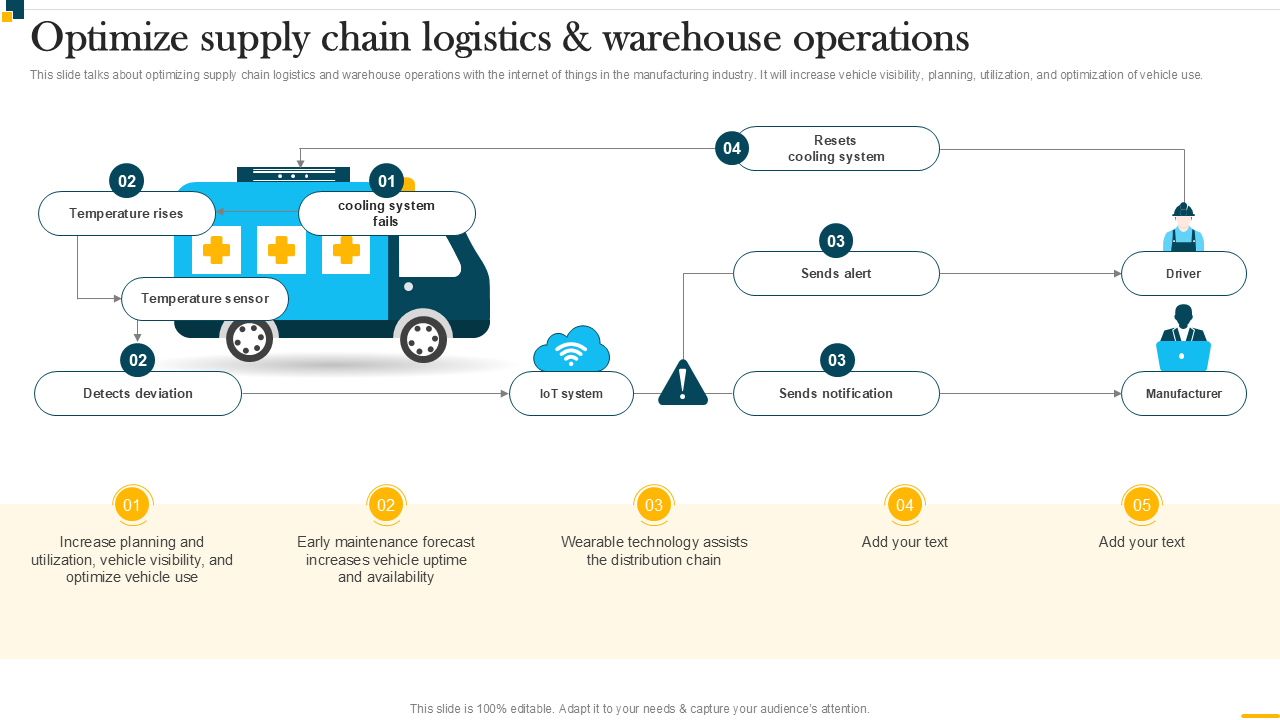
Template 10 - IT in Manufacturing Industry V2 Optimize Supply Chain Logistics and Warehouse Operations Template
Efficiency rules the manufacturing industry, none better than in the warehouse operations and supply chain management (SCM) maze. Speed, accuracy, and cost-effectiveness characterize the present day, and IT solutions have now become tools in optimizing logistics, warehouse management, and order processing. The ability to track, manage, and move goods in a timely, effective, and efficient manner is no longer a luxury; it has become a necessity that forms the basis of modern-day supply chain logistics. Due to e-commerce and international trade, businesses must now embrace the technologies or face extinction. Manufacturers can improve their speed, accuracy, and efficiency through IT-driven solutions, thus ensuring that every piece of their warehouse operations contributes to a robust and fleet-footed supply chain. Integrating such innovative technologies into the business will be the future of manufacturing, and the very few who do it will lead the industry in precision and reliability.
Conclusion
The warehouse supply chain is the brain behind modern commerce, knitting together manufacturers, suppliers, and consumers in one cohesive operation schematic. Inventory management forms the backbone of coordinating the stock of processed goods, preventing the conditions of overstocking and stockouts. Poor warehouse operation organization can cause a business to lag in meeting demand, resulting in expensive delays and unsatisfied customers. Also, logistics' primary duty occurs here, moving warehouses smoother and faster. Ultimately, a warehouse supply chain's efficiency directly impacts last-mile delivery, the final stage for getting products to customers. Be it an e-commerce giant promising same-day delivery or a pharmaceutical company ensuring timely shipment of life-saving medications to hospitals, a well-managed warehouse ecosystem is required. In an era where speed, accuracy, and adaptability define success, companies investing in advanced warehouse solutions stay ahead of the competition and build customer trust and operational excellence.