

Organizational Chart Introduction For Supply Chain Management Organization




Try Before you Buy Download Free Sample Product
 Impress Your
 Audience
 100%
100% Editable
 Save Hours
 of Time


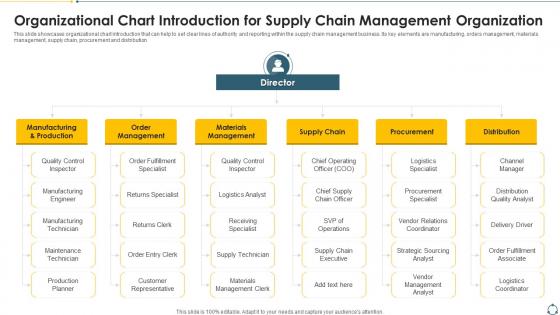
This slide showcases organizational chart introduction that can help to set clear lines of authority and reporting within the supply chain management business. Its key elements are manufacturing, orders management, materials management, supply chain, procurement and distribution.
People who downloaded this PowerPoint presentation also viewed the following :
Content of this Powerpoint Presentation
Supply chain management is like a giant spider sitting in the center, keeping the flow of goods and services in check. It is vital for any business to keep its supply chain healthy to meet customer demands for its products and services. The supply chain is responsible for quickly moving expensive products to avoid holding them in inventories. Management involves everything from finding raw materials to transforming them into final products.
If the supply chain is deployed correctly, it can reduce the cost of delivering products to the consumer, prevent expensive product recalls, and eradicate supply shortages.
Supply chain management is an ongoing effort to keep supply chains as efficient and economical as possible. According to SCM, every product launched in the market comes from the hard work and efforts of multiple organizations, ultimately forming a supply chain. Supply chains were present even in the 1990s, but businesses have optimized them in recent years to make operations run smoothly.
This blog introduces a PPT Template to solve all your supply chain-related problems. This one-pager template covers everything from finding raw materials for manufacturing to disrupting the final product. We will also explain how you can use this supply chain management chart in your organization and its implementation benefits.
Template: Organizational Supply Chain Management Chart PPT Template
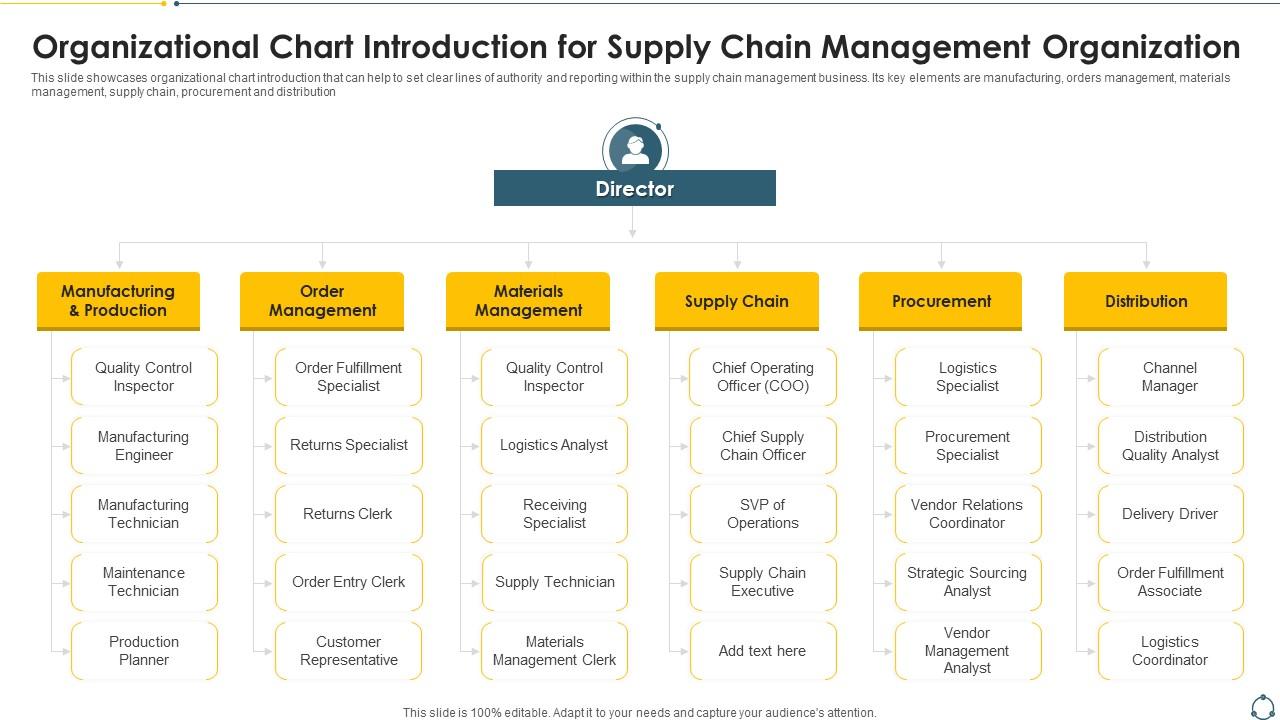
This slide is divided into six columns, each describing the essentials of supply chain management. This PPT Template provides information on the various steps that result in the supply chain working properly, and you can also determine how your organization's supply chain can maximize customer value while achieving a sustainable competitive advantage.
Explore the utility of the six phases of supply chain management to optimally use the PPT Layout.
Manufacturing & Production
The manufacturing and production department is responsible for finding efficiency in production, speed, quality control, production planning, maintenance technicians, and others. All these areas of work are necessary to satisfy customers and help businesses gain competitive advantages in their industry. Using this slide, you can determine how you establish a production line and advance technologies as core assets for the business expansion.
Order Management
Making a product from raw materials is one thing, but ensuring that your wide inventory is seamlessly able to navigate the order process could lead to several challenges. As a result, with a proper order management system (OMS), your organization can fulfill orders accurately and on time. You can provide the names of the individuals who are responsible for specific tasks, such as order fulfillment specialist, return clerk, order entry clerk, customer representative, and returns specialist.
Materials Management
Managing materials is another crucial aspect of supply chain management, including quality control, waste reduction, maintaining seamless workflow, and others. Using this PPT Template you can record the important characteristics of the process and the tasks assigned to individuals.
Supply Chain
Here, you can add the names of the individuals recognized as Chief Operating Officer (COO), Chief Supply Chain Officer, SVP of operations, supply chain executives, etc. You can present the responsibilities that individuals in this position must handle to keep the supply chain healthy.
Procurement
The last set of operations in supply chain management is procurement. This group handles logistics, vendor relations, strategising sources for raw materials, and vendor reporting. Managing these operations in the right way can make or break the supply chain.
This can also be included in a business model, as procurement focuses on inputs such as getting supplies for the manufacturing of the products, sealing contracts with the sellers, settling the invoices generated by the vendors, and finding new suppliers in various national and international regions that can help in selling their product.
Wrapping Up
Using this slide, you can explain how the flow of goods, data, and finances for the manufacturing and production of a product will be handled efficiently.
With these slides, you can make everyone on the team be on the same page regarding the information related to the whole supply chain of the organization. In addition, every team member will know what the other person is responsible for. As a result, it becomes easier for people to respond and report the supply chain issues and resolve them as early as possible.
Read more about the agriculture supply chain and logistics that work behind the scenes to make the organization generate the required revenue.
Organizational Chart Introduction For Supply Chain Management Organization with all 6 slides:
Use our Organizational Chart Introduction For Supply Chain Management Organization to effectively help you save your valuable time. They are readymade to fit into any presentation structure.





FAQs for Organizational Chart Introduction For Supply
Start with a Supply Chain Director/VP running the show. Then you need managers for Procurement, Operations/Production, Logistics, and Demand Planning. Inventory Management and Quality Control are absolutely critical - I've seen companies crash and burn when these get overlooked. Add someone for Supplier Relationships too. A Supply Chain Analyst helps with all the data stuff, though that might be overkill depending on your size. Honestly, just map out who's doing what right now (even if Jim from accounting is somehow also handling inventory). Clear reporting lines matter more than perfect titles.
Honestly, it's all about what industry you're in. Tech companies go super flat with cross-functional teams since everything changes constantly. Manufacturing? Way more hierarchical - they need those separate procurement and logistics departments to keep production lines running smoothly. Retail has merchandising teams you won't find anywhere else, and pharma gets stuck with tons of compliance people because of regulations (such a headache). Food companies usually need cold chain specialists too. I'd just stalk some competitor org charts on LinkedIn to see what roles they think are crucial.
Honestly, a good org chart saves you SO much hassle. When stuff breaks (and it will), you know exactly who to bug instead of sending those awkward "um, who deals with this?" emails to everyone. Dependencies become super obvious too, which is clutch for spotting bottlenecks early. External teams can actually find the right person instead of just hitting up whoever answers first - we used to get random requests all the time before we fixed ours. Oh, and update it every few months or it becomes useless pretty fast.
Honestly, going digital with your org chart is a game changer. Tools like Visio or Lucidchart let you build interactive versions where people can click around and see who's who, contact details, current projects - the whole deal. Real-time updates mean no more confusion when someone gets promoted or leaves (we've all been there with those ancient PDFs). Everyone across different offices sees the same current version instantly. Hook it up to your existing systems and it'll update automatically when roles change. I'd start simple - just digitize what you have and add some clickable links to profiles.
Ugh, where do I even start? Biggest pain is gonna be ownership boundaries - like who actually owns what piece. Operations and procurement always end up stepping on each other's toes. Then there's the reporting mess since supply chain touches literally everything. Matrix structures sound smart but honestly they're kind of a nightmare to manage day-to-day. Don't even get me started on trying to coordinate global teams across time zones. Here's what worked for me though - map out how stuff actually gets done first. Not the official process, the real one. Build your structure around that instead of some textbook org chart.
Honestly, it's all about breaking down those old-school department walls. Cross-functional teams become the norm - so your procurement folks might answer to both their usual boss AND someone in manufacturing. Gets confusing fast, but that's just how it works now. Communication has to speed up too, with shared decision-making across the whole supply chain. The trick is nailing down who does what upfront. Otherwise you'll have three people doing the same job or nobody taking ownership when things go sideways with external partners.
Dude, your org chart is basically a crisis roadmap. When suppliers crash or logistics fall apart, you'll know instantly if your procurement person can green-light new vendors or if it needs approval from higher up. Communication flows become super clear too - I've watched teams waste precious hours during emergencies just trying to figure out who reports to who, which is honestly painful to watch. Plus it shows you backup decision-makers when key people aren't around. Just make sure it's current and everyone can actually find it when stuff hits the fan.
So you'll definitely need transportation management and warehousing operations as your main pillars. Inventory control is huge too, along with freight coordination. Distribution planning and carrier relations - honestly those two get forgotten all the time but they'll save you major headaches later. If you've got your own trucks, throw in fleet management. Order fulfillment ties everything together nicely. Oh, and customs compliance if you're shipping internationally (that one's non-negotiable). Make sure your reporting structure is super clear between departments. Trust me, logistics turns into chaos quickly when nobody knows who's responsible for what.
Dude, I'd say every 6 months minimum - or right when something big happens like new hires or restructuring. Quarter check-ins work even better though. Supply chain stuff changes so damn fast with new vendors and partnerships that you'll be shocked how quickly things get outdated. I've literally seen org charts still showing people who quit like 8 months ago lol. Set a calendar reminder or you'll forget. Trust me, nothing's worse than everyone working off different info when responsibilities have already shifted around.
So cross-functional teams are basically your way out of departmental drama. You grab people from procurement, logistics, operations - whoever's relevant - and put them on the same project together. No more "not my job" BS when something goes wrong. They spot issues way earlier since everyone's actually talking to each other. Decision-making speeds up too, which honestly saves your sanity during crises. I'd start with your biggest supply chain nightmare and build a team around fixing that specific mess. It's like having a specialized squad for each major problem instead of hoping departments will magically coordinate on their own.
Dude, regular org charts are just boring boxes that tell you who's the boss. You want yours to actually show how stuff moves through your supply chain. Throw some arrows on there mapping product flow - procurement to warehousing to distribution. Color-code the different teams too (maybe blue for procurement, green for logistics). That way people can instantly see who does what. The game-changer though? Add those dependency lines showing handoff points. Suddenly you've got something people will actually reference when they're trying to figure out where things are getting stuck.
Ugh, globalization makes supply chains such a mess. You end up needing regional managers everywhere, plus people who can actually deal with different cultures and time zones. The whole thing becomes this matrix nightmare instead of a clean hierarchy - you're juggling suppliers, shipping, and regulations across like 10 different countries. What really changes is you can't control everything from the top anymore. Local teams need to make their own calls or you'll be waiting forever for approvals. Oh, and definitely figure out what decisions can stay local vs. going up the chain before you reorganize. Trust me on that one.
Your org chart is basically a talent roadmap. Shows you exactly where the skill gaps are and helps map out career paths - like going from procurement analyst to sourcing manager to CPO. Super helpful for recruiting too since candidates can see their growth potential right away. I'd start by comparing your current chart to where you want to be strategically. Training programs become way easier to plan when you can see the role relationships. Honestly, most companies don't use their org charts this way but they should. Quick audit of what you have versus what you need will show the biggest gaps.
Track stuff like cycle times and order fulfillment rates first - that shows if info actually flows between teams. Communication gaps are huge too. How fast do decisions get made? Are issues getting escalated when they shouldn't be? Nobody wants to be that bottleneck person, trust me. Employee satisfaction scores matter more than people think. If your team's constantly confused about who owns what, something's broken. Oh, and cross-functional collaboration - definitely measure that. Honestly, just pick 3-4 metrics that match your biggest headaches and start there. Don't overcomplicate it.
So here's the thing - you need to actually ask people if your org chart makes sense. Talk to your suppliers, customers, internal teams, logistics folks. Ask them where communication breaks down or where they're confused about who does what. Honestly, most org charts look perfect until you try using them. People will tell you when approval chains take forever or when two departments are stepping on each other. Use that feedback to fix reporting lines and clarify who owns what. Oh, and do this every few months because things change fast. Your structure should match how work actually flows, not just look pretty on paper.
-
Placing an order on SlideTeam is very simple and convenient, saves you a lot of your time.
-
I can always count on your designs for my professional needs. I believe I found a one-stop-shop for PPTs.