


Warehousing logistics powerpoint presentation slides




Try Before you Buy Download Free Sample Product
 Impress Your
 Audience
 100%
100% Editable
 Save Hours
 of Time


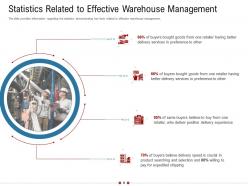
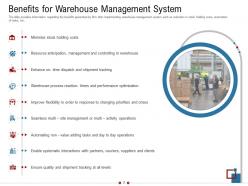
Introducing our warehousing logistics PowerPoint presentation slides. Enhance warehouse workforce management with our stockroom management PowerPoint deck. This inventory setup PPT theme consists of a slide that talks about the statistics related to effective warehouse management. Utilizing this storage authority organization PPT layout helps you in discussing the benefits of having a warehouse management system. This readymade storehouse standard arrangement PowerPoint design contains a slide discussing the optimizing warehouse layout. Assimilating this particular storeroom inventory PPT theme allows you to label areas for effective warehouse management. This store command PowerPoint creative set contains a slide that lets you talk about the automated warehouse order picking system. Selection of this inventory authority PowerPoint template allows you to discuss the order shipping process. This warehouse management PPT deck lets you make required variations to icons and colors. Choose this inventory administration PowerPoint design to showcase organization and assurance. Download this PPT slide to explore true perfection.
People who downloaded this PowerPoint presentation also viewed the following :
Content of this Powerpoint Presentation
Warehousing is not just about storing and stocking up on goods, rather it's much more than that. It refers to the physical flow of products. As the world becomes a global village, the importance of warehousing cannot be underestimated. It is the foundation of storing products and reducing costs for companies. The supply chain will be immobilized, if the warehouse operation is ineffective.
Benefits of Warehouse Logistics:
It enables businesses to manage their inventory through a dedicated space for storing goods. This facilitates better tracking and organizing of stock.
When warehouse logistics are in order, businesses are able to fulfill their customer orders timely. This results in lower processing time and customer satisfaction.
With a centralized area for storing goods, businesses can take advantage and optimize transportation costs which lead to cost saving.
This expertly curated PowerPoint bundle in 50 slides helps in enhancing warehouse efficiency, workforce management, stockroom management, and more. These content-ready slides are 100% editable and customizable. It provides the much needed head-start and acts as a guide for warehouse logistics. Let’s explore a few of the slides that you must include in the PPT Presentation.
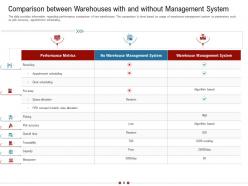
Template 1: Comparison between Warehouses with and without Management System
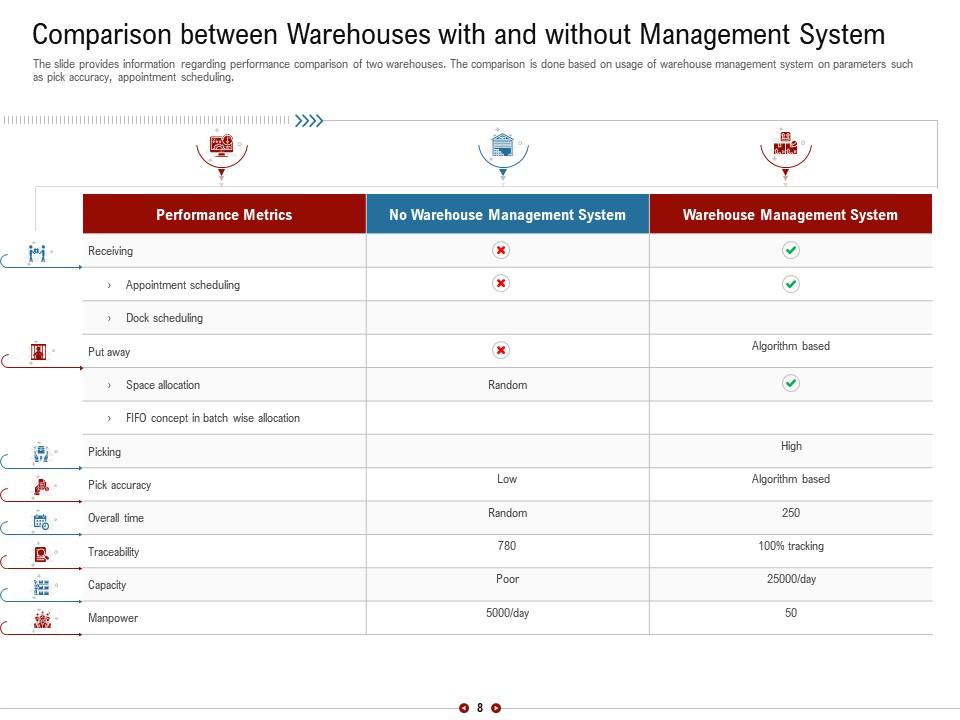
This PowerPoint Slide showcases information on the performance of two warehouses. The template includes a comparative table with three columns. Column one being performance metrics, the second being no warehouse management system and the third on warehouse management system. Performance metrics include appointment scheduling, dock scheduling, picking, pick accuracy, traceability, etc. Each metric has its own icon, placed next to the text.
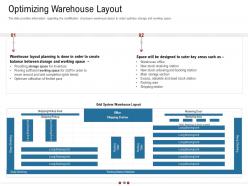
Template 2: Optimizing Warehouse Layout
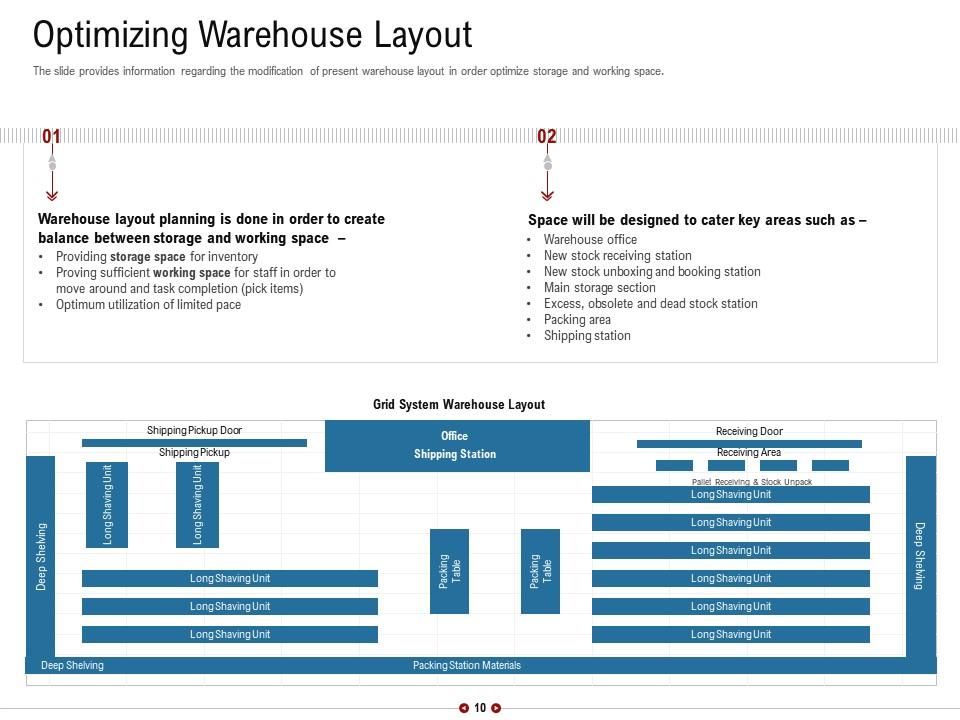
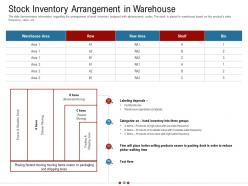
This PowerPoint Slide showcases information on the modification of present warehouse layout to optimize storage and working space. It includes a grid system warehouse layout that depicts a shipping pickup door as well as a receiving door. It also displays where the office shipping system and packing station materials station will be located. The slide also depicts how space will be designed to cater to the warehouse office, main storage section, excess, obsolete and dead stock station etc.
Template 3: Automated Warehouse Order Picking Systems
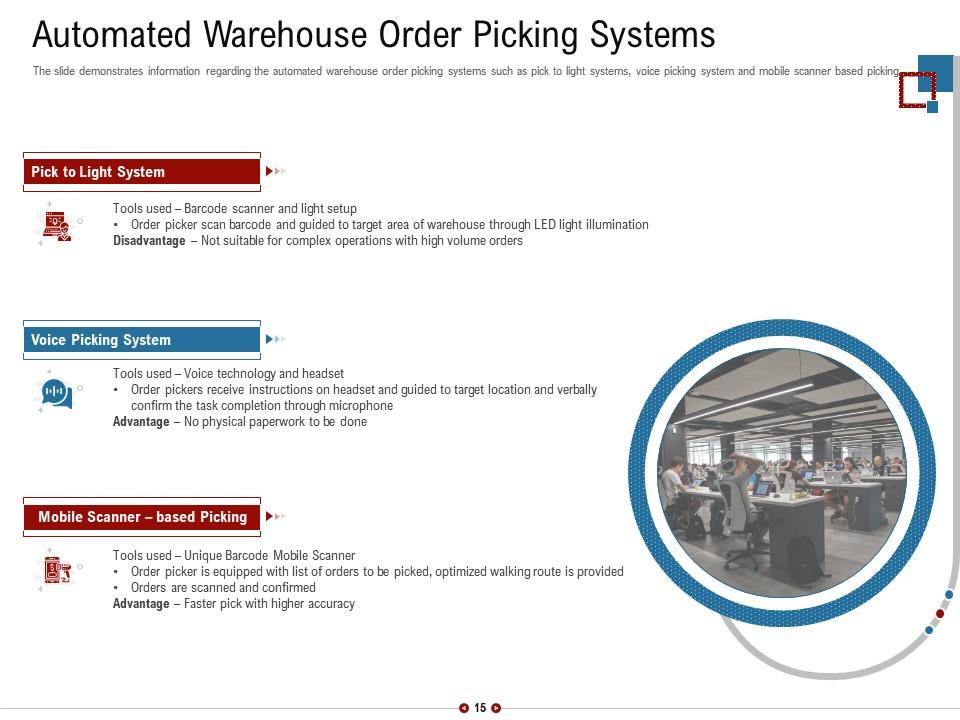
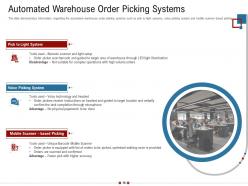
This PowerPoint Template illustrates information regarding an automated warehouse order picking system. The image in this template is divided into 3 key sections like Pick to Light System, Voice Picking System, Mobile Scanner-based Picking. A brief description of each component is mentioned next to a visually appealing icon for good comprehension. Tools used for each component are also mentioned along with the advantages and disadvantages of each.
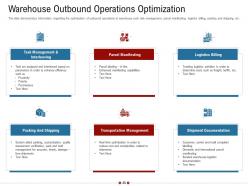
Template 4: Warehouse Outbound Operations Optimization
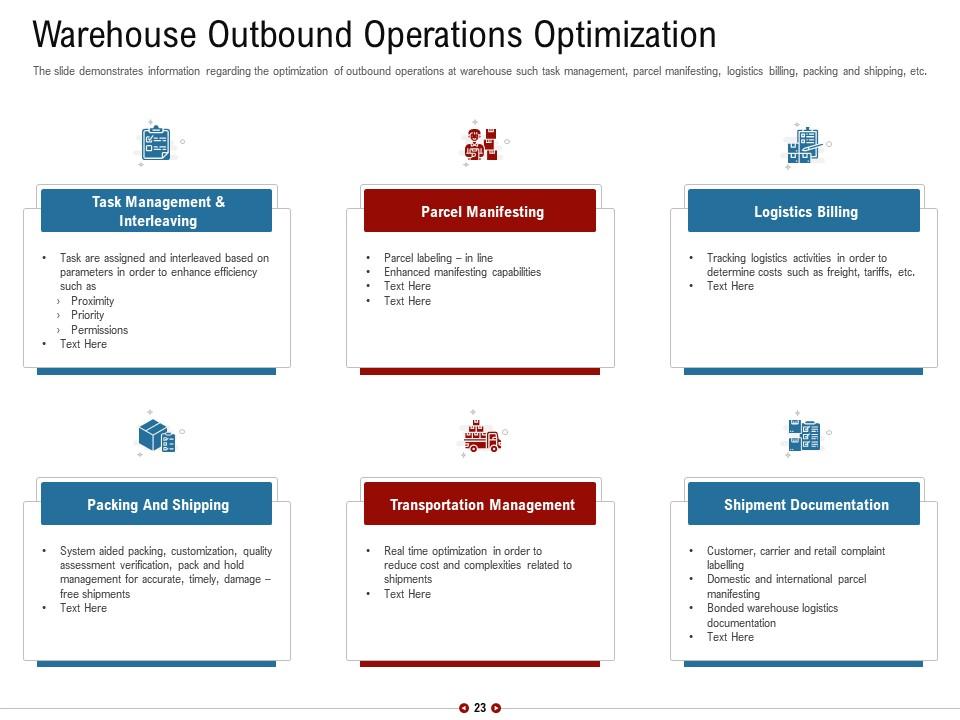
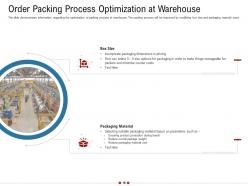
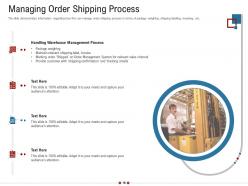
Use this PowerPoint Slide to showcase information about the optimization of outbound operations optimization. It includes multiple key metrics presented separately with icons placed next to each. Task Management and Interleaving, Parcel Manifesting, Logistics Billing, Packing and Shipping, Transportation Management and Shipment Documentation along with a brief description of each, are included in this PowerPoint template.
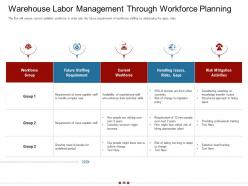
Template 5: Warehouse Labor Management Through Workforce Planning
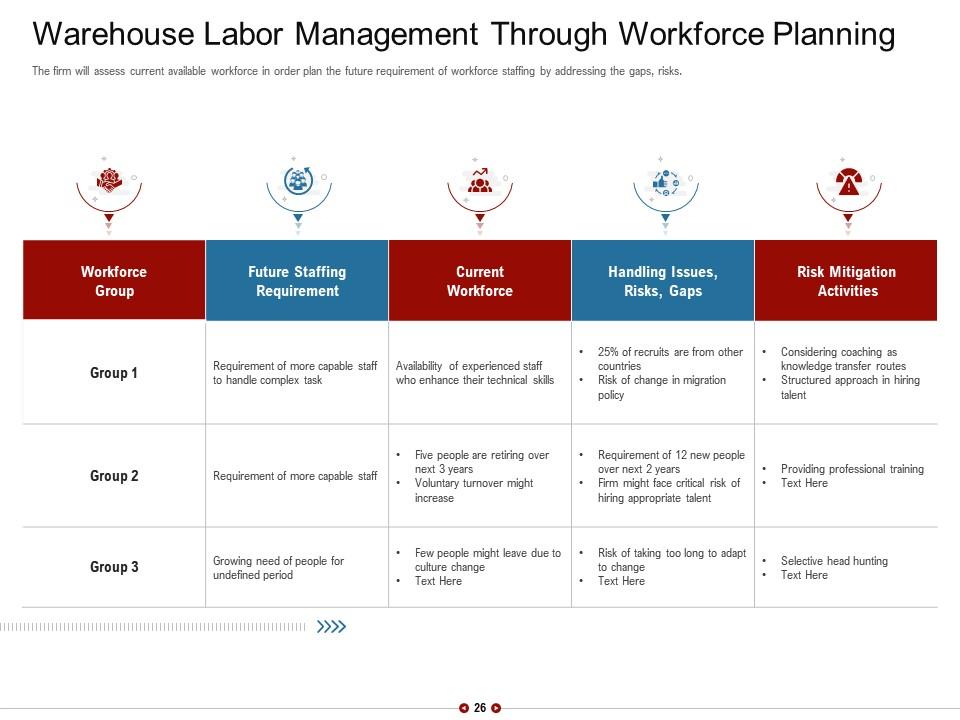
This PPT Template includes an image, which has been divided into 5 key elements like workforce group, future staffing requirement, current workforce, handling issues, risks, gaps, and risk mitigation activities. The idea is to ensure optimized operations.
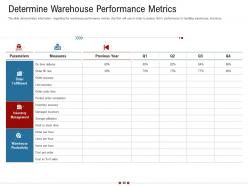
Template 6:Determine Warehouse Performance Metrics
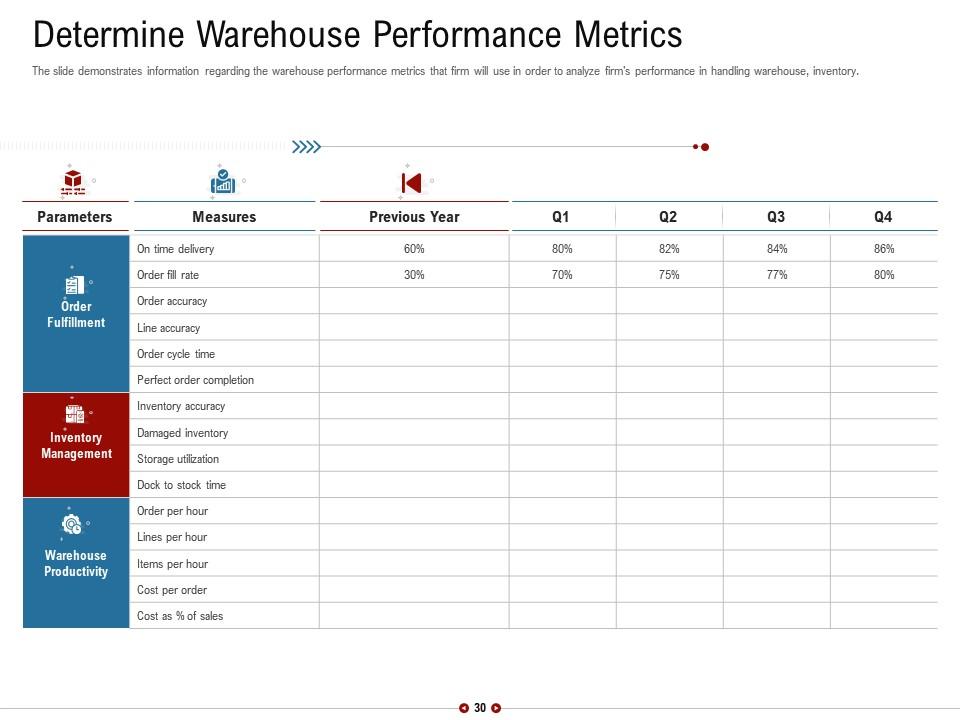
This PowerPoint Slide showcases metrics of the warehouse performance that a firm uses to analyze a firm's performance in handling a warehouse. Key parameters include order fulfillment, inventory management, and warehouse productivity. Further, a column for measures along with previous year and all four quarters is also mentioned in this template. Measures included in this slide are on time delivery, order fill rate, order accuracy, inventory accuracy, damaged inventory, storage utilization, order per hour, and many more.
Template 7: Choosing Suitable Warehouse Management System Software
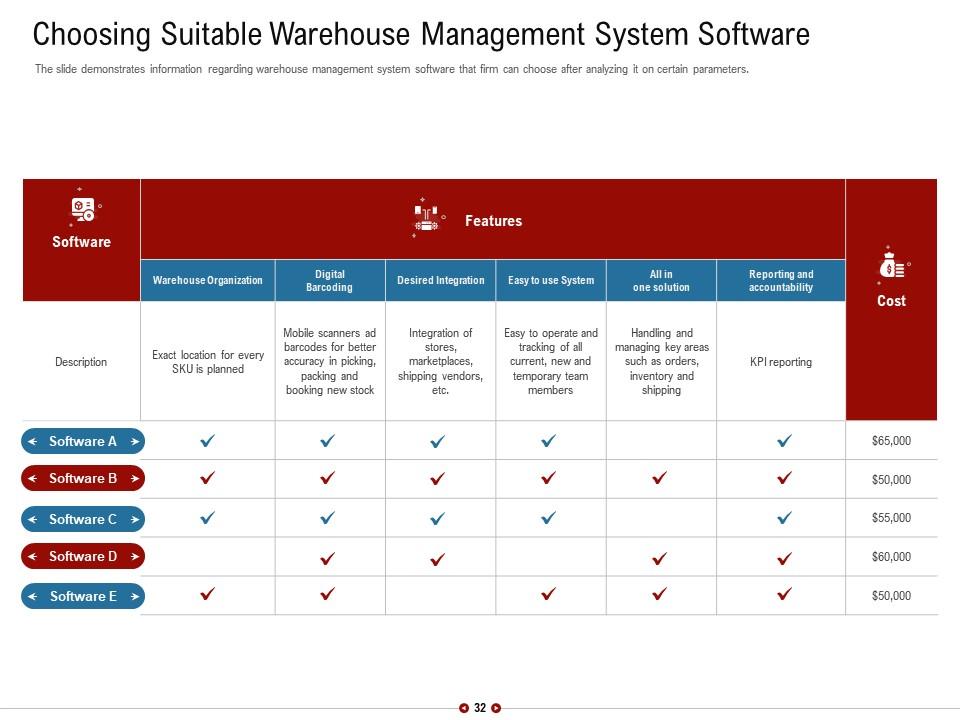
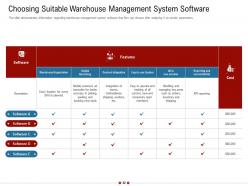
Showcase information on warehouse management system software which the firm can choose after analyzing it on certain parameters. This PowerPoint Slide includes an image displaying parameters like software, features, and cost. The features include warehouse organization, digital barcoding, desired integration, easy to use system, etc. The comparable analysis helps the viewer in better understanding of the information provided.
Template 8: Impact of Warehouse Management System on ROI
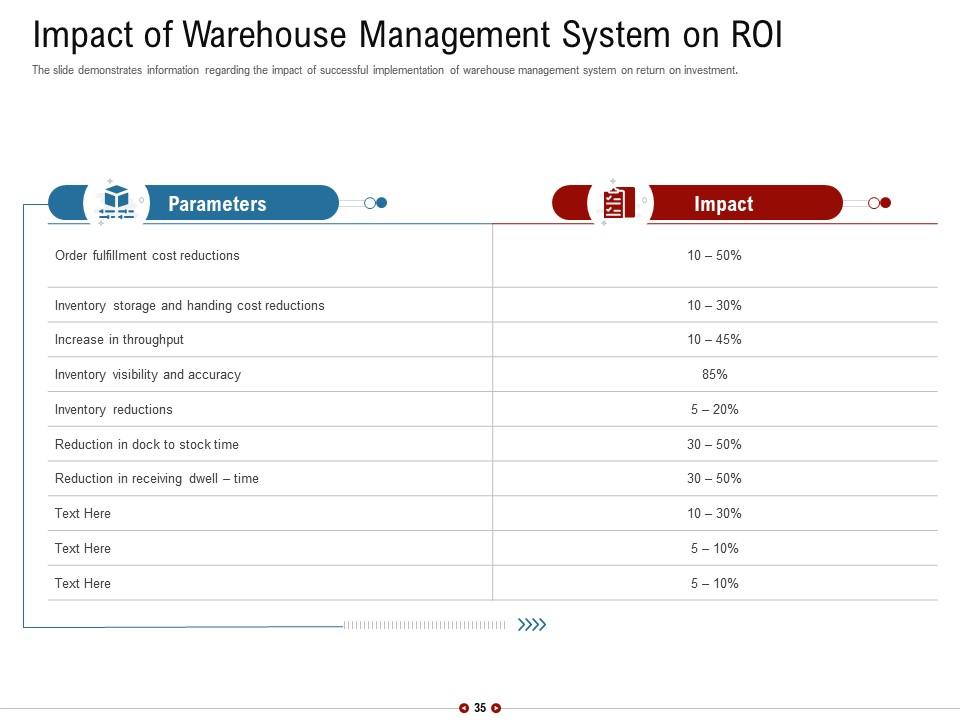
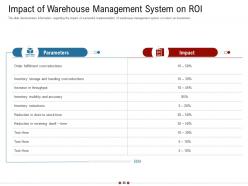
This PowerPoint Template showcases the impact of successful implementation of warehouse management systems on return on investment. The slide includes parameters like order fulfillment cost reductions, inventory storage and handling cost reductions, inventory visibility and accuracy, inventory reductions, etc along with its impact displayed next to the specific parameter.
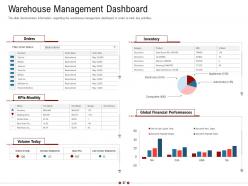
Template 9: Warehouse Management Dashboard
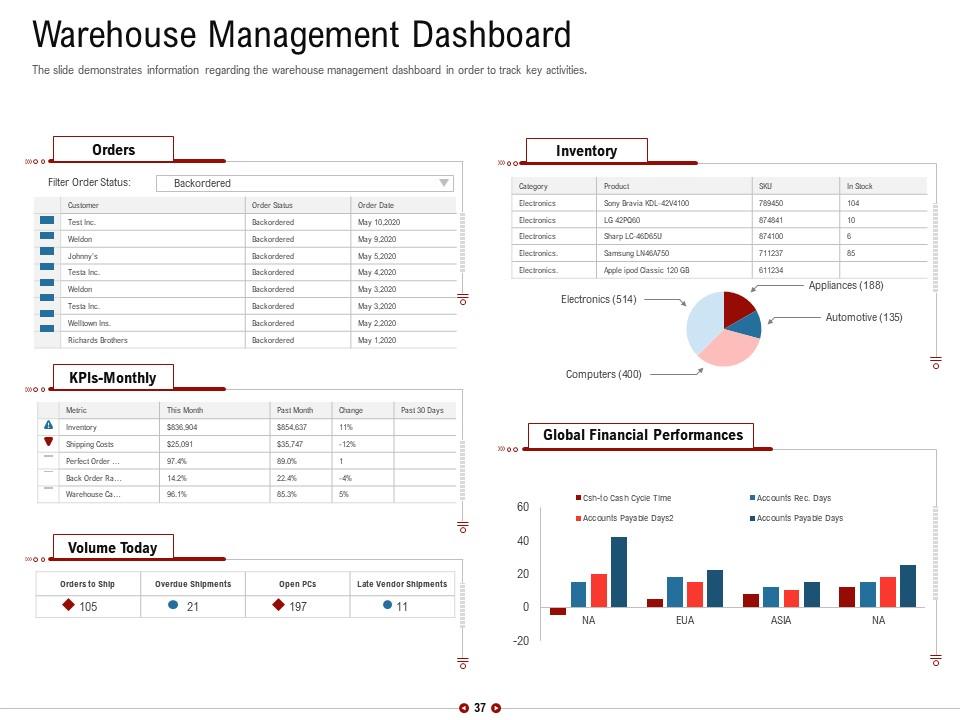
This dashboard displays multiple charts highlighting elements such as orders, KPIs monthly, Volume today, Inventory and Global Financial Performances. Inventory also includes a pie chart. Likewise, Global financial performance displays a graph showing the trend.
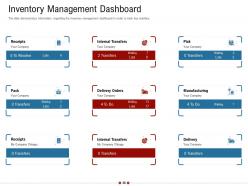
Template 10: Inventory Management Dashboard

This PowerPoint Slide depicts information regarding the inventory management dashboard to track key activities. This template showcases elements like receipts, pack, internal transfers, delivery orders, manufacturing and delivery, etc. Each element is depicted through a specific color for better comprehension of the information by the reader. Catchy icons placed next to the elements adds to the visual aid.
CONNECTING SUPPLY TO DEMAND
With the growth in e-commerce business, warehouse logistics has come to play a very important role, serving as the backbone for efficient inventory management and storage. When goods are strategically organized in the warehouse, it reduces the overhead expenses of handling.It facilitates the smooth flow of products from production to distribution channels. This enables timely delivery and customer satisfaction. These slides provide a structure for efficient warehouse management.
Warehousing logistics powerpoint presentation slides with all 50 slides:
Use our Warehousing Logistics Powerpoint Presentation Slides to effectively help you save your valuable time. They are readymade to fit into any presentation structure.


FAQs for Warehousing logistics
Honestly, start by mapping where most of your orders ship to - that's your north star. Proximity to customers is huge because it cuts delivery time and shipping costs. Labor availability is another big one - doesn't matter how perfect the location looks if you can't find reliable workers. Transportation costs will eat you alive if you're not careful. Real estate might seem cheap somewhere, but if it's got terrible highway access, you'll regret it. Don't forget local regulations and tax breaks either, that stuff adds up quick. Find the sweet spot between keeping costs down and actually serving customers well.
Dude, automation is a game changer for warehouses. Robots work way faster than people and don't make nearly as many mistakes - honestly, watching them work is pretty satisfying. Most places see throughput jump 25-50% depending on what they automate. Yeah, the upfront cost sucks and you're looking at 2-3 years before it pays for itself. But the labor savings are huge, plus your accuracy goes through the roof. I'd start small though - figure out where your biggest manual slowdowns are happening first, then tackle those spots.
Dude, inventory management literally makes or breaks your whole warehouse. Bad inventory data? Your operation's screwed. You'll have stockouts that tick off customers or way too much stuff eating your storage space and cash. Real-time tracking systems are a must - you need to know what's actually there vs what the computer says. Your picking routes, layout, even how many people you need all depend on getting this right. I've watched warehouses completely implode when their inventory gets out of whack. Seriously though, nail this part and everything else flows so much smoother.
Honestly, start with a decent warehouse management system - it'll track everything in real-time and figure out the best picking routes. RFID tags and barcode scanners are game changers for accuracy, no more counting mistakes. Get some automated sorting and conveyor systems to do the grunt work. Mobile devices keep everyone connected to live data which is huge. ROI usually hits around 12-18 months, sometimes sooner if you're really inefficient now (not saying you are lol). Don't go crazy though - pilot one system first before you tear everything apart.
Honestly, most warehouses waste so much vertical space it's crazy. Go taller with your shelving and maybe add mezzanines if you can swing it. Put your fast-moving stuff at eye level and close to where people are picking - saves tons of time. Slower inventory can go up high. I'd also look into adjustable racking systems since your inventory mix probably changes. We helped one client gain like 30% more capacity just by thinking vertically instead of spreading everything out. Oh, and do a walkthrough to spot those dead zones where you're basically storing air.
Dude, real-time analytics is a total game changer - you get instant visibility into what's happening right now instead of relying on yesterday's dusty reports. Bottlenecks? You'll catch them forming. Staffing issues? Adjust on the spot. When pick rates suddenly tank, you can actually figure out why instead of playing detective later. The alerts alone are worth it - equipment problems, inventory shortages, workflow mess-ups all pop up before they wreck your whole day. Honestly, I'd probably start small though. Pick your biggest headaches first, then build dashboards around those specific problems.
Here's what I'd do - map out your current setup first because you can't fix what you don't understand. Get barcode scanning going for everything coming in, trust me on this one. Without it you're basically flying blind with inventory. Set up clear receiving schedules with suppliers and have staging areas ready. When stuff goes out, batch your orders and plan picking routes that actually make sense. Your team will thank you for not making them zigzag across the warehouse all day. Real-time inventory tracking prevents those awkward "sorry we're out of stock" conversations. Oh, and cross-docking works great if you can swing it.
Start with the easy wins - LED lights and maybe some energy management stuff will slash your electric bill. Rearrange your warehouse layout so people aren't walking miles between tasks (honestly saves time AND energy). Electric forklifts are worth it if yours are dying anyway. Set up recycling for all that packaging waste, and get decent inventory software so you're not stuck with tons of overstock. Solar's cool if you've got the cash, but don't stress about doing everything at once. Pick like two things and see how it goes first.
Dude, the speed thing will kill you - suddenly you're picking single items instead of shipping pallets to stores. Your warehouse setup probably wasn't built for this either, so workers are literally hiking around just to grab one thing. Inventory tracking gets crazy complex too since people want to know if stuff's in stock RIGHT NOW. Returns are honestly the worst part though - everyone sends back their own random stuff instead of bulk returns. I'd start by watching where your pickers waste the most time walking around. That's usually where you'll see the biggest improvement first.
So these systems track how your warehouse workers spend their time - pretty much like a fitness tracker but for your whole operation. You'll get real-time data on picking rates, walking time, task completion, all that stuff. Super helpful for spotting bottlenecks, like when people are wasting time walking between zones. The system suggests better routing and task order too. Performance benchmarks help you figure out who needs training on specific tasks. I'd start with just your busiest zone first - way less overwhelming and you'll see results faster.
Look, your warehouse flow totally depends on getting transportation timing right. Delayed trucks? You're stuck with jammed receiving areas. Early deliveries when you're not ready? Staff standing around doing nothing - super frustrating. Honestly, most people don't realize how much outbound pickup schedules mess with storage costs too. If trucks show up late, inventory just sits there eating up floor space. Track your delivery patterns for like a month and you'll spot exactly where the timing's screwing you over. Once you match those pickup windows with your actual warehouse capacity, everything flows way better.
So cross-docking basically skips the whole warehousing thing - you're just moving stuff straight from trucks coming in to trucks going out. Takes hours instead of days since you're not doing that whole receive-store-pick-ship dance. Think of it more like being a traffic cop than running a storage unit, you know? Your products don't just sit there forever and customers get their orders way quicker. The tricky part is you really need your suppliers and shipping schedules to be on point. I'd start by figuring out which products would actually work for this setup first.
Honestly, start with a facility walkthrough this week - spot your top three risks and tackle those first. Your team better know emergency procedures cold, and keep up with OSHA training because compliance isn't optional. Equipment maintenance is critical, plus you need clear aisle markings and proper lifting techniques. Don't overlook the basics either - good lighting and ventilation prevent way more accidents than you'd think. If you're dealing with hazardous materials or food, there's extra regulations to follow. Oh, and schedule those equipment inspections regularly or you'll regret it later.
Okay so first thing - you absolutely need separate zones for different temps (frozen, chilled, room temp). Don't even think about skipping this part. Get real-time monitoring with alerts set up because honestly, the tech is pretty solid now compared to a few years ago. Your team needs to know exactly what to do when temps go wonky, and backup power is a must. Oh and definitely map out where you're storing everything currently - you'll probably find some blind spots you didn't know existed. SOPs for receiving and shipping are crucial too.
So third-party warehousing is pretty solid for cutting costs - you split facilities, staff, and equipment expenses with other businesses. Their systems are already dialed in too, which honestly saves you from a ton of headaches when you're growing fast. Downside though? Way less control over day-to-day stuff. And if their service sucks, that's on your customers' experience now. Costs can balloon as you get bigger too - learned that one the hard way at my last company. Definitely tour their warehouse first and hammer out those service agreements before signing anything.
-
Innovative and attractive designs.
-
Presentation Design is very nice, good work with the content as well.
-
Unique and attractive product design.
-
Awesomely designed templates, Easy to understand.
-
Perfect template with attractive color combination.
-
Visually stunning presentation, love the content.
-
Illustrative design with editable content. Exceptional value for money. Highly pleased with the product.
-
Easily Understandable slides.
-
The content is very helpful from business point of view.