


Delivery logistics pitch deck ppt template




Try Before you Buy Download Free Sample Product
 Impress Your
 Audience
 100%
100% Editable
 Save Hours
 of Time


Delivery logistics company caters solid fundraising strategy to ensure a reasonable chance of funding. It focuses on managing the storage of goods services across the supply chain, guaranteeing lean management of resource flow from acquiring, storage and transportation to destination. Check out our competently designed pitch deck on Delivery Logistics that serves as an effective tool in attracting investors by distilling the company in a condensed and marketable message for potential investors. Grabbing investors attention through slides depicting challenges faced, courier management system as a reliable solution, automated shipment tracking system, offering services to different clients, critical deliverables of the logistics firm, etc. The deck caters to investors attention through slides depicting logistics industry statistics across the globe, market opportunity, a business model with key revenue streams, competitive assessment of significant existing players, key people involved, etc. Firms can even present their facts, including vision, mission, core values, target audience, premium services, significant clients, headquarters, year of experience, etc. One can even exhibit the substantial concerns and proposed solutions using images, bar graphs, etc. Book a free demo with our research team and customize this 100 percent editable pitch deck now.
People who downloaded this PowerPoint presentation also viewed the following :
Content of this Powerpoint Presentation
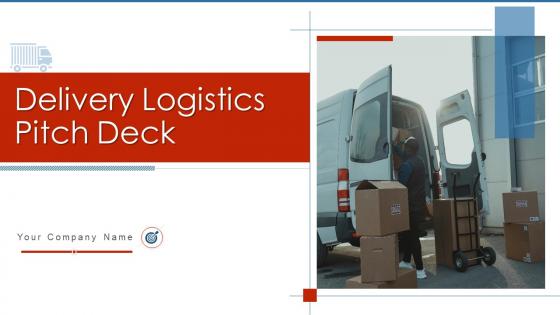
Slide 1: This slide introduces Delivery Logistics Pitch Deck. State Your Company Name and begin.
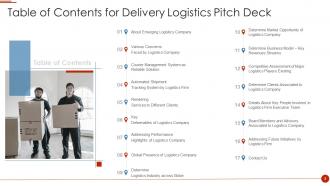
Slide 2: This slide shows Table of Contents for Delivery Logistics Pitch Deck.
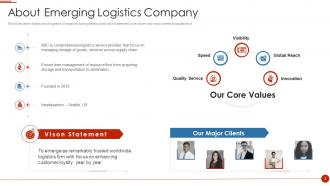
Slide 3: This slide presents details about logistics company including details about vision statement, core values and major clients associated to it.
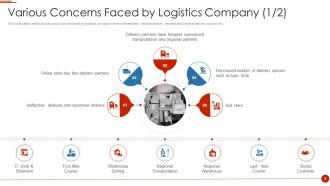
Slide 4: This slide caters details about various concern faced by logistics company in terms of ineffective, delayed delivery, etc.
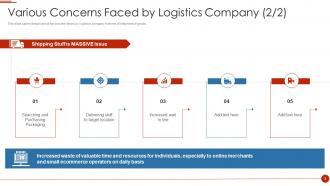
Slide 5: This slide displays details about key concern faced by logistics company in terms of shipment of goods.
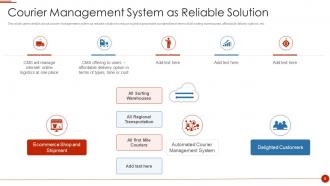
Slide 6: This slide caters details about courier management system as reliable solution to reduce logistics processes complexities.
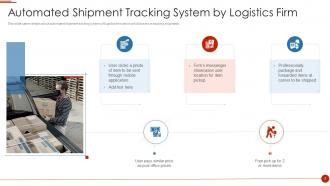
Slide 7: This slide caters details about automated shipment tracking system of logistics firm which will aid users in tracking shipments.
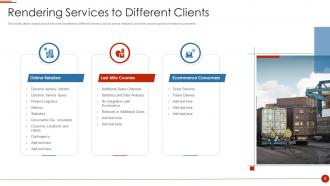
Slide 8: This slide presents details about services rendered to different clients such as online retailers, last mile couriers and ecommerce customers.
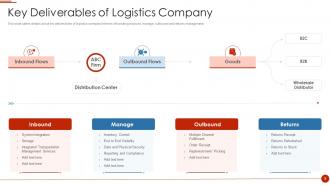
Slide 9: This slide shows key deliverables of logistics company in terms of handling inbound, manage, outbound and returns management.
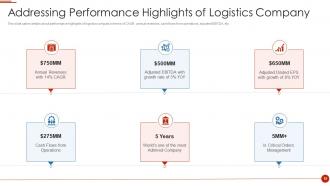
Slide 10: This slide displays details about performance highlights of logistics company in terms of CAGR, annual revenues, cash flows from operations, etc.
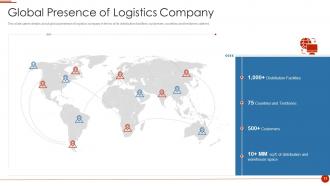
Slide 11: This slide caters details about global presence of logistics company in terms of its distribution facilities, customers, countries and territories catered.
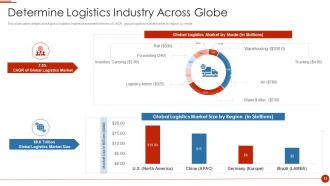
Slide 12: This slide caters details about global logistics market assessment in terms of CAGR.
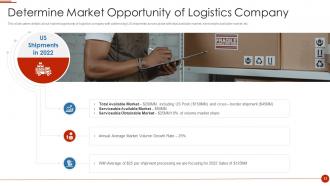
Slide 13: This slide presents details about market opportunity of logistics company with addressing US shipments across globe.
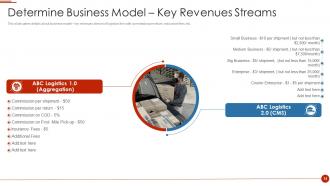
Slide 14: This slide caters details about business model – key revenues stream of logistics firm with commission per return.
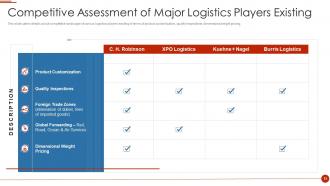
Slide 15: This slide displays details about competitive landscape of various logistics players existing in terms of product customization, quality inspections, etc.
Slide 16: This slide caters details about clients associated to logistics company in terms of major clients and client testimonials.
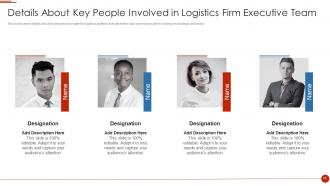
Slide 17: This slide shows Details About Key People Involved in Logistics Firm Executive Team.
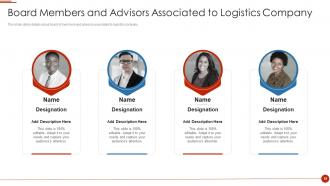
Slide 18: This slide presents Board Members and Advisors Associated to Logistics Company.
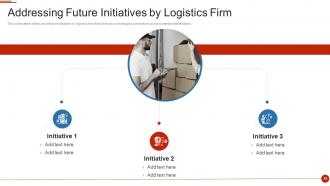
Slide 19: This slide caters details about future initiatives by logistics firm that will focus on leveraging connections across potential stakeholders.
Slide 20: This is a Contact Us slide with address, contact numbers and email address.
Slide 21: This slide shows Icons for Delivery Logistics Pitch Deck.
Slide 22: This slide is titled as Additional Slides for moving forward.
Slide 23: This is About Us slide to show company specifications etc.
Slide 24: This is Our Mission slide with related imagery and text.
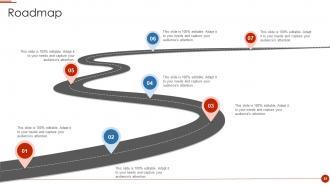
Slide 25: This slide displays Roadmap with additional textboxes.
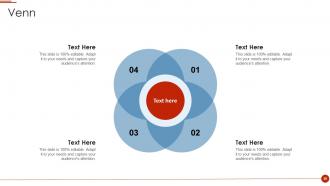
Slide 26: This slide shows Venn diagram with text boxes.
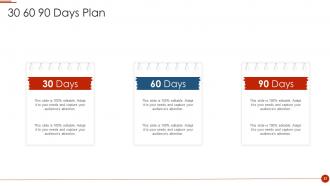
Slide 27: This slide shows 30 60 90 Days Plan with text boxes.
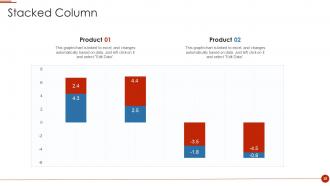
Slide 28: This slide presents Stacked Column chart with two products comparison.
Slide 29: This slide shows Post It Notes. Post your important notes here.
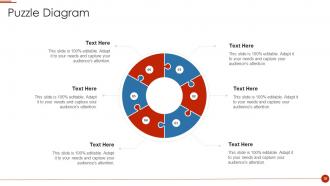
Slide 30: This slide displays Puzzle with related icons and text.
Slide 31: This is a Thank You slide with address, contact numbers and email address.
Delivery logistics pitch deck ppt template with all 31 slides:
Use our Delivery Logistics Pitch Deck Ppt Template to effectively help you save your valuable time. They are readymade to fit into any presentation structure.


FAQs for Delivery logistics pitch
Honestly, route optimization is probably your biggest win - that and figuring out where to place your inventory. Delivery windows matter too, obviously. Vehicle capacity and having enough drivers available will make or break you. Real-time tracking is just expected now, everyone does it. Weather screws everything up, especially same-day stuff. I think people underestimate how much warehouse location affects last-mile costs though. Oh, and get your demand forecasting sorted first - like, actually accurate - then you can work backwards to fix your routing.
Dude, route optimization software is where you want to start - seriously cuts fuel costs right away and your drivers won't hate their lives as much. GPS algorithms map out the smartest routes automatically, saving tons of time daily. Real-time tracking keeps customers from constantly calling you too, which is honestly such a relief. AI demand forecasting is getting scary good at predicting where to place inventory closer to customers. Automated dispatch handles the boring stuff so your team can focus on actual problems. I'd skip the fancy bells and whistles at first though - just nail the basic route planning and you'll see immediate improvements without overwhelming everyone.
Your inventory system controls everything you can actually deliver - and when. Real-time stock visibility lets you ship from the closest warehouse that has the item, which cuts both time and costs. Bad inventory tracking? You'll end up overselling and dealing with angry customers (trust me on this one). The whole thing falls apart if your inventory data doesn't sync properly with orders. Honestly, I'd start by checking your current accuracy rate. If you're below 95%, fix that first before you even think about optimizing routes.
Track on-time delivery, cost per delivery, and customer satisfaction - those are your main three. Delivery time accuracy is massive too because being consistently late kills trust faster than being slow. Failed delivery attempts will eat your profits, same with poor driver utilization. Oh, and order accuracy - returns are such a pain to deal with. Honestly, most companies overthink this stuff. Start with these six metrics and you'll know exactly where you stand. Way better than drowning in data you don't actually use.
Honestly, global disruptions mess everything up so you've gotta get way more flexible. Don't put all your eggs in one basket - diversify suppliers and routes like crazy. Buffer inventory is huge now, plus finding local suppliers saves you when international stuff gets wonky. Multiple backup plans are non-negotiable because something always breaks (Murphy's law, right?). Better tracking tech helps you pivot fast when chaos hits. Oh, and redundancy in everything - sounds boring but it works. Always have Plans B, C, and D ready because Plan A rarely survives first contact with reality.
Look at their reliability first - on-time rates, how often stuff gets damaged, customer service response times. Seriously, one carrier that keeps messing up deliveries will tank your reputation fast. Pricing models vary a ton - flat rate, zone-based, dimensional weight - so figure out what actually works for your typical shipments. Oh, and make sure they even deliver to all your areas properly. I've seen businesses get burned by carriers with sketchy coverage in certain zones. Definitely talk to other companies like yours for references. Do a test run too before you sign anything long-term.
Route optimization software is probably your best starting point - you'll see fuel savings right away plus lower emissions. Electric or hybrid vehicles help too if you can swing the upfront costs. Honestly, partnering with local fulfillment centers was huge for us because it cuts shipping distances way down. Consolidating shipments works well, and customers actually like those scheduled delivery windows more than I expected. Sustainable packaging is another easy switch. Oh, and if you're doing multiple deliveries to the same area, definitely batch those together. The math on fuel savings really adds up over time.
Honestly, customer behavior controls your entire delivery game. Same-day delivery expectations? Last-minute schedule changes? You've got to build that flexibility right into your routes from day one. Holidays are insane - it's literally like running a completely different company for two months. I learned this the hard way last year. Weather patterns, return rates, delivery preferences - all of it matters when you're planning capacity. Historical data is your best friend here. It helps you predict when those crazy demand spikes will hit so you're not scrambling to find drivers at the last minute.
So basically the software finds the shortest routes between all your stops, which cuts down on gas and how long drivers are out there. Way better than having dispatchers just wing it - those algorithms can crunch way more variables than any human. Your trucks don't get beat up as much either. Plus you can squeeze more deliveries into each day without needing extra vehicles, and drivers aren't doing crazy overtime because they're not sitting in traffic forever. Honestly, just track what you're spending on fuel and labor now, then see how much you save after a few months with the software.
Last-mile delivery is what'll kill your budget first. Everyone wants free two-day shipping but also wants to pay nothing - makes total sense, right? Failed deliveries are a nightmare too. Peak season planning is brutal, honestly worse than you'd think. International stuff gets messy fast with customs and regulations. You'll need solid tracking systems, but more importantly, just be upfront about delivery times from the start. Returns processing is another pain point. Oh, and picking the right carriers matters way more than people realize - cheap isn't always better when they're constantly late.
Dude, real-time tracking is huge for keeping customers happy. Like, people get genuinely anxious when they don't know where their package is - I'm totally guilty of this too. You'll cut down on so many "where's my order?" messages just by letting them follow along. Customers feel way more in control when they can see what's happening. Plus you can get ahead of delays instead of having angry people find out the hard way. Honestly, at this point not having tracking just looks amateur. It's wild how much this one feature can flip complaints into people actually thanking you for being upfront about issues.
Honestly, the route optimization AI stuff is getting pretty insane right now. Companies can adjust deliveries in real-time based on traffic and weather patterns. You've also got autonomous delivery bots and drone networks popping up everywhere. Micro-fulfillment centers are being built closer to customers, plus there's predictive analytics that basically guesses where demand'll spike next. Some cities are even testing underground delivery tunnels - wild, right? But if you're looking at upgrades, I'd start with the routing software first. Way cheaper than buying a robot army, and you'll actually see results fast.
Ugh, weather absolutely wrecks delivery schedules. Rain and snow shut down roads, flights get delayed, and your drivers can't safely get around. I always map backup routes ahead of time and build extra buffer time into windows. Ice storms though? Total nightmare - found that out the hard way last winter. Some products need climate control when it's super hot or cold, so you might need different trucks. Oh and constantly check forecasts - like obsessively. Have your backup plans ready before the storm hits, not when you're already scrambling to fix everything.
Definitely focus on three things: packaging, delivery proof, and smart routing. Tamper-evident seals are clutch - seriously, the amount of stuff that gets wrecked from crappy packaging is insane. For verification, make people sign or use those photo confirmations. Amazon lockers work great too for pricier items. GPS tracking catches problems early, which saves your ass later. Try scheduling deliveries when people are actually home. Oh, and mix up your routes so thieves can't predict patterns - they're sneakier than you'd think. Start with the packaging stuff first since it's cheaper and you'll see results fast.
Honestly, customers have gotten spoiled by Amazon and now expect that level of service everywhere. Same-day delivery, live tracking, changing delivery times mid-route - the whole nine yards. What used to be "wow, that's fast!" is now just expected. Five years ago, getting something in two days felt amazing. Now people want to know exactly where their package is and get annoyed if they can't reschedule delivery on the fly. The returns process matters too - nobody wants to jump through hoops anymore. I'd compare what you're offering to the big players and see where you're falling short. Those gaps are probably what's tanking your customer reviews.
-
Understandable and informative presentation.
-
Unique design & color.
-
Excellent design and quick turnaround.
-
Visually stunning presentation, love the content.
-
Great product with effective design. Helped a lot in our corporate presentations. Easy to edit and stunning visuals.