


Logistics Tracking Sheet For Supply Chain Management Transportation And Fleet Management




Try Before you Buy Download Free Sample Product
 Impress Your
 Audience
 100%
100% Editable
 Save Hours
 of Time


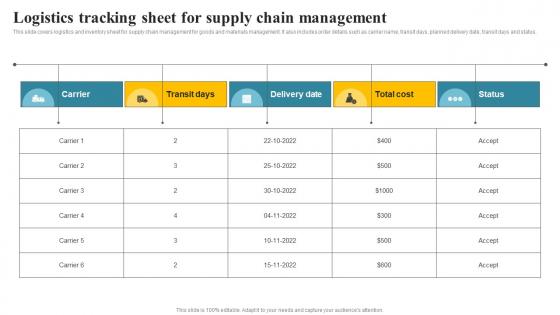
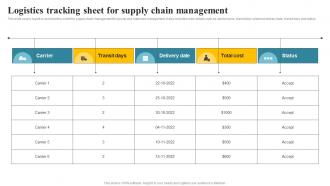
This slide covers logistics and inventory sheet for supply chain management for goods and materials management. It also includes order details such as carrier name, transit days, planned delivery date, transit days and status.
People who downloaded this PowerPoint presentation also viewed the following :
Logistics Tracking Sheet For Supply Chain Management Transportation And Fleet Management with all 9 slides:
Use our Logistics Tracking Sheet For Supply Chain Management Transportation And Fleet Management to effectively help you save your valuable time. They are readymade to fit into any presentation structure.








FAQs for Logistics Tracking Sheet For Supply Chain Management Transportation
Key components of an effective logistics tracking sheet include shipment details, tracking numbers, carrier information, delivery timelines, cost breakdowns, and status updates. These elements streamline supply chain visibility by enabling real-time monitoring, reducing delivery delays, and improving customer communication, with many logistics companies finding that comprehensive tracking ultimately delivers enhanced operational efficiency and competitive advantage.
A logistics tracking sheet improves supply chain visibility by centralizing shipment data, monitoring delivery status, and identifying bottlenecks across the entire network. Through real-time tracking capabilities, organizations can proactively address delays, optimize route planning, and enhance customer communication, with many logistics companies finding that comprehensive visibility ultimately reduces operational costs and delivers superior service reliability.
Commonly used tools include Microsoft Excel, Google Sheets, SAP, Oracle Transportation Management, Manhattan Associates, JDA Software, and specialized platforms like ShipBob or Freightos. These solutions enhance logistics operations by automating data entry, providing real-time visibility, and generating comprehensive reports, with many organizations finding that cloud-based platforms deliver improved collaboration and scalability.
Logistics tracking sheets should be updated in real-time or at minimum every 2-4 hours during active operations, with critical shipments requiring continuous monitoring throughout transit phases. This frequency enables supply chain managers to identify delays early, communicate proactively with customers, and make strategic routing adjustments, ultimately delivering enhanced visibility and competitive service reliability.
Businesses should track delivery times, transportation costs, inventory turnover rates, order accuracy percentages, and customer satisfaction scores in their logistics monitoring efforts. These metrics enable organizations to streamline operations, reduce expenses, and enhance service quality, with many retail and manufacturing companies finding that comprehensive tracking ultimately delivers competitive advantages and improved customer experiences.
Logistics tracking sheets integrate with inventory management systems through API connections, barcode scanning technologies, RFID integration, automated data synchronization, and cloud-based platforms. These integrations streamline operations by providing real-time visibility into shipments and stock levels, reducing manual data entry errors, and enabling automated reorder triggers, with many retailers and manufacturers finding that seamless integration ultimately delivers enhanced operational efficiency and improved customer experiences.
Best practices for maintaining data accuracy in logistics tracking sheets include real-time data entry, standardized input formats, automated validation rules, regular audits, and staff training protocols. These methods streamline operations by minimizing human error, ensuring consistent tracking standards, and enabling immediate correction of discrepancies, with many logistics companies finding that automated systems deliver enhanced visibility and operational efficiency.
Logistics tracking sheets assist in route optimization by analyzing historical delivery data, identifying traffic patterns, and measuring vehicle performance across different routes. Through detailed tracking of delivery times, fuel consumption, and customer locations, companies streamline transportation costs, reduce delivery windows, and enhance customer satisfaction, while ultimately gaining competitive advantage in increasingly demanding markets.
Logistics tracking sheets can be extensively customized for specific industries by incorporating sector-specific data fields, compliance requirements, performance metrics, and regulatory standards. Manufacturing companies might track batch numbers and quality checkpoints, while pharmaceutical logistics requires temperature monitoring and chain-of-custody documentation, ultimately enabling industry-tailored visibility and streamlined operational efficiency.
Common implementation challenges include data accuracy issues, employee resistance to new processes, integration difficulties with existing systems, and maintaining consistent updates across multiple locations. While these obstacles can initially slow adoption, businesses in manufacturing, retail, and distribution find that proper training, phased rollouts, and automated data capture significantly reduce errors and enhance operational visibility, ultimately delivering improved customer satisfaction and competitive advantage.
Automation enhances logistics tracking sheets by eliminating manual data entry, providing real-time updates, and reducing human errors through integrated systems and sensors. Through RFID technology, GPS tracking, and automated workflows, companies streamline inventory management, accelerate delivery notifications, and improve customer visibility, ultimately delivering faster responses and enhanced operational efficiency across supply chains.
Logistics tracking sheets support compliance by maintaining detailed audit trails, documenting chain of custody, recording temperature controls for sensitive goods, tracking regulatory certifications, and ensuring proper documentation for customs clearance. These comprehensive records enable organizations to demonstrate adherence to industry standards like FDA regulations for pharmaceuticals or DOT requirements for hazardous materials, ultimately minimizing compliance risks and regulatory penalties.
Logistics tracking sheets facilitate communication by providing centralized visibility into shipment status, delivery timelines, inventory levels, and potential delays across all stakeholders. Through real-time updates and standardized data formats, supply chain teams, warehouse managers, and customer service representatives can coordinate responses, proactively address issues, and maintain transparency, ultimately delivering improved customer experiences and operational efficiency.
Data visualization transforms logistics tracking sheets by converting complex shipping data, delivery timelines, inventory levels, and route performance into clear charts, graphs, and dashboards. Through interactive maps, trend analysis, and real-time status indicators, logistics managers can quickly identify bottlenecks, optimize delivery routes, and monitor fleet performance, ultimately enabling faster decision-making and enhanced operational efficiency across supply chain networks.
Businesses measure logistics tracking sheet ROI by comparing cost savings from reduced delays, inventory optimization, and operational efficiency against implementation expenses. Through tracking delivery performance, fuel consumption, and resource allocation, companies achieve measurable improvements in customer satisfaction, reduced overhead costs, and faster order fulfillment, ultimately delivering competitive advantage and enhanced profitability.
-
The presentations are very helpful. I am always able to get appropriate templates for the different topics related to my profession.
-
It saves your time and decrease your efforts in half.