


Logistics service proposal template powerpoint presentation slides





Try Before you Buy Download Free Sample Product
 Impress Your
 Audience
 100%
100% Editable
 Save Hours
 of Time


All successful business leaders acknowledge the vital significance of effectively organized logistics. Seamless logistics service is a key element in keeping up with customer demands. As a logistic service provider, it is essential for a company to pitch various business groups, for which you need a well-designed proposal. SlideTeam presents you a professionally designed logistic service proposal PPT slideshow. With the help of this proposal presentation, explain to your potential clients how your logistics services can help them cut on the costs and time they spend to move products from one point to another. This logistics service proposal will help you make your clients believe that you ensure a high value of supply chain with an effectively organized transport system. This business proposal will enable you in explaining to your potential clients how your logistics operations can benefit their company. Mention about the logistics services that your company offers which may include warehousing solutions, reverse logistics, custom servicing, freight forwarding, etc. With this professionally designed proposal persuade your potential customers or management that you can fulfill their needs. Help them take advantage of this opportunity. The logistics service proposals allow you to frame important discussions in terms of your customer’s goals. Pitch various business operators by explaining how your logistics services can be beneficial for them by using this business proposal in your presentation. Download this professionally designed proposal PowerPoint presentation now and attract leading companies.
People who downloaded this PowerPoint presentation also viewed the following :
Content of this Powerpoint Presentation
Slide 1: This slide introduces the Logistics Service Proposal Template. Add designation, company Name and client name.
Slide 2: This slide depicts the Cover Letter. Add user Name, designation, and company name.
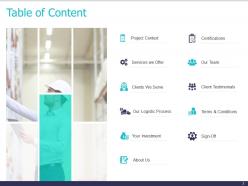
Slide 3: This slide represents Table of Content such as- About Us, Clients We Serve, Client Testimonials, Your Investment, Sign-Off, Services we Offer, Our Team, Project Context, Certifications, Our Logistic Process, Terms & Conditions.
Slide 4: This slide represents Project Context for Logistics Service.
Slide 5: This template portrays the Logistics Services we offer such as warehousing solutions, reverse logistics, etc.
Slide 6: This template represents the Clients we Serve for Logistics Services such as retailers, manufacturers, etc.
Slide 7: This template elucidates Our Logistic Process.
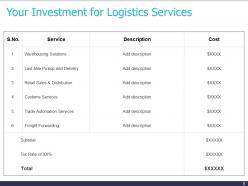
Slide 8: This template shows Your Investment for Logistics Services.
Slide 9: This slide shows About Us.
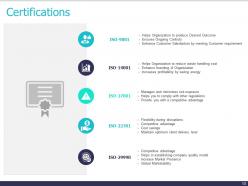
Slide 10: This template reveals the Certifications.
Slide 11: This slide shows the names of Our Team members.
Slide 12: This slide shows the names and designation of Our Team members.
Slide 13: This template unveils the Client Testimonials.
Slide 14: This template depicts the Terms & Conditions pertaining to- Bills of Lading, Agreement to Terms, Customer Warranties.
Slide 15: This is a continuation of Terms & Conditions and shows payment, and necessary Documentation.
Slide 16: This slide depicts Sign-Off. Add User Assigned Company Name, Client Name & Address.
Slide 17: This is a contact us slide containing Address, Contact Number, and e-mail Address.
Slide 18: This slide is titled as Additional Slides for moving forward.
Slide 19: This slide shows Our Mission- Vision, mission and value.
Slide 20: This template explains the roadmap.
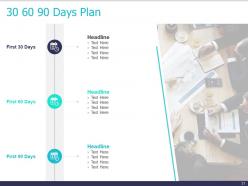
Slide 21: This layout depicts the 30 60 90 Days Plan.
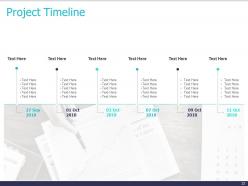
Slide 22: This slide illustrates the Project Timeline.
Slide 23: This slide shows idea Generation.
Logistics service proposal template powerpoint presentation slides with all 23 slides:
Use our Logistics Service Proposal Template Powerpoint Presentation Slides to effectively help you save your valuable time. They are readymade to fit into any presentation structure.










FAQs for Logistics service proposal template
Okay so definitely hit the main stuff - what services you're offering, pricing breakdown, timeline, and why your company rocks at this. Case studies are gold here, honestly clients eat that up when they see you've crushed similar projects. Break down your costs super clearly because nobody likes surprise fees later. Also explain your tech setup and how you handle problems (because something always goes wrong lol). The key thing though? Actually address their specific headaches instead of copy-pasting some generic proposal. Wrap it up with concrete next steps and when they need to decide.
Honestly, data makes all the difference in logistics proposals. Instead of just saying "we're great at shipping," you can pull up actual numbers - like how you cut delivery times by 23% or saved another client $50K. Historical shipping data helps you nail down realistic delivery predictions too. Route optimization shows where they're bleeding money (and there's always somewhere). The best part? You can dig into their specific shipping patterns and actually customize solutions instead of pitching the same generic stuff to everyone. Numbers don't lie, and clients eat that up.
Look, you absolutely cannot skip the needs assessment part - it's everything. Dig into their actual problems first. What's breaking in their current setup? Where are they bleeding money? I always do way more discovery calls than I probably need to, but it's worth it. Once you know their pain points inside and out, writing the proposal becomes so much easier. You're not just pitching random services anymore - you're solving their specific mess. Honestly, half the proposals I see fail because people jump straight to solutions without understanding the problem. Don't be that person.
Okay so first thing - audit what you're already doing, then build from there. Route optimization software cuts fuel costs big time. Electric fleets are huge right now, plus carbon-neutral shipping options. Partner with eco-certified warehouses if you can swing it. Packaging reduction is low-hanging fruit too. But here's the thing - you need actual numbers, not just fluffy promises. Like "25% emission cuts" or "90% recyclable packaging." Clients expect this stuff now, it's not optional anymore. Oh, and skip the generic green buzzwords. Nobody's buying that anymore.
Focus on the money stuff first - show them exact percentage savings vs what they're spending now. Then hit them with delivery stats (95%+ on-time if you can prove it), faster transit times, and how you'll speed up their inventory turnover. Damage rates are huge but honestly most people overlook them until something breaks. Customer satisfaction scores matter too. Oh, and definitely show how you handle volume spikes without killing their budget - that's where a lot of logistics partners fail. Skip the fancy words. Just give them clean charts with solid before/after numbers that actually move the needle on profit.
Dude, skip the feature lists and show actual results instead. Like "cut delivery times by 30%" or "99.8% tracking accuracy" with real client names if you can. Screenshots of your dashboard beat long descriptions every time - people need to see it working. Honestly, I'm so tired of proposals that just slap "AI-powered" on everything without explaining what that actually means. Walk them through how someone would use it day-to-day, you know? Show how it fixes their specific headaches. Then offer a quick demo or pilot so they can try it themselves rather than just taking your word for it.
Honestly, the worst thing you can do is send some generic template - clients see right through that BS. Customize everything to their specific problems and industry. Skip the tech jargon unless you're explaining why it matters to their bottom line. Don't lowball your pricing just to win (trust me on this one). Be upfront about costs with clear breakdowns. Set realistic deadlines instead of promising the moon. Oh, and actually read their RFP requirements - sounds obvious but you'd be surprised how many people miss half the checklist items.
Definitely break down your pricing into clear tiers instead of one massive number. Trust me, clients lose their minds over surprise fees later - I had someone flip out over "hidden" costs that were literally just bundled together. Show everything: fuel charges, handling, storage, whatever. Make it super scannable with bullet points or tables. Volume discounts are clutch if you do those. Oh, and here's the key part - connect each price to what they actually get for that service level. That way they're not just picking the cheapest option blindly, you know?
You definitely need competitive analysis in logistics proposals - I've watched so many people skip this and then act shocked when they lose. Show clients you actually know the market and can explain why you're better than the other guys. Focus on specific weaknesses your competitors have while playing up your strengths. Maybe that's better tech, pricing, or coverage areas. Here's the thing though - don't just rattle off features like some boring spec sheet. Instead, connect those differences to actual business value they'll see. That's what really moves the needle when decision time comes.
For logistics proposals, flowcharts work great - they show your whole service process clearly. Network maps are clutch for displaying coverage areas. Cost savings infographics grab attention too. Don't sleep on comparison charts showing delivery times vs competitors. Keep it simple though. I've seen proposals go overboard with fancy animations that just distract people. Photos of your facilities or fleet help if they actually look good. Implementation timelines are solid for showing next steps. Oh, and make sure everything's readable at a glance - complex logistics stuff needs to be digestible fast. Focus on clear over clever.
Okay so definitely create a whole risk section - don't hide it somewhere random. Figure out what actually scares your client: supply chain issues, weather, damage, reg changes, you know the drill. Map out your game plan for each one. Backup carriers, different routes, insurance, tracking tech - all that stuff. Oh and clients eat up those stories where you saved the day before, so definitely include a few. The numbers thing is huge too - like "cuts delays by 40%" or whatever you've got. Basically prove you're already thinking about their nightmares before they happen.
Look, timelines and milestones are basically your proof that you're not just winging it. Clients need concrete checkpoints they can actually track - builds way more trust than vague promises. Everyone's been screwed over by vendors who overpromise, so realistic milestones help you avoid that mess. They also stop scope creep before it starts, which honestly saves everyone headaches later. Just make sure you factor in real stuff like customs delays or bad weather. Clients actually respect that honesty more than pretending everything goes perfectly. Without clear milestones, you're just another vendor making empty guarantees.
Look, testimonials and case studies are basically your proof that you're not just talking a big game. They show actual results from real clients instead of empty promises. Here's the thing - case studies work because they tell the complete story: what problem existed, how you fixed it, plus the measurable wins afterward. When prospects read that you cut someone's shipping costs by 20% or sped up deliveries, suddenly they can picture you doing that for them too. Honestly? They practically sell themselves. Just make sure you include specific numbers and client names whenever you can get away with it.
Insurance and liability stuff is huge - cover those first. GDPR compliance matters if you're touching customer data, plus whatever industry regs your client deals with. Carrier licensing is another box to check. Honestly, the termination and dispute clauses are where I've seen deals go sideways later, so spell those out clearly. Cross-border work gets tricky with different regulations too. Get your legal people to eyeball the compliance section before sending - I've watched proposals tank over missing one random requirement. Oh, and hazardous materials handling has its own nightmare of rules if that applies.
Structure your proposal with different service tiers for various market sizes. Highlight your local strengths first - regional partnerships, same-day delivery, knowing local regulations inside out. Then show how those capabilities stretch globally through your network or international carrier partnerships. That "locally rooted, globally connected" line sounds corny but honestly clients eat it up. Give concrete examples like "24-hour domestic delivery PLUS international customs clearance." Different pricing models for each segment are crucial. Oh, and definitely include case studies from both local and international clients - proves you can actually handle whatever scope they're throwing at you.
-
Visually stunning presentation, love the content.