


Creating logistics value proposition by a company case competition powerpoint presentation slides




Try Before you Buy Download Free Sample Product
 Impress Your
 Audience
 100%
100% Editable
 Save Hours
 of Time


Logistics strategy helps you increase the supply chain performance of your business while improving the management as a whole. Proposition for a company can be built using various approaches like optimizing freight spend, getting KPIs in order, choosing the best shipping partners, utilizing outsourcing, etc. Firms can assess infrastructure and action plans in context to the project, along with a timeframe for each activity or stage. Here is an efficiently designed template on Creating Logistics Value Proposition by a Company to utilize the technology available and conduct risk and resilience assessments. Organizations can present their project team in the proposal by depicting each members work history and professional designation. The template highlights the challenges faced by customers and multiple project objectives to mitigate them. The proposal demonstrates the strategies and projects scope by presenting the data migration plan, shipment scanning suite, system usage training, etc. One can also exhibit the features and functions of software by indicating key achievements for a logistics firm. The shipment template displays the tentative investment cost providing information about the cost of multiple stages with tax rates. Book a free demo with our research team and download our 100 percent editable template on Creating Logistics Value Proposition by a Company. Get access to the proposal, ask for a free sample and talk to our experts for all your specific needs.
People who downloaded this PowerPoint presentation also viewed the following :
Content of this Powerpoint Presentation
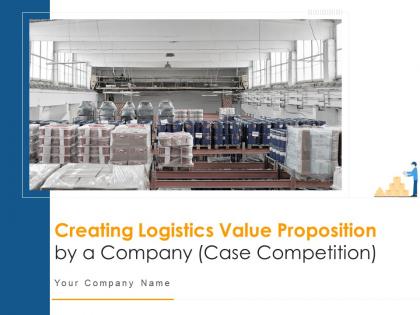
Slide 1: This is the cover slide for Creating Logistics Value Proposition by a Company PowerPoint deck.
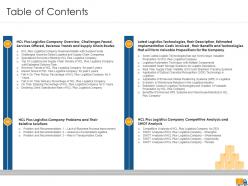
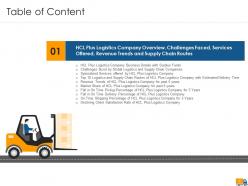
Slide 2: This is the Table of Contents slide that lists out all the essential elements covered in the deck.
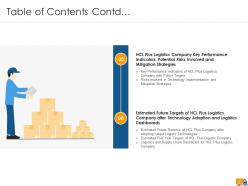
Slide 3: This is the Table of Contents slide that lists out all the essential elements covered in the deck.
Slide 4: This slide presents Logistics company overview.
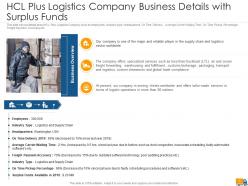
Slide 5: This slide shows details about HCL Plus Logistics Company such as employees, industry type, headquarters, On Time Delivery , Average Carrier Waiting Time, On Time Pickup Percentage, Freight Payment Accuracy etc.
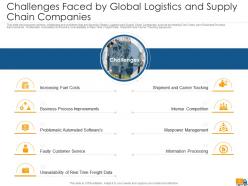
Slide 6: This slide shows some common challenges and problems that are faced by Global Logistics and Supply Chain Companies such as Increasing Fuel Costs, poor Business Process Improvements, Problematic Automated Software’s, Unavailability of Real Time Freight Data, Shipment and Carrier Tracking issues etc.
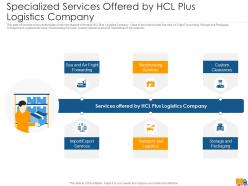
Slide 7: This slide shows the array/variety/class of services that are offered by HCL Plus Logistics Company. Class of services include Sea and Air Fright Forwarding, Storage and Packaging, Transport and Logistics services, Warehousing Services, Custom Clearance service, Import/Export Services etc.
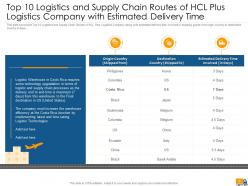
Slide 8: This slide shows the Top 10 Logistics and Supply Chain Routes of HCL Plus Logistics Company along with estimated delivery time involved in shipping goods from origin country to destination country in days.
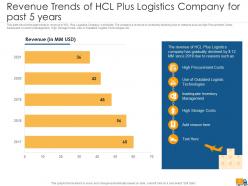
Slide 9: This slide shows the past trends in revenue of HCL Plus Logistics Company worldwide. The company’s revenue is constantly declining due to reasons such as High Procurement Costs, Inadequate Inventory Management, High Storage Costs, Use of Outdated Logistic Technologies etc.
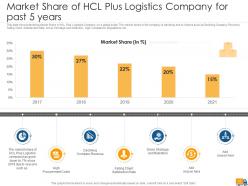
Slide 10: This slide shows declining Market Share of HCL Plus Logistics Company on a global scale. The market share of the company is declining due to factors such as Declining Company Revenue, Falling Client Satisfaction Rate, Driver Shortage and Retention, High Compliance Regulations etc.
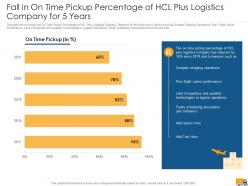
Slide 11: This slide shows a fall in the On Time Pickup Percentage of HCL Plus Logistics Company. Reasons for the fall is due to factors such as Complex Shipping Operations, Poor Fright Carrier Performance, Lack of Expertise and Updated Technologies in Logistic Operations, Faulty Scheduling Procedures and Software’s etc.
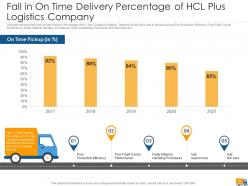
Slide 12: This slide shows a fall in the On-time Delivery Percentage of HCL Plus Logistics Company. Reasons for the fall is due to factors such as Poor Production Efficiency, Poor Fright Carrier Performance, Faulty Material Handling Procedures, Faulty Scheduling Procedures and Software’s etc.
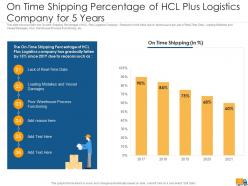
Slide 13: This slide shows a fall in the On-time Shipping Percentage of HCL Plus Logistics Company. Reasons for the fall is due to factors such as Lack of Real-Time Data, Loading Mistakes and Vessel Damages, Poor Warehouse Process Functioning, etc.
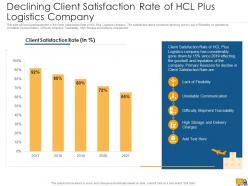
Slide 14: This slide shows a gradual decline in the Client Satisfaction Rate of HCL Plus Logistics Company. The satisfaction rate is constantly declining due to Lack of Flexibility on operations, Unreliable Communication, Difficulty Shipment Traceability, High Storage and Delivery Charges etc.
Slide 15: This slide introduces Logistics company problems.
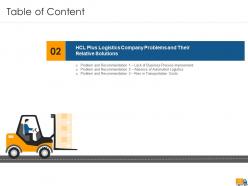
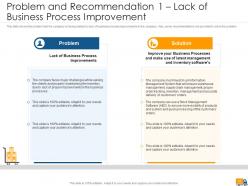
Slide 16: This slide shows the problem that the company is facing related to lack of business process improvements in the company. Also, some recommendations are provided to solve the problem.
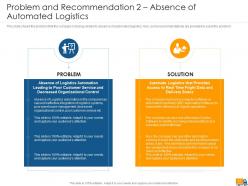
Slide 17: This slide shows the problem that the company is facing related to absence of automated logistics. Also, some recommendations are provided to solve the problem.
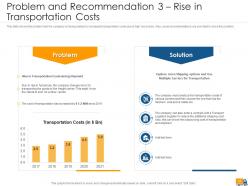
Slide 18: This slide shows the problem that the company is facing related to increased transportation costs due to high fuel prices. Also, some recommendations are provided to solve the problem.
Slide 19: This slide introduces logistics technologies, description, Table of Content
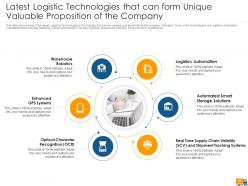
Slide 20: This slide shows some of the latest Logistics Technologies in the Industry that can be valuable and beneficial for the company if adopted. Some of the technologies are Logistics Automation, Automated Smart Storage Solutions, Advanced Shipment Tracking Systems, Warehouse Robotics, Enhanced GPS Systems etc.
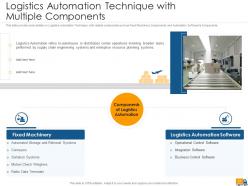
Slide 21: This slide talks about logistics automation technique with multiple components.
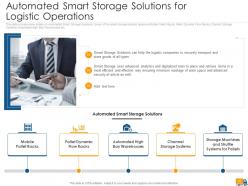
Slide 22: This slide provide some details on Automated Smart Storage Solutions. Some of the smart storage solution types are Mobile Pallet Racks, Pallet Dynamic Flow Racks, Channel Storage Systems, Automated High Bay Warehouses etc.
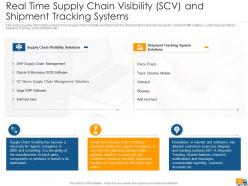
Slide 23: This slide provides information on Real Time Supply Chain Visibility and Shipment Tracking Solutions that can be used to monitor traffic patterns, customize reporting's, inventory tracking, port conditions etc.
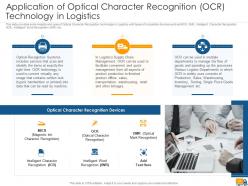
Slide 24: This slide provides some insights and uses of Optical Character Recognition technology in Logistics with types of recognition devices such as MICR, OMR, Intelligent Character Recognition (ICR), Intelligent Word Recognition (IWR) etc.
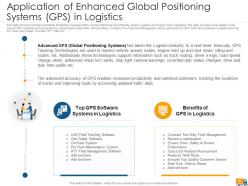
Slide 25: This slide shows how Enhanced Global Positioning Systems (GPS) can be effectively and efficiently used in Logistics and Supply Chain Industries. This slide provides some details on the uses of GPS Systems such as monitoring vehicle speed, Real-Time Vehicle Status, Constant Two-Way Fleet Management along with some Top GPS Software Systems in Logistics such as Pro Fleet, Geo-Tablet, On-Fleet, RTY Fleet etc.
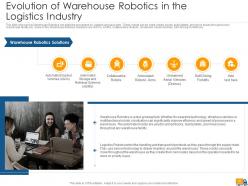
Slide 26: This slide shows how Warehouse Robotics can ease the processes in Logistics and save time. These robots can be used unload trucks, build pallets, and move boxes throughout any warehouse facility etc. Some of the Warehouse Robotics Solutions are AGV’s, AS/RS, Collaborative Robots, Unmanned Aerial Vehicles, Self-Driving Forklifts etc.
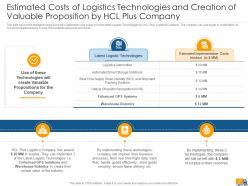
Slide 27: This slide shows the estimated costs involved in application and usage of some latest Logistic Technologies by HCL Plus Logistics Company. The company can use single or combination of two technologies keeping in mind the available resources and funds.
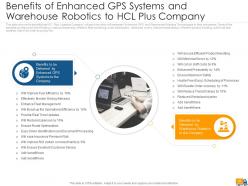
Slide 28: This slide shows the benefits that HCL Plus Logistics Company will get when they will implement Enhanced GPS and Warehouse Robotics Technologies in their processes. Some of the benefits are improved fuel efficiency, reduced expenses, effective fleet monitoring, route optimization, minimized errors, reduce transit delays, effective product handling, quick real time updates, improved order accuracy etc.
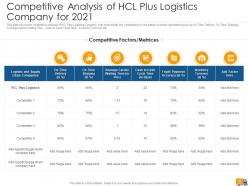
Slide 29: This slide shows the competitive analysis of HCL Plus Logistics Company with other similar line competitors on the bases of certain parameters such as On Time Delivery, On Time Shipping, Average Carrier Waiting Time , Cash to Cash Cycle Time , Inventory Turnover etc.
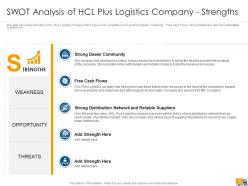
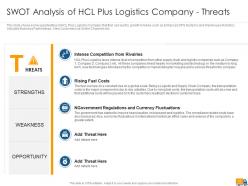
Slide 30: This slide shows the strengths of HCL Plus Logistics Company that it has over its competitors such as Strong Dealer Community , Free Cash Flows , Strong Distribution Network and Reliable Suppliers etc.
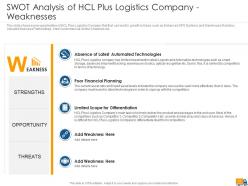
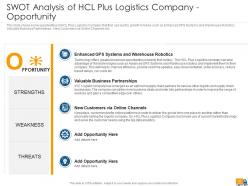
Slide 31: This slide shows some opportunities of HCL Plus Logistics Company that that can lead to growth in future such as Enhanced GPS Systems and Warehouse Robotics , Valuable Business Partnerships , New Customers via Online Channels etc.
Slide 32: This slide shows some opportunities of HCL Plus Logistics Company that that can lead to growth in future such as Enhanced GPS Systems and Warehouse Robotics , Valuable Business Partnerships , New Customers via Online Channels etc.
Slide 33: This slide shows some opportunities of HCL Plus Logistics Company that that can lead to growth in future such as Enhanced GPS Systems and Warehouse Robotics , Valuable Business Partnerships , New Customers via Online Channels etc.
Slide 34: This slide presents Logistics company Key performance indicators.
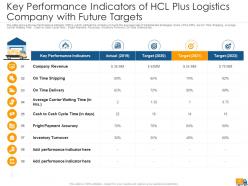
Slide 35: This slide shows the key Performance Indicator (KPI)’s which will help the company to track the success rate of implemented strategies. Some of the KPI’s are On Time Shipping, Average Carrier Waiting Time , Cash to Cash Cycle Time , Fright Payment Accuracy , Inventory Turnover, On Time Delivery etc.
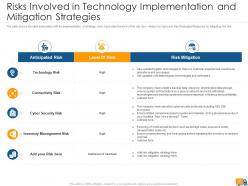
Slide 36: This slide shows the risks associated with the implementation of strategy. Also, it provides the level of the risk (low, medium or high) and Key Strategies/Measures for mitigating the risk.
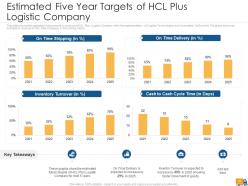
Slide 37: This slide presents estimated future targets of logistics company.
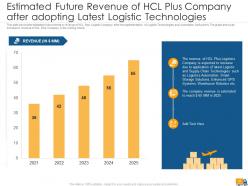
Slide 38: This slide shows the estimated future trends in revenue of HCL Plus Logistic Company after the implementation of Logistic Technologies and Automation Software's. The graph shows an increase in revenue of HCL Plus Company in the coming future.
Slide 39: This slide shows the estimated future trends in revenue of HCL Plus Logistic Company after the implementation of Logistic Technologies and Automation Software's. The graph shows an increase in revenue of HCL Plus Company in the coming future.
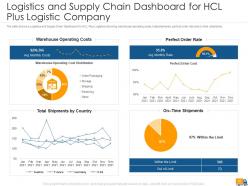
Slide 40: The slide shows a Logistics and Supply Chain Dashboard for HCL Plus Logistics showing warehouse operating costs, total shipments, perfect order rate and on time shipments.
Slide 41: This is an Icon Slide. You can use it as per your needs.
Slide 42: This is an Additional Slides
Slide 43: This is an About Us slide that can be used to give an overview of your organization.
Slide 44: This is Our Mission slide that can be used to state your mission and vision.
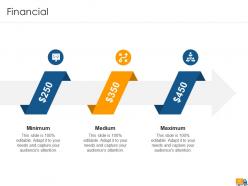
Slide 45: This is Financial slide that can be used to state your company's finances.
Slide 46: This Our Team slide with name and designation to fill.
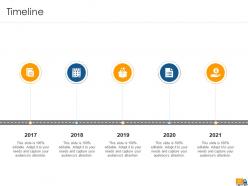
Slide 47: This is a Timeline slide that can be used to showcase chronological sequence of events.
Slide 48: This is a creative Puzzle image slide to state information, specifications etc.
Slide 49: This is a 30 60 90 Days Plan that can be used to create robust plans.
Slide 50: This is Post It Notes slide that can be used to keep important data at one place.
Slide 51: This is a Venn diagram slide to compare three different elements.
Slide 52: This is a Thank You slide for acknowledgment. You can share your contact details here.
Creating logistics value proposition by a company case competition powerpoint presentation slides with all 52 slides:
Use our Creating Logistics Value Proposition By A Company Case Competition Powerpoint Presentation Slides to effectively help you save your valuable time. They are readymade to fit into any presentation structure.

FAQs for Creating logistics value proposition by a company case competition
Honestly, focus on three things: cost savings, reliability, and visibility. Show them exact numbers - like "2-day delivery with 98% on-time rate" instead of vague promises. Real-time tracking is huge because nobody wants to play guessing games with their shipments. Most companies actually care more about reliability than pure speed, which surprised me when I first learned that. Don't just say you'll save them money - prove it with specific data about their current setup versus what you're offering. The worst thing you can do is overpromise something you can't deliver on.
Dude, tech is a total game-changer for logistics. Real-time tracking keeps your customers from constantly calling you (thank god), and AI route optimization actually cuts delivery times in half. Warehouses basically run themselves now with automation, which saves you tons on labor costs. Your clients can literally stalk their packages across three states - kind of creepy but they love it. The data you get helps catch problems before they blow up your budget. Oh, and automated systems work weekends without complaining. Invest smart and you'll deliver better service while spending way less.
Look, everyone's moving packages around, but what can you do that others can't? Maybe you're crushing same-day delivery to places nobody else touches, or you've got insane tracking visibility. Temperature monitoring for pharma stuff? That's gold right there. Honestly, I'd focus on whatever your customers actually care about most - could be speed, cost, or just not screwing up their orders. Sustainability angle works too if that's your thing. The trick is finding what you're genuinely better at, not just making up differences that don't matter.
Track your delivery times, shipping costs, and how often orders arrive correct - that's your baseline data. Customer satisfaction scores matter too, obviously. But here's the thing: you need to figure out if faster shipping actually equals more sales, which is harder than it sounds. I'd straight up ask customers what they care about most because you're probably wrong about what matters to them. Monthly check-ins on these numbers will show you what's working. Then tweak your messaging based on whatever's actually driving results, not what sounds good on paper.
Here's the thing - logistics only gets noticed when it breaks. Nobody celebrates when their package arrives on time, right? But mess up once and suddenly everyone's an expert on your supply chain. What makes it worse is that all your benefits are behind-the-scenes stuff like faster delivery or better inventory management. Decision-makers don't get excited about warehouse metrics - they want to know how you'll solve their actual problems. So instead of rattling off operational stats, translate everything into their language. Show them how your supply chain fixes their headaches, not how efficiently you can move boxes around.
Honestly, just figure out what each industry actually stresses about. Healthcare? They're obsessed with temp control and compliance - one spoiled batch costs them huge. Retail wants everything yesterday because customers are spoiled now. Manufacturing needs things predictable so their lines don't shut down (nightmare scenario). E-commerce gets crazy during holidays so they need systems that can handle the rush. I'd dig into their actual daily headaches first, then show how you fix exactly those problems. Don't use generic sales speak - talk about the metrics that keep them up at night.
Your B2B customers are totally making vendor choices based on environmental stuff now, not just price and delivery times. Seriously, it's wild how much this has shifted. Start with an audit of what green initiatives you're already doing - carbon-neutral shipping, route optimization that cuts emissions, sustainable packaging, electric vehicles if you have them. Then work all that into your pitch deck. This isn't optional anymore; you'll lose contracts without it. My buddy's company learned that the hard way last quarter. Bottom line: sustainability is your new competitive edge.
So your customers are literally the blueprint for your whole logistics pitch. Figure out what they're actually stressed about first - speed? Costs? Just wanting stuff to show up when promised? I've seen companies totally miss this and wonder why nobody cares about their "innovative solutions." Survey your biggest clients about what keeps them up at night. Then build your value proposition around fixing those exact headaches. Don't just rattle off what you can do - explain how you solve their specific problems. Makes way more sense than the generic approach most people take.
Honestly, complex supply chains are a goldmine for logistics companies. Think about it - when businesses are juggling suppliers across different countries, dealing with crazy regulations, and getting hit by random disruptions, they're scrambling for help. That's where you come in. The messier their situation gets, the more they'll pay someone who actually knows what they're doing. It's kinda like when you're planning some insane multi-country trip and suddenly that travel agent doesn't seem so expensive anymore. Don't just pitch yourself as moving boxes around - show them you're the one who'll make sense of all their chaos.
So basically, your logistics needs to match whatever your company's trying to do overall. Like if you're going for amazing customer experience, then logistics should be all about speed and getting stuff there reliably. Cost leadership? Then you're optimizing for efficiency and cutting expenses wherever possible. Honestly, most companies overthink this part. Just figure out your top 3 business priorities first. Then ask yourself - how can logistics actually give us an edge here? Whether that's expanding into new markets, standing out from competitors, or just making more money. Once you map those connections, it's way clearer what to focus on.
Honestly, most people think logistics is just about being cheap and fast. Wrong. Your clients actually want reliability and visibility way more than saving a few bucks. Don't get sucked into price wars - that's a race to the bottom. Focus on real outcomes instead. Like how you'll cut their inventory costs or keep their customers happy. Oh, and stop thinking every customer wants identical things. A manufacturer has totally different headaches than a retailer. Best approach? Ask what's stressing them out at night, then show how you fix exactly that problem.
Honestly, working with your supply chain partners is a game changer. You'll get way better visibility into what's happening and can split costs on stuff like transportation and warehousing. Instead of everyone running around doing their own thing (which is pretty wasteful tbh), you coordinate shipments and optimize routes together. The result? Lower costs, faster deliveries, more reliable service. I'd start small though - pick one solid partner and suggest sharing transport on a route you both use regularly. Once that works, you can expand from there. It's like... why fight the current when you can swim together, you know?
Honestly, I'd track four main things: cost savings (are you actually spending less?), service improvements like faster delivery, customer happiness scores, and efficiency stuff like lower inventory costs. The annoying part is comparing before/after fairly - it's harder than it sounds. Also keep an eye out for random benefits you didn't expect. Those are often the best part. Get your baseline numbers first, obviously. Then check quarterly to see what's actually working. Oh, and don't overthink it initially - you can always add more metrics later if needed.
Okay so here's the thing - you gotta tell a story that hits them in the feels first. Pick a real scenario, like some retailer who got crushed during the holidays because shipments were late. Make them feel that panic. Then flip it and show how your logistics would've saved their ass. People forget numbers but they remember how you made them feel, trust me. Walk through the whole mess-to-success journey, hitting those key moments where you're the hero. Oh and always wrap up with "so here's exactly what this does for YOU." That's honestly what seals it.
Honestly, green logistics is huge right now - customers actually care about carbon footprint stuff. AI's totally changing warehouses and delivery routes too, so you gotta show you're not stuck in 2015. E-commerce is still exploding (trust me, my credit card knows), which means everyone expects same-day delivery now. That's just baseline. Real-time tracking and solid data analytics will set you apart from competitors. Oh, and maybe check how you're doing against these trends every few months? Otherwise you'll fall behind fast.
-
Best way of representation of the topic.
-
Very unique, user-friendly presentation interface.
-
Great designs, really helpful.
-
Enough space for editing and adding your own content.