


Supply Chain Management Process Powerpoint Presentation Slides





Try Before you Buy Download Free Sample Product
 Impress Your
 Audience
 100%
100% Editable
 Save Hours
 of Time


Select Supply Chain Management Process PowerPoint Presentation Slides to explain the SCM process. Demonstrate the steps of demand planning, strategic planning, supply planning, procurement, warehousing, manufacturing, transportation and order fulfilment with this content ready supply chain network PPT slides. This Includes various custom-made slides with all sorts of relevant charts and graphs, overviews, topics subtopics templates, and analysis templates. Showcase flow of goods from supplier to sales channel using resource planning PowerPoint templates Furthermore, supply management Presentation layout can also be used to represent related concepts like warehouse management system, inventory control systems, inventory management, logistics management, demand chain management, operations management, distribution, enterprise planning system and many more. It also assists in planning of supply chain functions, transportation, warehousing, inventory management and production planning. Download this inventory control system Presentation graphics to assess the productivity of supply chain management process. Heighten the impact of the experience with our supply chain management ppt Slides. It helps inject a bit of drama.
People who downloaded this PowerPoint presentation also viewed the following :
Content of this Powerpoint Presentation
Slide 1: This slide introduces Supply Chain Management Process. State the name of your company and get started.
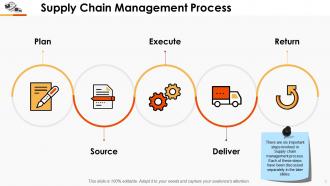
Slide 2: This slide shows six important steps involved in Supply Chain Management Process. Each of these steps have been discussed separately in the later slides.
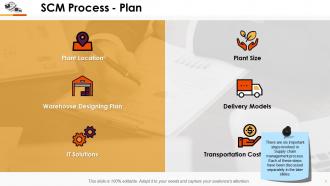
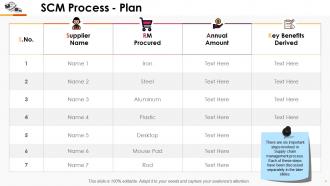
Slide 3: This slide shows SCM Process - Plan with- Plant Location, Warehouse Designing Plan, IT Solutions, Plant Size, Delivery Models, Transportation Cost Modeling.
Slide 4: This slide shows another variation of SCM Process - Plan.
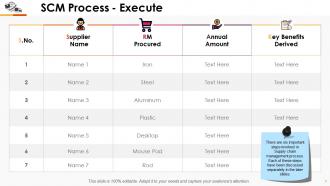
Slide 5: This slide shows SCM Process - Execute table with the following sub headings to state- Supplier Name, RM Procured, Annual Amount, Key Benefits Derived.
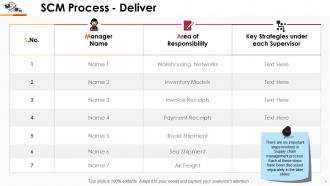
Slide 6: This slide shows SCM Process - Deliver with the following sub headings- Manager Name, Area of Responsibility, Key Strategies under each Supervisor.
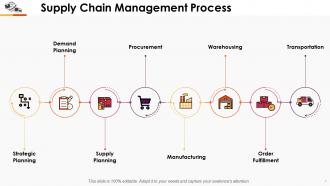
Slide 7: This slide shows the following steps involved in Supply Chain Management Process- Strategic Planning, Supply Planning, Manufacturing, Order Fulfillment, Transportation, Warehousing, Procurement, Demand Planning.
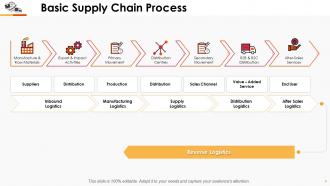
Slide 8: This slide shows Basic Supply Chain Process with its constituents.
Slide 9: This is an Area Chart slide to show product/ entity growth, comparison, specifications etc.
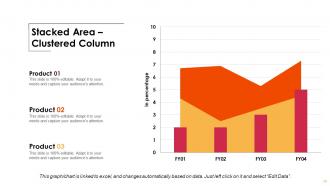
Slide 10: This is a Stacked Area- Clustered Column slide to present product/ entity comparison, specifications etc.
Slide 11: This slide is titled Additional Slides. You can change the slide content as per your needs.
Slide 12: This is Supply Chain Management Process Icons Slide. Alter the icons as per your need.
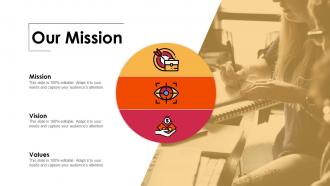
Slide 13: This slide contains Our Mission, Vision and Values with text boxes.
Slide 14: This slide helps depict Our Team with text boxes.
Slide 15: This is an About Us slide. State team/ company specifications here.
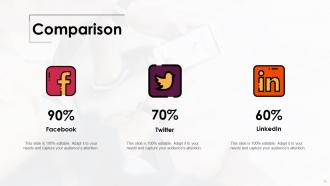
Slide 16: This is a Comparison slide to compare products/ entities etc.
Slide 17: This is a Quotes slide. State business message, beliefs etc. here.
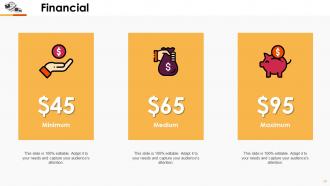
Slide 18: This slide shows Financial score with Minimum, Maximum and Medium parameters.
Slide 19: This is a Thank You slide with Address# street number, city, state, Contact Numbers, Email Address.
Supply Chain Management Process Powerpoint Presentation Slides with all 19 slides:
The audience will get drawn in by our Supply Chain Management Process Powerpoint Presentation Slides. Your expertise will come to the fore.




FAQs for Supply Chain Management Process
You need demand planning, supplier relationships, inventory optimization, and logistics coordination. Risk management and performance metrics are crucial too. Map out your current supply chain first - see everything end-to-end. That's where you'll spot the biggest bottlenecks. Honestly, visibility across your network makes or breaks everything. If you can't see what's happening at each stage, you're flying blind. Think of it like... well, managing a bunch of moving parts that all need to sync up. Start with those bottlenecks though - they'll show you exactly where to focus your energy first.
Honestly, the visibility you get now is insane - IoT sensors and RFID let you watch products move in real-time from supplier to customer. Blockchain adds another layer of tracking too. You'll catch bottlenecks way before they blow up into major problems, plus customers love getting accurate delivery updates. When something goes wrong, tracing it back to the source becomes way easier. Oh, and having all that reliable data really helps with stakeholder trust since everyone's looking at the same info. I'd start tracking your most critical stuff first, then just build from there.
Honestly, data analytics is like having a crystal ball for your supply chain. You can actually predict when demand's gonna spike and catch bottlenecks before they screw you over. The forecasting stuff these days is pretty incredible - though I got a bit obsessed with the algorithms when I first started using them. It helps you nail inventory levels so you're not stuck with dead stock. Real-time supplier tracking is clutch too. You'll spot quality issues way earlier than you used to. My advice? Start with something specific like demand forecasting first. Prove it works there, then expand.
Honestly, global disruptions are like surprise tests for your whole supply chain - they'll show you every weak spot you never saw coming. Companies that recover fast? They're the ones who already had backup suppliers and flexible routes mapped out. When COVID hit, you could tell which businesses were prepared and which were scrambling. Multiple suppliers are your friend here, not just the cheapest option. Short sentences hit different sometimes. Don't wait until you're in crisis mode to figure out where your vulnerabilities are - that's when everyone else is also fighting for the same backup options and prices go crazy.
Dude, start by mapping out your whole supply chain - can't protect what you don't know exists. Spread suppliers across different regions instead of clustering them. Real-time tracking systems are a game changer for visibility. Oh, and build relationships with backup suppliers even when you don't need them yet. Most companies wait until they're screwed to think about this stuff, which is honestly backwards. The visibility thing might cost upfront but it's worth it when everything goes sideways.
Honestly, most companies are weaving sustainability through their entire supply chain these days. They're picking suppliers based on eco-practices, cutting transport emissions, using actually recyclable packaging (not that greenwashing BS). Regulations and customer pressure make it pretty much mandatory now. Start grilling your suppliers about carbon footprints and waste - sounds boring but it'll save you compliance nightmares later. Plus you'll look good compared to competitors still ignoring this stuff. Win-win situation really.
Dude, the warehouse stuff is getting insane - like swarms of picking robots that actually coordinate with each other. AI predictive analytics is huge right now, plus you've got collaborative robots working with people instead of replacing them. Autonomous delivery vehicles are everywhere too. Smart sensors track inventory constantly, and machine learning can spot supply chain problems before they even happen. What's crazy is this tech used to cost a fortune but now it's way more accessible. Honestly though, I'd just pick one process to automate first and see how it goes.
Honestly, JIT is all about nailing two things: solid supplier relationships and decent demand forecasting. Work closely with your main suppliers to get reliable delivery schedules down pat. Maybe try vendor-managed inventory too. The forecasting part though? That's where everyone screws up at first - you really need good software and historical data analysis. Short sentences work better sometimes. Always have backup suppliers ready because when JIT goes wrong, it's a complete disaster. Oh, and don't go crazy right away - test it out with non-critical stuff first before you commit fully.
Honestly, your suppliers can totally make or break you. Good relationships mean better prices, you'll get priority when stuff gets scarce, and they'll actually call you when problems are coming. COVID was brutal - watched so many companies get screwed because they treated suppliers like just another vendor instead of actual partners. Regular check-ins matter more than you'd think. Fair payment helps too (shocking, I know). I'd start with your top 3-5 critical ones and set up quarterly meetings. Face-to-face works way better than emails for building real trust.
Honestly, consumer behavior is what makes or breaks your supply chain planning. People's shopping habits change constantly - one day they're buying in stores, next day it's all online orders. Remember the whole toilet paper thing? That's what happens when buying patterns go completely sideways and mess up your forecasting. Seasonal stuff, loyalty shifts, even TikTok trends can throw everything off. You've got to stay flexible with your systems. Real-time data helps, but sometimes you're just reacting to whatever weird thing consumers decide to do next. Building in wiggle room saves your sanity.
Honestly, it's a total mess trying to keep track of everything. Your inventory systems are probably all over the place - online shows one thing, stores show another, wholesale is doing its own thing. Customers expect everything to work perfectly no matter where they shop, which is... ambitious lol. Returns are another headache since each channel handles them differently. Plus coordinating shipping between all your fulfillment methods? Nightmare fuel. I'd say fix your data first - get one system that actually talks to all your channels. Makes everything way less chaotic once you can see what's actually in stock everywhere.
Pick KPIs that actually move the needle - delivery times, cost per unit, inventory turnover, supplier reliability. Most companies are drowning in useless metrics tbh. Use whatever systems you already have (ERP, WMS) to track consistently and build dashboards for quick trend spotting. Regular check-ins with your team and suppliers about performance gaps are crucial. But here's the thing - if a metric doesn't help you make better decisions, dump it. Focus on actionable stuff, not what looks good in PowerPoint. The goal is insights that drive real improvements, not impressive-looking reports that sit in someone's inbox.
So 3PLs are companies that handle all your logistics headaches - warehousing, shipping, fulfillment, the whole nine yards. They're everywhere now because honestly, who wants to build their own warehouse network? Way too expensive. Amazon has theirs, but regular companies just use these third-party guys instead. You save money, get faster deliveries, and don't have to become a logistics expert overnight. Smart approach is figuring out what's actually worth doing yourself vs. what's just eating up your time and cash. Most stuff? Just outsource it.
Honestly, you don't want to just grab the cheapest supplier out there. Look at the whole picture - what's it actually gonna cost you when you factor in quality issues and returns? I've watched companies get absolutely wrecked by cheap suppliers who seemed great upfront. Build solid relationships with people you can trust. Set up quality checks along the way, and track your data on both cost and quality over time. Oh, and definitely audit who you're working with now - rank them on both factors so you can spot the gaps. Some companies forget that fixing problems later costs way more than preventing them.
Oh man, supplier selection is such a headache! First things first - check their finances and quality standards. Production capacity too. Location's tricky because sure, you'll save money going overseas, but then shipping takes forever and supply chains get messy. Labor and environmental stuff matters way more now - companies are super picky about that ESG nonsense. Communication can totally kill a project if there's language barriers. Make sure they've got proper certifications and follow local rules. Honestly though? Just fly out there and see their operation yourself before you commit to anything big. I learned that one the hard way.
No Reviews