


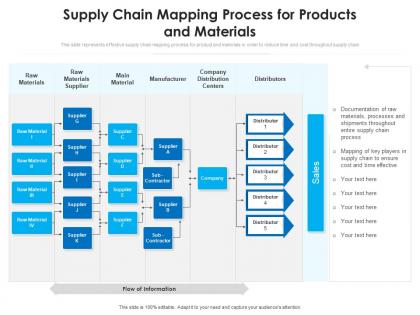
Supply chain mapping process for products and materials




Try Before you Buy Download Free Sample Product
 Impress Your
 Audience
 100%
100% Editable
 Save Hours
 of Time


This slide represents effective supply chain mapping process for product and materials in order to reduce time and cost throughout supply chain
People who downloaded this PowerPoint presentation also viewed the following :
Supply chain mapping process for products and materials with all 2 slides:
Use our Supply Chain Mapping Process For Products And Materials to effectively help you save your valuable time. They are readymade to fit into any presentation structure.
FAQs for Supply chain mapping process for
So you'll need the basics first - supplier info like who they are, where they're located, what they actually provide. Then map out how materials flow between different tiers and show the relationships/dependencies. Don't forget lead times and capacity data. Geographic plotting helps too, though that can get messy fast. Visuals are everything here - seriously, spreadsheets will make you want to cry when things get complicated. Focus on your tier 1 and tier 2 suppliers at minimum. Going deeper is better but honestly, just start somewhere. My advice? Begin with your most critical stuff and expand from there. Way easier than trying to boil the ocean right away.
Think of supply chain mapping like drawing a family tree for your business - you can see every supplier, vendor, and partner in one place. When stuff goes sideways (and it will), you'll know exactly who to call instead of panicking. You can spot bottlenecks before they screw you over. Plus you'll have backup plans ready to go. Honestly, I wish more companies did this upfront instead of learning the hard way. Start with your main suppliers first, then dig deeper from there. Game changer for sure.
Honestly, just start with Excel or Google Sheets if you're testing the waters. Works better than you'd think for basic stuff. Once you outgrow that, there's SAP Ariba for procurement mapping, Resilinc handles risk management pretty well, and you've got specialized ones like Sourcemap or Blue Yonder (used to be LLamasoft - they love rebranding, don't they?). Tableau and Power BI are solid for making interactive maps after you collect your data. Focus on tier-1 suppliers first though. Don't blow your budget on fancy software until you actually know what insights you need.
OK so basically it's like having x-ray vision into your whole supply chain - you can actually see where problems might hit before they do. Map out all your suppliers, routes, the works. You'll be shocked at how many blind spots exist (most companies are flying blind tbh). Once you see everything laid out, the scary stuff becomes obvious - like relying on one supplier in a flood zone or shipping through sketchy political areas. Then you can prep backup plans, spread out your suppliers, maybe stockpile stuff strategically. I'd start with your main suppliers first, then dig deeper.
Honestly, you can't map supply chains well anymore without tech backing you up. AI and machine learning will automatically find suppliers way down the chain that you didn't even know existed. Blockchain keeps tamper-proof records of everything. Real-time tracking through IoT and GPS shows you where stuff actually is - not where it's supposed to be, which can be wildly different (learned that the hard way). Cloud platforms tie all this data together so you can share it with partners instantly. My advice? Pick whatever tech fixes your biggest blind spot first. That's usually finding those tier 2+ suppliers nobody talks about.
Look, mapping your supply chain is honestly a game changer for communication. You get this clear picture of everyone you're dealing with and how they fit together. Then you can actually send relevant messages instead of blasting the same generic stuff to everyone - your main suppliers need totally different updates than the smaller tier-3 guys, you know? Plus it helps you spot where communication breaks down before things get messy. I'd start simple though - just map out who you currently work with first, then build your communication channels from there. Way less overwhelming that way.
Honestly, the data collection part is a nightmare. Suppliers hate sharing info about their own suppliers - they think you're gonna cut them out or something. Real-time data? Good luck with that. Most smaller suppliers don't even have decent tracking systems, and everything's constantly changing anyway. Global supply chains are just messy by nature - multiple tiers, tons of moving pieces. The whole thing gets expensive fast if you try to do everything at once. My advice? Pick your most critical suppliers first and work outward from there. Way less overwhelming that approach.
Honestly, mapping your supply chain is like getting a satellite view of all your mess. You'll see exactly where stuff gets stuck - maybe inventory's piling up at one warehouse, or that one supplier who's always late (we all have that guy). Instead of guessing what's wrong, the visual layout makes bottlenecks super obvious. Short version: you can actually spot the red flags slowing everything down. Then just tackle the worst problems first. Way better than trying to fix random issues and hoping something improves.
Check four things to see if your supply chain mapping actually works. How much of your supplier network is mapped? That's your visibility coverage. Data accuracy matters too - stale info is worthless. Can you catch disruptions before they mess things up? That's risk identification. Also track response time - are you reacting faster than before? I'd run these numbers quarterly because honestly, too many companies just make fancy charts that don't help when stuff hits the fan. The whole point is better decision-making, not prettier PowerPoints.
Your suppliers and logistics partners are honestly your best intel source - they see stuff you'll never catch from your office. Think about it: they know their own secondary suppliers, weird seasonal capacity issues, transportation hiccups you'd never hear about. Customers can spot outdated info in your maps too. I'd set up regular check-ins with these people instead of doing some massive annual review (which sounds terrible). Data-sharing agreements help, but really it's just staying in touch consistently. They catch discrepancies that would totally fly under your radar otherwise.
Update those maps quarterly minimum, but really whenever suppliers change or you launch new stuff. Most companies totally blow this off because it's boring as hell. Get your suppliers to ping you automatically when their sub-suppliers shift around too. Don't make it everyone's job - that's how nothing gets done. Pick specific people to own it. Let suppliers update their own sections directly through whatever platform you're using. Oh, and actually audit the info sometimes. People lie on paperwork constantly, so spot-check what they're telling you.
So basically, supply chain mapping shows you exactly where your stuff comes from and who's touching it along the way. Super important for ethics and sustainability. You'll spot suppliers doing sketchy things - child labor, trashing the environment, treating workers badly. All the stuff you'd never know about otherwise. Think of it like x-ray vision for your whole supply network. Once you've mapped everything, you can actually make smart choices about suppliers and hold them accountable. Oh, and start with your direct suppliers first - way easier than trying to tackle everything at once.
Honestly, it depends on what industry you're in because each one has its own nightmare scenarios. Pharma companies are stuck with crazy strict regulations and cold storage headaches - mess up the temperature chain and you're screwed. Manufacturing is wild - these massive networks where if one tiny supplier goes down, whole production lines stop. Food companies? They're juggling spoilage timelines, seasonal chaos, and having to trace every ingredient. Tech is dealing with components that change constantly plus all the chip shortage drama we've seen lately. My advice: figure out what keeps your sector up at night first, then build your mapping around those specific problems instead of some cookie-cutter solution.
Honestly, mapping your supply chain is a game changer for forecasting. You'll see exactly where demand signals come from instead of just guessing. The whole network becomes visible - different channels, bottlenecks that mess with your data, lead times at every step. Plus you can catch shifts from retail partners way before they show up in your own sales numbers. I'd start with your top 3 revenue streams first since that's where you'll see the biggest impact. Takes way less work than trying to map everything at once, and you'll actually get results fast.
Here's my take on supply chain mapping - it's basically like having GPS for all your stuff. You can actually see where materials come from and how long each step takes. Without that visibility, you're just shooting in the dark with reorder points. The mapping shows you which suppliers really matter and what lead times actually look like (not what they promise). Plus you'll spot where bottlenecks might mess with your inventory levels. I'd start with your top 20% of SKUs first since that's where you'll see the biggest wins. Way better than guessing at safety stock levels.
-
Easily Editable.
-
Great product with effective design. Helped a lot in our corporate presentations. Easy to edit and stunning visuals.
-
Content of slide is easy to understand and edit.
-
Excellent design and quick turnaround.
-
Informative presentations that are easily editable.