


Supply chain management flow for construction industry




Try Before you Buy Download Free Sample Product
 Impress Your
 Audience
 100%
100% Editable
 Save Hours
 of Time


Our Supply Chain Management Flow For Construction Industry are topically designed to provide an attractive backdrop to any subject. Use them to look like a presentation pro.
People who downloaded this PowerPoint presentation also viewed the following :
Content of this Powerpoint Presentation
Description:
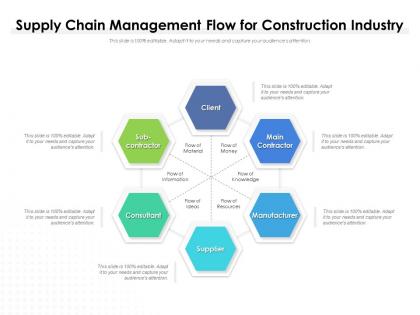
The image is a PowerPoint slide illustrating the "Supply Chain Management Flow for Construction Industry." It depicts the interconnections between various entities in the construction supply chain. The slide consists of hexagonal and rectangular shapes representing different roles and the flow of resources between them.
1. Client:
Positioned at the top, signifying the start of the supply chain. The client provides the capital and has the demand which drives the whole process.
2. Main Contractor:
Central to the slide, reflecting their role in coordinating the project. They manage the flow of money, material, knowledge, and resources.
3. Sub-Contractor:
Linked to both the Client and the Main Contractor, handling specific tasks assigned by the Main Contractor and providing specialized services or work.
4. Consultant:
They offer expertise and advice, influencing the flow of information and ideas to ensure the project meets technical and regulatory standards.
5. Manufacturer:
Produces the materials and products required for construction, feeding into the supply chain by providing essential resources.
6. Supplier:
Supplies the raw materials or finished goods to the contractors and sub-contractors for the actual construction work.
Use Cases:
Industries where such supply chain slides are applicable:
1. Construction:
Use: Illustrating project management workflows.
Presenter: Supply Chain Manager
Audience: Project stakeholders, team members
2. Manufacturing:
Use: Describing the production supply chain.
Presenter: Operations Director
Audience: Suppliers, production staff
3. Energy:
Use: Managing the supply chain of energy production projects.
Presenter: Procurement Manager
Audience: Contractors, investors
4. Automotive:
Use: Outlining the flow of auto parts from suppliers to manufacturers.
Presenter: Logistics Coordinator
Audience: Parts suppliers, assembly line managers
5. Pharmaceutical:
Use: Detailing drug manufacturing and distribution networks.
Presenter: Quality Assurance Lead
Audience: Regulatory bodies, healthcare providers
6. Aerospace:
Use: Explaining the assembly of aircraft components from various suppliers.
Presenter: Program Manager
Audience: Engineers, subcontractors
7. Technology:
Use: Tracking the flow of electronic components for product assembly.
Presenter: Supply Chain Analyst
Audience: Vendors, internal management teams
Supply chain management flow for construction industry with all 2 slides:
Use our Supply Chain Management Flow For Construction Industry to effectively help you save your valuable time. They are readymade to fit into any presentation structure.
FAQs for Supply chain management flow
You need four main things: demand forecasting, supplier relationships, inventory optimization, and logistics coordination. Forecasting is where most companies totally bomb - way trickier than people think. Good communication systems between all your partners are key, plus you want real-time visibility across everything. Risk management matters big time after all the chaos we've seen lately. Oh, and build in flexibility instead of just chasing the lowest costs. That's probably the biggest mistake I see. Start by mapping your current suppliers, then figure out where you're most exposed. Makes the whole process less overwhelming.
So basically you get these IoT sensors everywhere - tracking shipments, inventory, equipment, all that stuff. Then AI crunches the numbers and spots problems before they actually blow up. Honestly, it's pretty sweet not having to play phone tag just to find out where your stuff is! The alerts are automatic when things go sideways, plus you can see bottlenecks forming. Demand forecasting gets way better too. My advice? Don't go crazy at first. Just pick one area that's giving you headaches - maybe incoming shipments - and throw some sensors on that.
So demand forecasting is pretty much what keeps your whole supply chain from falling apart. You analyze past sales data and seasonal patterns to predict what customers will actually buy. This way you don't end up with empty shelves OR a warehouse full of junk nobody wants. Both scenarios suck equally, trust me. Good forecasting helps you figure out optimal inventory levels, better supplier negotiations, and keeps customers from getting pissed off. Start with your historical sales - that's where the magic happens. It's way better than just guessing and hoping for the best.
Honestly, global disruptions are brutal for supply chains - they hit everything at once. Factories shut down, ports close, trucks get delayed, workers call out sick. COVID was the worst example of this. Remember all those cargo ships just sitting there for weeks? Companies with their fancy just-in-time strategies got completely screwed. The problem is everything's so connected now. One supplier goes down in Asia and suddenly you can't make anything in Ohio. It spreads like wildfire through the whole system. That's why you need backup suppliers and some extra inventory sitting around, even though it costs more upfront. Way better than scrambling when everything falls apart.
Clear communication upfront is everything - set those expectations early with regular check-ins and solid metrics. Build actual partnerships, not just transactional stuff. I know it sounds cheesy, but really understanding their business makes a massive difference. Don't put all your eggs in one basket though - diversify suppliers and always have backup plans ready. Quarterly reviews with mutual KPIs keep everyone honest. Oh, and create some kind of scorecard system to track performance objectively. Trust me, it makes those awkward conversations way easier when you've got data backing you up.
Yeah totally doable! Start with your biggest cost drains first - that's where you'll see real impact. Fewer suppliers but better relationships = way more negotiating power and usually better prices too. Poor communication between teams burns through cash like crazy, I swear half these companies don't even realize it. Get your demand forecasting down pat so you're not stuck with dead inventory. Oh and logistics - consolidating shipments saves a ridiculous amount. You don't have to mess with product quality at all, just optimize how you're doing things.
Start with cost, time, quality, and service level - that's your foundation. Total supply chain costs, order fulfillment time, defect rates, on-time delivery percentages. Don't sleep on inventory turnover though! Seriously, most companies ignore it but it'll make or break your cash flow. Pick 5-6 metrics max at first. You'll go crazy trying to track everything. Focus on what actually moves the needle for your customers and profits. Industry matters too - what works for manufacturing might not work for retail. Build your dashboard around metrics that directly hit your bottom line, then add more later once you've got the basics down.
So sustainability is basically making you question every single choice in your supply chain. Like, where you get materials, how stuff gets shipped, even your packaging. Yeah it's a balancing act between cost and being green - honestly took our company a while to figure out. But now we're finding local suppliers, cutting waste, smarter shipping routes. The thing is, it's not just feel-good stuff anymore - customers actually care and regulations are getting stricter. I'd start by looking at what you're doing now and finding your biggest environmental mess-ups first.
Don't put all your suppliers in one place - spread them across different regions. Keep backup vendors on speed dial for anything critical. Real-time tracking is a lifesaver because you'll catch problems early instead of scrambling later. Yeah, it sucks to tie up cash in extra inventory, but honestly? Better safe than sorry for your essential stuff. Map out where you're most vulnerable first - that's where I'd start. Run through worst-case scenarios regularly to stress-test everything. Trust me, the time you spend planning now saves major headaches down the road.
Oh man, cultural stuff can totally wreck your supply chain partnerships if you're not careful. Different communication styles are huge - some cultures are crazy direct while others dance around problems. That leads to weird misunderstandings about deadlines and quality standards. Time moves differently everywhere too. What you think is urgent? They might see as totally normal pace. Some partners need to build personal relationships first before they'll even talk business details, which honestly makes sense but can be frustrating. Best thing is spending time upfront figuring out how your partners actually operate and adjusting how you communicate with them.
Dude, so much is changing right now. Companies are finally moving production closer to home - took them long enough after all those shipping nightmares! AI forecasting is getting really good too. Everyone's obsessed with going green because customers won't shut up about sustainability (not that it's bad). Digital twins are everywhere now, giving you crazy visibility into everything. Oh, and nearshoring is huge. Honestly? Just figure out where you can't see what's happening in your supply chain and fix that first. That's where you'll get burned.
Look, good inventory management is a game changer for cutting costs and keeping customers happy. You'll want to try ABC analysis first - it helps you focus on your most valuable stuff instead of wasting time on random items. Just-in-time ordering is solid too, stops you from having warehouses full of junk nobody wants. EOQ calculations sound boring but they actually help you figure out how much to order without going broke. Oh, and get some real-time tracking going so you know what's selling. Honestly though, just start by checking your current turnover rates - that'll tell you everything.
Honestly, data analytics is a game-changer for supply chains. You'll stop guessing about demand and actually predict what's coming. Spotting bottlenecks becomes way easier before they blow up into real problems. Your inventory won't be all over the place anymore - no more panic ordering or warehouses stuffed with junk nobody wants. The coolest part? You start catching patterns you totally missed before. Real-time tracking means you can fix issues fast instead of discovering disasters weeks later. My advice: start with demand forecasting and see where it takes you.
Build redundancy for your critical stuff, but streamline everything else. COVID taught me this lesson - companies that only cared about costs got wrecked. Map out which suppliers handle most of your volume (usually like 20% do 80% of the work) and start there. Lock in long contracts with reliable partners for your standard products. But keep things flexible for the unpredictable items - shorter deals, backup suppliers, that kind of thing. Honestly, it's all about segmenting your supply base smartly. Don't optimize everything the same way or you'll get burned when something goes sideways.
Look, outsourcing can save you serious money and gets you experts without hiring full-time. You'll focus on what actually matters instead of dealing with logistics BS. Scaling up or down becomes way easier too. But here's the thing - you're basically handing over control, which honestly makes me anxious just thinking about it. Communication gets messy, quality might slip, and you're stuck depending on other people. Oh, and surprise fees are totally a thing. My take? Try it with something small first - like, don't outsource your entire operation right off the bat.
No Reviews