


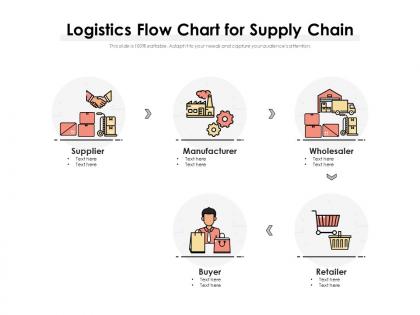
Logistics flow chart for supply chain




Try Before you Buy Download Free Sample Product
 Impress Your
 Audience
 100%
100% Editable
 Save Hours
 of Time


Our Logistics Flow Chart For Supply Chain are explicit and effective. They combine clarity and concise expression.
People who downloaded this PowerPoint presentation also viewed the following :
Logistics flow chart for supply chain with all 2 slides:
Give your audience a fulfilling experience. They will find our Logistics Flow Chart For Supply Chain elevating.

FAQs for Logistics flow chart
A logistics flow chart visualizes the entire supply chain process, mapping material and information flows from suppliers to end customers, identifying bottlenecks, dependencies, and optimization opportunities. These visual tools streamline operations by enhancing coordination between warehouses, transportation, and distribution centers, while enabling faster decision-making and cost reduction, ultimately delivering improved customer satisfaction and competitive advantage.
A logistics flow chart improves operational efficiency by visualizing supply chain processes, identifying bottlenecks, standardizing workflows, and optimizing resource allocation across warehouses and distribution centers. Through clear process mapping, organizations streamline inventory management, reduce transportation costs, and accelerate delivery times, with many logistics companies finding that systematic visualization ultimately delivers enhanced customer satisfaction and competitive advantage.
Key elements include supplier information, inventory management, transportation routes, warehousing operations, distribution channels, and customer delivery points. These components work together by tracking product movement, optimizing resource allocation, and identifying bottlenecks, with many logistics companies finding that comprehensive flow charts reduce operational costs while enhancing delivery speed and customer satisfaction.
Logistics flow charts help identify bottlenecks by visually mapping each step in the supply chain process, revealing where delays, inefficiencies, or capacity constraints occur most frequently. Through systematic analysis of workflow patterns, organizations can pinpoint problem areas like warehouse congestion, transportation delays, or inventory shortages, ultimately enabling targeted improvements that streamline operations and enhance overall supply chain performance.
Software tools significantly enhance logistics flow chart creation by automating diagram generation, enabling real-time data integration, facilitating collaborative editing, and providing customizable templates for various supply chain scenarios. These platforms streamline visualization processes while delivering improved accuracy, faster updates, and enhanced stakeholder communication, with many logistics companies finding that digital tools ultimately reduce planning time and operational errors.
Common mistakes include overcomplicating processes, omitting key stakeholders, failing to account for delays and bottlenecks, and neglecting regular updates. These oversights create confusion, inefficient resource allocation, and poor decision-making across operations, with many logistics managers finding that clear, regularly maintained flow charts ultimately streamline coordination and enhance operational efficiency.
Logistics flow charts support communication among teams by providing visual clarity, standardizing processes, and eliminating confusion through shared understanding of workflows. These charts enable cross-functional collaboration between warehousing, transportation, and customer service teams by clearly mapping handoff points, responsibilities, and timelines, ultimately reducing miscommunication errors and accelerating decision-making across complex supply chain operations.
Data visualization transforms complex logistics information into clear, actionable insights through interactive dashboards, real-time tracking displays, heat maps, and performance metrics charts. These visual tools enable logistics managers to quickly identify bottlenecks, optimize routes, and monitor shipment status across warehouses, distribution centers, and transportation networks, ultimately delivering faster decision-making and enhanced operational efficiency.
Logistics flow charts should be updated quarterly or whenever significant operational changes occur, such as new suppliers, technology implementations, route modifications, or regulatory requirements. Many companies find that regular reviews help identify bottlenecks, optimize delivery times, and reduce costs, while major supply chain disruptions or seasonal variations may require immediate updates to maintain competitive advantage.
Linear logistics flow charts follow a traditional sequence from sourcing to disposal, moving materials through production, distribution, and consumption in a straight path. Circular logistics flow charts emphasize sustainability by incorporating recycling, remanufacturing, and waste reduction loops, with companies like IKEA and Unilever finding that circular approaches minimize costs, enhance resource efficiency, and deliver competitive environmental advantages.
Logistics flow charts facilitate better customer service by visualizing delivery processes, identifying bottlenecks, and streamlining order fulfillment workflows from warehouse to doorstep. These visual tools enable companies to reduce delivery times, improve tracking accuracy, and enhance communication with customers, with many e-commerce and retail organizations finding that optimized logistics flows ultimately deliver faster services and superior customer experiences.
Logistics flow charts significantly impact cost management by identifying bottlenecks, eliminating redundant processes, and optimizing resource allocation across supply chain operations. Through visual process mapping, organizations streamline warehouse operations, reduce transportation expenses, and minimize inventory holding costs, with many logistics companies finding that systematic flow analysis delivers 15-20% operational cost reductions while enhancing delivery efficiency.
Logistics flow charts serve as comprehensive visual training tools by illustrating step-by-step processes, decision points, responsibility handoffs, and workflow sequences that new employees must master. Through these structured diagrams, organizations streamline onboarding in warehouses, distribution centers, and supply chain operations, with many companies finding that visual learning accelerates comprehension and reduces training time significantly.
Logistics flow charts aid compliance by mapping regulatory checkpoints, documenting audit trails, standardizing procedures, tracking certifications, and visualizing approval workflows throughout supply chains. These visual tools enable organizations to demonstrate adherence to industry standards, streamline inspections, and maintain transparent documentation, with many logistics companies finding that structured flow mapping reduces compliance violations and accelerates regulatory approvals.
Best practices for reviewing logistics flow charts include regular performance audits, stakeholder feedback sessions, bottleneck analysis, cost-efficiency assessments, and technology integration evaluations. Through systematic reviews, organizations streamline warehouse operations, optimize delivery routes, and enhance supply chain visibility, with many logistics companies finding that quarterly refinements reduce operational costs and improve customer satisfaction in increasingly competitive markets.
No Reviews