


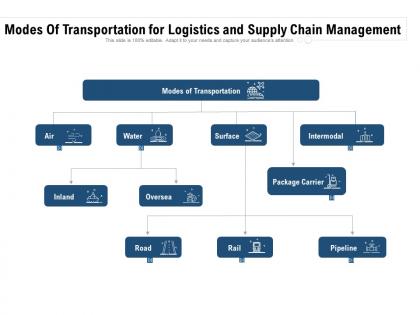
Modes of transportation for logistics and supply chain management




Try Before you Buy Download Free Sample Product
 Impress Your
 Audience
 100%
100% Editable
 Save Hours
 of Time


Our Modes Of Transportation For Logistics And Supply Chain Management are explicit and effective. They combine clarity and concise expression.
People who downloaded this PowerPoint presentation also viewed the following :
Modes of transportation for logistics and supply chain management with all 2 slides:
Give your audience a fulfilling experience. They will find our Modes Of Transportation For Logistics And Supply Chain Management elevating.
FAQs for Modes of transportation for logistics and
EVs are everywhere now, obviously. But micro-mobility is blowing up too - all those e-scooters and bike shares in cities. Heavy transport is going hydrogen, which makes sense for long hauls. Autonomous cars keep getting delayed though, typical tech promises lol. Smart traffic systems are actually pretty cool, using AI to cut emissions and optimize routes. Public transit's finally getting decent with electric buses and better connections. Honestly? If your company wants in, charging infrastructure is the goldmine right now. Everyone's buying EVs but good luck finding a charger half the time.
Dude, the transit apps are game-changers - you can actually see when your bus is coming instead of just standing there like an idiot. Most cities have contactless payment now too, so you just tap your phone. The AI stuff is pretty wild actually, they're using data to predict when more people will need buses and adjust routes in real-time. Oh and they're testing electric buses everywhere, which is cool I guess. Honestly though, just download your city's app if you don't have it yet. The real-time tracking alone will save you so much waiting around - I wish I'd done it sooner.
Here's my take: EVs are definitely cleaner than gas cars, mainly because no tailpipe emissions. Yeah, making the batteries isn't great for the environment, but over the car's whole life you're still way ahead. The cool part is your car literally gets greener as more solar and wind power hits the grid - which is happening fast these days. Even if you live somewhere that burns a lot of coal, electric usually wins on emissions. I'd check what your local power company uses and see where you could charge it. Honestly, the math works out pretty well for most people.
Dude, so bike-share stations and e-scooters are huge for this. Also those little shuttle buses that run between train stations and neighborhoods. The quarter-mile rule is pretty solid - people won't walk much further than that, let's be real. Those apps that combine everything are honestly a lifesaver, way better than juggling like 5 different transit apps. I'd probably start with the busiest areas first since you'll actually see people using it. Oh, and definitely map out where the worst gaps are before doing anything else. Makes way more sense than just throwing stuff everywhere and hoping it works.
So basically, transportation projects are solid investments. Short-term you get construction jobs, long-term your whole area becomes way more business-friendly. Companies actually want to move somewhere with decent roads and transit - makes sense, right? Property values go up too, which means more tax money coming in. Oh and the cost savings for local businesses are huge once everything's built. If you're looking at specific projects, go for the ones that fix your worst traffic nightmares first. Those usually pay off the fastest.
Dude, autonomous cars are gonna completely change how we get around cities. Fewer people will own cars since ride-sharing becomes dirt cheap and seamless. Traffic actually flows better because these cars talk to each other and find optimal routes. Even buses get smarter - they'll adjust routes based on where people actually need to go. Here's the cool part: your commute becomes productive time since you're not stuck behind the wheel. Parking downtown might basically disappear, which is wild to think about. Oh, and maybe start factoring this into your transportation budget planning - this stuff's happening faster than most people realize.
Honestly, the timing thing is a total mess - buses, trains, rideshares all doing their own thing with zero coordination. Makes connecting between them such a pain. Then you've got payment systems that are completely separate, so you're juggling like three different apps just to get across town. Infrastructure's another headache since bike lanes don't actually connect to transit stops half the time. Oh, and don't get me started on parking integration at stations. Best bet is probably fixing the digital stuff first - shared platforms, unified payment. Way easier than ripping up streets to redo all the physical connections.
Yeah, cultural attitudes totally drive how people move around. Europeans are super into public transit - they're cool with sharing space and care about the environment. Americans? Cars equal freedom and status, no question. Asian cities though, they've figured out that good mass transit is just smart and modern. It's wild how some places see bikes as normal transportation while others think it's just for weekend rides. Oh and here's the thing - if you're doing any transport planning, you gotta get the cultural stuff first. Infrastructure's only half the battle. People won't use what doesn't fit their values.
Honestly, ride-sharing is kinda weird with public transit - sometimes it helps, sometimes it doesn't. Like, Uber definitely steals riders from buses, especially for quick trips or when the transit sucks anyway. But it's also getting people to subway stations they couldn't walk to before, which is pretty useful. Some cities are losing riders overall while others figured out how to make both work together. Oh, and if this is for a project or something, I'd probably look at what your local transit people are actually doing about it instead of just complaining.
Dude, transportation stuff really does mess with air quality. Cities that build better public transit and bike lanes? Their air gets cleaner fast - like 20-30% less pollution in some areas. All those car fumes with particulates and nitrogen oxides are what make people's asthma worse. Electric buses help too, though they're still kinda pricey to roll out everywhere. Kids and older people especially benefit when there's less smog around. Fewer people end up in the ER for breathing problems. If you're trying to convince local politicians, honestly just show them the healthcare savings - that's what gets their attention.
So the biggest stuff happening right now? Autonomous trucks are getting crazy good - Tesla and Waymo have semis that could literally drive all day without stopping for breaks. Route optimization with AI is huge too, plus drones handling those final deliveries to your door. Smart warehouses are using robots and predictive tech to handle everything smoother. Oh, and electric trucks are picking up steam, especially in cities where everyone's freaking out about emissions. Honestly, if you're working in logistics, you should probably start paying attention to this stuff because it's changing how much things cost and how fast people expect their packages.
So basically your city needs sensors everywhere tracking how traffic actually moves, then AI adjusts the lights in real time instead of those ancient timers. The cool part? It predicts jams before they happen. When there's an accident or whatever, the whole system reroutes people automatically. You'll want everything connected - buses, parking, the works. Otherwise you're just throwing money at separate systems that don't talk to each other (which honestly most cities do anyway). I'd say pick your worst intersection first and test it there.
Dude, transportation is huge for rural areas. Roads and rail basically unlock everything - farmers can actually get their crops to market, people can commute to decent jobs, businesses can move stuff around. It's wild how one good highway can completely change an area's prospects. New companies will actually consider setting up shop when they know logistics won't be a nightmare. Oh, and if you're ever working on development stuff out there? Hit transportation first. Seriously, nothing else works without it. Everything builds from there - jobs, growth, the whole deal.
Honestly, extreme weather is like that friend who always shows up unannounced - you gotta be ready. Build backup routes into everything because your main roads will get flooded or iced over. Use materials that can actually handle the beating nature dishes out. Your drainage needs to be way more robust than what seems logical right now. Heat waves, storms, snow - they each break stuff differently. I'd start by figuring out what disasters hit your area most often, then beef up those weak spots first. Don't design for average weather anymore; that ship has sailed.
So you'll want to cover the basics first - ramps, elevators, wheelchair-accessible spaces. Audio announcements help visually impaired folks, visual displays work for people with hearing issues. Clear signage is huge too, like way more important than people think. Cognitive accessibility matters just as much - simple layouts that actually make sense. Honestly though? Skip the design manuals and just talk to people from different disability communities. Their real feedback will tell you what's actually working versus what looks good on paper. Universal design covers most stuff, but user testing is where you'll find the gaps.
No Reviews