


Supply chain management goals ppt slides diagrams




Try Before you Buy Download Free Sample Product
 Impress Your
 Audience
 100%
100% Editable
 Save Hours
 of Time


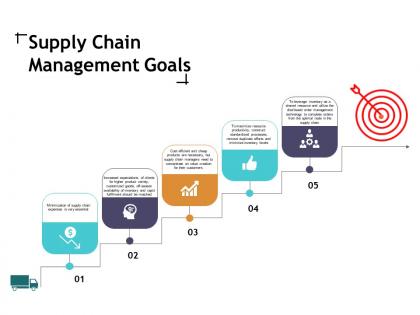
Go to giddy heights with our Supply Chain Management Goals Ppt Slides Diagrams. Your ascent will be beyond imagination.
People who downloaded this PowerPoint presentation also viewed the following :
Supply chain management goals ppt slides diagrams with all 5 slides:
Draw in the disinterested with our Supply Chain Management Goals Ppt Slides Diagrams. Curiosity about your ideas will begin to grow.




FAQs for Supply chain management goals
The primary objectives of effective supply chain management include cost reduction, enhanced customer satisfaction, improved operational efficiency, risk mitigation, and sustainable practices. These strategic goals enable organizations to streamline procurement processes, accelerate delivery times, and maintain competitive advantage, with many companies finding that integrated supply chain approaches ultimately deliver stronger profit margins and market responsiveness.
Companies measure supply chain success through key performance indicators including cost reduction, delivery performance, inventory turnover, customer satisfaction scores, and supplier reliability metrics. These measurements enable organizations to identify bottlenecks, optimize resource allocation, and enhance operational efficiency, with many manufacturing and retail companies finding that comprehensive tracking ultimately delivers competitive advantage and improved profitability.
Technology serves as the backbone for achieving supply chain management goals by enabling real-time visibility, automating processes, and optimizing resource allocation across operations. Through AI-powered analytics and IoT sensors, organizations streamline inventory management, enhance demand forecasting, and minimize operational costs, with manufacturers and retailers finding that these digital solutions ultimately deliver faster response times and significant competitive advantages.
Sustainability initiatives enhance supply chain management objectives by reducing environmental impact, improving resource efficiency, and meeting consumer demand for responsible practices. These programs streamline operations through waste reduction, energy optimization, and circular economy principles, with companies like Unilever and Nike finding that sustainable practices ultimately deliver cost savings, brand differentiation, and competitive advantage.
Key supply chain performance metrics include inventory turnover, order fulfillment accuracy, delivery performance, cost per unit, and supplier reliability scores. These indicators enable organizations to streamline operations, reduce costs, and enhance customer satisfaction, with manufacturing and retail companies finding that tracking these metrics simultaneously delivers improved efficiency, better resource allocation, and significant competitive advantage.
Collaboration among stakeholders enhances supply chain efficiency by improving information sharing, coordinating planning activities, and aligning objectives across partners. Through integrated communication platforms and shared forecasting systems, manufacturers, suppliers, and distributors streamline operations, reduce inventory costs, and accelerate delivery times, ultimately delivering enhanced customer satisfaction and competitive advantage.
Companies face challenges including inconsistent communication between departments, conflicting short-term operational pressures versus long-term strategic objectives, lack of integrated data systems, and difficulty measuring cross-functional performance metrics. These alignment gaps often result in inefficient resource allocation, missed market opportunities, and reduced competitive advantage, with many organizations finding that establishing clear governance frameworks and shared KPIs significantly improves strategic coordination.
Risk management is critically important in supply chain goals, serving as the foundation for operational continuity, cost control, and competitive advantage. Through diversified supplier networks, scenario planning, and real-time monitoring systems, organizations can mitigate disruptions while maintaining service levels, with many companies finding that proactive risk strategies ultimately deliver greater resilience and customer satisfaction.
Organizations can implement demand forecasting analytics, just-in-time delivery systems, automated reordering protocols, supplier collaboration platforms, and real-time inventory tracking technologies to optimize stock levels. These methods streamline operations by reducing carrying costs, minimizing stockouts, and enhancing supply chain visibility, with many retailers and manufacturers finding that strategic inventory optimization ultimately delivers improved cash flow and customer satisfaction.
Supply chain transparency enhances strategic goals by enabling better risk management, regulatory compliance, and stakeholder trust through real-time visibility and data sharing. Through advanced tracking technologies, organizations streamline operations, reduce costs, and improve customer satisfaction, while many companies find that transparent supply chains deliver competitive advantages and support sustainability initiatives in increasingly complex global markets.
Globalization requires supply chain objectives to emphasize flexibility, risk diversification, and cross-cultural coordination while managing extended lead times, regulatory complexities, and currency fluctuations. Organizations increasingly focus on building resilient networks that balance cost efficiency with supply security, with many manufacturers finding that strategic regional partnerships and digital visibility platforms ultimately deliver competitive advantage in volatile international markets.
Customer feedback influences supply chain decisions by revealing demand patterns, quality issues, delivery preferences, and service gaps that drive strategic adjustments. Companies leverage this input to optimize inventory levels, enhance supplier performance, streamline logistics routes, and improve product offerings, with retailers and manufacturers finding that customer-driven insights ultimately deliver faster response times and competitive advantage.
Data analytics enhances supply chain performance by optimizing inventory levels, predicting demand patterns, identifying bottlenecks, and improving supplier relationships through real-time visibility. Through predictive modeling and automated insights, companies streamline operations, reduce costs, and accelerate delivery times, with many manufacturers finding that data-driven approaches ultimately deliver competitive advantage and improved customer satisfaction.
Supply chain agility strategies include demand forecasting technologies, flexible supplier networks, real-time inventory tracking, scenario planning systems, and cross-functional collaboration platforms. These approaches streamline operations by enabling rapid response to market changes, minimizing disruptions, and optimizing resource allocation, with many organizations finding that strategic diversification and digital integration ultimately deliver competitive advantage and enhanced customer satisfaction.
Regulatory changes significantly reshape supply chain management goals by requiring enhanced compliance monitoring, transparency reporting, and risk mitigation strategies across global operations. These evolving requirements compel organizations to prioritize traceability, sustainability metrics, and vendor verification processes, with many companies finding that proactive regulatory alignment ultimately delivers competitive advantage and operational resilience.
No Reviews