


Supply chain management cycle powerpoint slide show




Try Before you Buy Download Free Sample Product
 Impress Your
 Audience
 100%
100% Editable
 Save Hours
 of Time


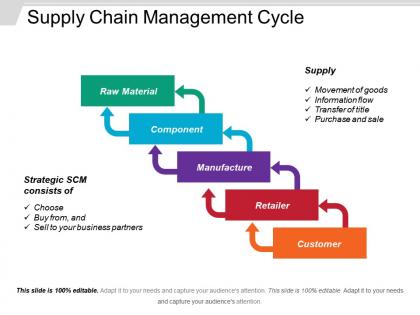
The supply chain management process PPT template aims at maximizing the customer value along with that maintaining a sustainable competitive advantage. Use this template to guide the team on how to handle the material at the pre-production level. Similarly, you may also need to describe managing work-in-process inventory along with the finished products, so you can take the help of the supply chain management process presentation template diagram. This professionally designed supply chain management cycle PowerPoint slide makes the task easier for the user because this slide enables him to illustrate the nitty-gritty of supply chain management in an effective and easy way. A presenter can highlight integration of the processes for collaboration of customer relationship or make his team understand about demand-planning through this supply chain example presentation slideshow.
People who downloaded this PowerPoint presentation also viewed the following :
Supply chain management cycle powerpoint slide show with all 5 slides:
Beat every deadline with our Supply Chain Management Cycle Powerpoint Slide Show. Get yourself ahead of the clock.




FAQs for Supply chain management cycle
So you'll need demand forecasting, supplier relationships, inventory optimization, and logistics coordination. Most companies screw this up because they run these like totally separate departments instead of one system. Risk management and performance tracking matter too - gotta know if things are actually working. Here's the thing though: magic happens when procurement talks to logistics, who talks to demand planning. It's all connected, which sounds obvious but apparently isn't? Start by mapping your whole process end-to-end. Then find where info gets stuck between teams.
Honestly, supply chain issues are brutal - they mess up everything at once. Your deliveries get delayed, costs shoot up, and customers get pissed and bail for competitors. Can't fulfill orders? There goes your revenue. Teams end up scrambling around trying to find backup suppliers or different shipping routes, which is honestly exhausting to watch. The worst part is you're stuck paying crazy fees for rush shipping while probably losing sales anyway. My advice? Stock up on critical stuff beforehand and have backup suppliers lined up. Trust me, you don't want to be figuring this out mid-crisis.
Dude, you literally can't survive without tech in supply chains anymore. ERP systems show you inventory in real-time, AI predicts demand patterns, and IoT sensors track shipments - temperature, location, all that stuff. The data processing capabilities now vs like 2019? Night and day difference. Analytics catch bottlenecks early while automation handles the boring repetitive work. Oh, and start by looking at whatever manual tasks are killing your team's productivity - that's usually where you'll get the biggest bang for your buck with upgrades.
Data analytics is honestly a game-changer for this stuff. You can track bottlenecks, predict when demand's gonna spike, and keep inventory levels actually useful instead of just guessing. It pulls info from suppliers, warehouses, even weird things like weather that might mess up shipments. You'll see which routes always suck, which vendors are chronically late, and what products are just sitting around being expensive paperweights. Start small though - pick your 3 biggest headaches and build simple dashboards around those. Then expand once you get the hang of it. Basic trend tracking alone can save you serious money on storage costs and those nightmare "we're out of stock" moments.
Honestly, you're probably wrestling with three main headaches right now. Disruptions are the worst - geopolitical stuff and natural disasters can kill your key routes instantly. Then there's the visibility problem where you can't see what's going down with suppliers way down the chain. Labor shortages are absolutely brutal too, especially for drivers and warehouse folks. Oh, and don't get me started on customers wanting everything faster while also demanding you go green. My advice? Get some decent supply chain mapping tools and start building relationships with backup suppliers now. Trust me, you don't want to be scrambling for alternatives when everything hits the fan.
Honestly, start by mapping out your whole supply chain - you need to see where the risks are hiding. Getting info on your suppliers' suppliers is a total nightmare though, like trying to peek behind three curtains at once. Set clear sustainability rules and audit your main vendors regularly. Don't just go for whoever's cheapest - partner with companies that actually care about the same stuff you do. Try some circular practices too, cut waste and design things so they can be recycled later. Track your carbon footprint and labor stuff, then use that data to decide who stays and who gets the boot.
Honestly, your suppliers can make or break you. If they screw up, you're stuck dealing with angry customers and missed deadlines - COVID taught everyone that lesson the hard way. Good relationships get you priority when things go sideways. They'll actually pick up the phone when you need help, give you heads up on potential problems, and usually cut you better deals too. Plus you can brainstorm solutions together instead of just being another order number. I'd start with your most important suppliers and actually talk to them regularly, not just when you need something.
Look, inventory management is basically what keeps your whole supply chain from falling apart. You want enough stock to meet demand without drowning in excess products that just sit there burning cash. Honestly, it sounds super straightforward until you actually try doing it - there's way more variables than you'd think. Stockouts piss off customers, but overstock kills your margins. The trick is nailing your demand forecasting and setting up those automatic reorder triggers. That way you're not constantly scrambling to put out fires every week.
Don't put all your eggs in one basket with forecasting - mix different approaches. Historical sales data is your foundation, but add market trends, promo schedules, and economic stuff on top. Get your sales and marketing teams involved too since they hear things from customers that won't show up in spreadsheets. Machine learning is cool for finding hidden patterns, though honestly if you're new to this, start simple first. Oh, and track how accurate your forecasts actually are. That's how you figure out what's working and what needs tweaking for your specific situation.
Start by mapping your whole supply chain to spot weak points - single suppliers, risky locations, sketchy transport routes. COVID taught me the hard way that cheap isn't always smart when everything falls apart. Diversify your suppliers even if it costs more upfront. Stock extra inventory for critical stuff. Have backup plans for different disaster scenarios. Oh, and actually test these plans regularly - I can't tell you how many companies have "plans" that exist only on paper. Your supply chain changes constantly, so your backup strategies should too.
Yeah, geopolitical stuff can totally wreck your supply chain. Tariffs hit, sanctions drop, borders close - suddenly your main supplier becomes crazy expensive or off-limits entirely. Look at the whole China-US trade mess or what happened with Russia. You've gotta map out where your suppliers are and spot the risky regions. Then line up backup options in more stable areas before things go sideways. Honestly, most companies wait until it's too late and then panic. Building that flexibility upfront saves you from scrambling when some political drama inevitably explodes.
Dude, e-commerce is totally reshaping how supply chains work. Companies are ditching the old warehouse-to-store setup for direct shipping to customers instead. Now everyone expects same-day delivery because Amazon spoiled us all lol. Distribution centers are popping up everywhere to get closer to customers. Inventory tracking has to be way more precise since online demand is all over the place. Oh, and returns? That's become a massive headache since people return stuff so easily online. Your supply chain needs to be fast and flexible or you're screwed.
JIT cuts your inventory costs big time - you only order what you actually need. Cash flow gets way better since money isn't stuck in random stock. Quality control improves too because you catch problems faster with smaller batches. Honestly though, your suppliers better be reliable. I've watched companies freak out over tiny delays. Demand forecasting has to be spot-on or you're screwed. But when it works? Storage costs drop and you can pivot quickly. My advice - test it on just one product first, see how messy it gets.
So AI can totally automate your demand forecasting and help optimize inventory - it's wild how accurate it gets. The algorithms crunch historical data plus outside stuff like weather patterns and market shifts to make way smarter buying decisions. Plus you get better visibility into supplier risks and routing. Honestly, the real-time supply chain tracking alone is worth it. My advice? Don't try to do everything at once though. Pick one headache area first - maybe demand planning - and nail that before expanding. Once you see those results, you'll be hooked.
Your customers are basically free consultants telling you exactly where your supply chain sucks. They feel the problems first - late deliveries, busted packages, empty shelves. Way more honest than your internal reports, honestly. Map their complaints back to specific suppliers or shipping partners. If everyone's bitching about slow delivery from your west coast warehouse, there's your answer. You can actually prioritize fixes based on what pisses people off most. Better than guessing which vendor to drop or where you need more inventory sitting around.
-
Good research work and creative work done on every template.
-
Enough space for editing and adding your own content.