

Demand Management Planning Process In Supply Chain Management




Try Before you Buy Download Free Sample Product
 Impress Your
Audience
 100%
Editable
 Save Hours
of Time


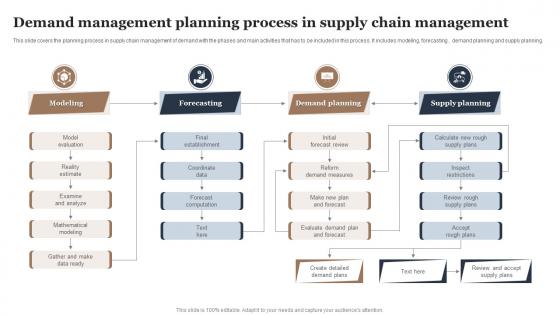
This slide covers the planning process in supply chain management of demand with the phases and main activities that has to be included in this process. It includes modeling, forecasting, demand planning and supply planning.
People who downloaded this PowerPoint presentation also viewed the following :
Demand Management Planning Process In Supply Chain Management with all 6 slides:
Use our Demand Management Planning Process In Supply Chain Management to effectively help you save your valuable time. They are readymade to fit into any presentation structure.






FAQs for Demand Management Planning Process In
Key principles of demand management include demand forecasting, customer segmentation, collaborative planning, demand sensing, and inventory optimization. These approaches streamline supply chain operations by reducing stockouts, minimizing excess inventory, and enhancing customer service levels, with many manufacturing and retail organizations finding that strategic demand management ultimately delivers cost savings and competitive advantage.
Demand forecasting directly influences inventory levels by enabling organizations to optimize stock quantities, reduce carrying costs, and minimize stockouts through predictive analytics and historical data analysis. Accurate forecasting streamlines service delivery by ensuring adequate resource allocation, faster order fulfillment, and improved customer satisfaction, with many retail and manufacturing companies finding that strategic forecasting ultimately delivers competitive advantage and operational efficiency.
Data analytics enhances demand management by providing predictive insights, identifying consumption patterns, optimizing inventory levels, and enabling real-time demand forecasting through historical data analysis. These capabilities streamline resource allocation and minimize waste, with many retail and manufacturing organizations finding that analytics-driven approaches deliver significantly improved operational efficiency and competitive advantage.
Organizations balance demand and supply in volatile markets through flexible forecasting models, diversified supplier networks, adaptive inventory strategies, and real-time demand sensing technologies. These approaches enable companies to respond quickly to market fluctuations, minimize excess inventory costs, and maintain service levels, with many retailers and manufacturers finding that strategic buffer management and collaborative planning ultimately deliver competitive advantage in unpredictable environments.
Demand forecasting accuracy improves through historical data analysis, statistical modeling, machine learning algorithms, market research integration, and collaborative planning with suppliers and customers. These techniques enable organizations to reduce inventory costs, minimize stockouts, and enhance customer satisfaction, with many retail and manufacturing companies finding that combining multiple forecasting methods delivers significantly better predictions than relying on single approaches.
Consumer trends and behaviors significantly impact demand management strategies by influencing purchasing patterns, seasonal fluctuations, and product preferences across different market segments. Companies increasingly leverage data analytics, social media insights, and behavioral tracking to anticipate shifts in consumer demand, enabling more accurate forecasting, optimized inventory levels, and strategic pricing adjustments that ultimately enhance customer satisfaction while minimizing costs.
Poor demand management risks include inventory shortages, excess stock accumulation, customer dissatisfaction, operational inefficiencies, and financial losses through misallocated resources. These challenges particularly impact retail, manufacturing, and logistics sectors, where companies experience disrupted supply chains, increased carrying costs, and diminished customer loyalty, ultimately undermining competitive advantage and profitability in increasingly dynamic markets.
Collaborative planning enhances demand management by enabling real-time information sharing, synchronized forecasting, and joint decision-making across supply chain partners. Through integrated platforms and shared analytics, manufacturers, suppliers, and retailers align production schedules, inventory levels, and promotional activities, ultimately reducing stockouts, minimizing excess inventory, and delivering improved customer satisfaction while strengthening partnerships.
Essential demand management technology tools include demand planning software, customer relationship management (CRM) systems, enterprise resource planning (ERP) platforms, advanced analytics tools, and automated forecasting systems. These technologies streamline operations by enhancing forecast accuracy, optimizing inventory levels, and improving customer responsiveness, with many organizations finding that strategic integration ultimately delivers reduced costs and competitive advantage.
Seasonality significantly impacts demand planning by creating predictable fluctuations that require strategic inventory management, adjusted production schedules, and flexible resource allocation. Retailers, hospitality businesses, and agricultural companies leverage historical seasonal data to optimize stock levels, staffing patterns, and supply chain operations, ultimately enabling better customer service while minimizing excess inventory costs and stockouts.
Organizations can implement markdown pricing strategies, alternative sales channels, inventory liquidation partnerships, supplier return agreements, and cross-functional demand planning teams to address excess inventory. These approaches help minimize financial losses through strategic discounting, online marketplace expansion, and B2B liquidation networks, while enhanced forecasting collaboration between sales, marketing, and operations teams ultimately delivers improved demand accuracy and reduced future overstocking risks.
Demand management contributes to sustainable practices by optimizing resource allocation, reducing waste through accurate forecasting, minimizing overproduction, and streamlining supply chain operations. By aligning production with actual demand patterns, organizations across manufacturing, retail, and consumer goods sectors ultimately deliver reduced environmental impact, lower operational costs, and enhanced resource efficiency while maintaining competitive advantage.
Organizations can leverage customer feedback through surveys, purchase pattern analysis, social media monitoring, and direct communication channels to identify demand trends and preferences. This feedback enables companies to adjust forecasting models, optimize inventory levels, and enhance product offerings, while many retail and manufacturing businesses find that customer-driven insights significantly improve demand accuracy and reduce stockouts.
Short-term demand management strategies focus on immediate adjustments like promotional pricing, inventory redistribution, and tactical resource allocation to address current market fluctuations. Long-term strategies emphasize capacity planning, supplier relationship development, and strategic forecasting models, with many organizations finding that combining both approaches delivers enhanced operational efficiency, reduced costs, and sustained competitive advantage across volatile market conditions.
Demand management adapts to supply chain disruptions through flexible forecasting models, diversified supplier networks, buffer inventory strategies, and real-time demand sensing technologies. Organizations increasingly leverage predictive analytics and scenario planning to anticipate shortages, while implementing dynamic pricing and product substitution strategies, ultimately maintaining customer satisfaction and operational resilience during volatile periods.
-
“Ample and amazing variety of templates available, really helpful for making professional PPT for day to day workings.”
-
Requested a complete pitch deck. Delivered immediately and with high quality well researched content.