

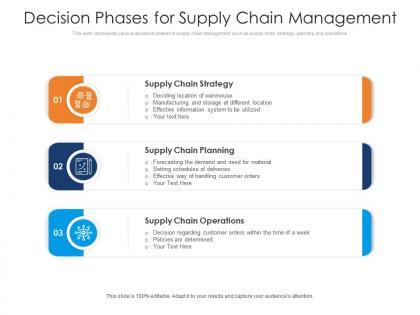
Decision phases for supply chain management




Try Before you Buy Download Free Sample Product
 Impress Your
 Audience
 100%
100% Editable
 Save Hours
 of Time


This slide represents various decisions phases in supply chain management such as supply chain strategy, planning and operations
People who downloaded this PowerPoint presentation also viewed the following :
Decision phases for supply chain management with all 2 slides:
Use our Decision Phases For Supply Chain Management to effectively help you save your valuable time. They are readymade to fit into any presentation structure.
FAQs for Decision phases for
So you've got five main phases to think about - planning, sourcing, manufacturing, delivery, and returns. Planning means forecasting demand (which is honestly harder than it sounds). Then you figure out suppliers and sourcing strategy. Manufacturing's pretty obvious. After that comes logistics to get stuff to customers. Returns is the phase everyone forgets about, but it'll bite you if you ignore it. The whole thing's connected though - you can't just fix one part and call it good. I'd start by mapping what you're doing now and see where things are breaking down.
Honestly, demand forecasting is what makes or breaks your entire supply chain. Get it wrong and you're either drowning in inventory costs or disappointing customers because you can't fill orders fast enough. Both scenarios suck, trust me. Your forecast dictates everything - procurement schedules, production ramps, where you store stuff, even how many people you need working. I've seen companies tank their cash flow over bad forecasts. My advice? Use the cleanest data possible but always plan for when things go sideways, because they will.
Honestly, tech makes supply chain decisions so much faster because you get real-time data instead of guessing. AI helps you predict demand better, IoT sensors track your inventory automatically, and dashboards show what's happening everywhere at once. Your whole team can access the same info through cloud platforms - no more waiting for Dave to send that ancient Excel file! Though seriously, pick tools that actually work with your current systems. You don't want to create more headaches by having data scattered everywhere.
Build flexibility right from the start - map out different "what-if" scenarios so you're not caught off guard. Keep buffer stock for your most critical stuff. Don't put all your eggs in one supplier basket either. Rolling forecasts work way better than those rigid yearly plans (learned that one the hard way). Nobody can predict everything, despite what some fancy consultants might tell you. Better to focus on building systems that can actually respond when stuff hits the fan. Figure out your biggest risk points first, then create backup plans for each. Even simple alternatives can be lifesavers when everything goes sideways.
Honestly, weighted scorecards are your best friend here - cost, quality, delivery times, financial health, all that stuff. RFPs let you compare suppliers fairly, but definitely do site visits too. You'll catch things that look fine on paper but are actually a mess. For complicated decisions with lots of people involved, try analytical hierarchy process (AHP) - sounds fancy but it works. Oh, and look at total cost of ownership, not just the sticker price. That'll save you headaches later. Set up your evaluation matrix before you start so you're not scrambling when everything's due tomorrow.
So inventory is basically the heart of your whole supply chain - get it right and everything flows smoothly. Too little stock? You're constantly scrambling to fill orders (super stressful). Too much? Your cash is just sitting there collecting dust. The trick is finding that sweet spot where you've got just enough to meet demand without drowning in excess. I'd start by looking at your demand patterns and lead times - honestly, most people skip this step and wonder why they're always stressed about stock levels. When you nail it though, customers stay happy and your whole operation runs way smoother.
Track different metrics based on what you're trying to figure out. Strategic stuff? ROI, total ownership costs, supplier scores. Planning phase needs inventory turnover and forecast accuracy - honestly capacity utilization is huge here too. Operations is more fun though - fulfillment times, defects, delivery performance. Don't try tracking everything at once, you'll go crazy. Pick 3-4 metrics that actually match your timeframe. Figure out which phase your problem sits in first, then choose from there. Way easier than drowning in data you don't need.
Honestly, the biggest win with collaboration is just getting everyone on the same page earlier. Your suppliers know stuff you don't - like when raw materials are about to get scarce. Same with distributors seeing demand shifts first. When teams actually communicate regularly instead of working in silos, you catch issues before they blow up. I'd start with your most important suppliers and set up regular check-ins, maybe some shared dashboards. Nothing fancy at first. The companies I've worked with that nail this save crazy amounts of money because they're not constantly firefighting. It's really about building those relationships so info flows both ways naturally.
Honestly, logistics is where everything gets messy fast. Capacity issues will hit you first - not enough trucks, not enough warehouse space, drivers quitting left and right. Costs keep climbing while customers still want same-day delivery (good luck with that). You'll spend forever trying to figure out inventory placement without either running out of stock or drowning in safety inventory. Oh, and route planning? Total headache with gas prices these days. My biggest tip: always have backup carriers lined up because your main guy will definitely bail when you need them most. Build in extra time for literally everything.
So basically, sustainability throws a wrench into your normal cost-speed-quality juggling act. Now you're checking suppliers' carbon footprints and whether they treat workers decently, not just their prices. Green materials cost more, which sucks for budgets. Manufacturing has to think about energy use and waste. Even shipping changes - rail might beat trucks even though it's slower. Honestly, the trick is just baking these green metrics into whatever decision process you already use instead of making it this separate thing you worry about later.
Start with a basic risk matrix - it's dead simple but works. Scenario planning tools are clutch for testing "what-if" situations. SWOT analysis sounds boring but honestly catches stuff you'd miss otherwise. Real-time dashboards with KPIs will save your sanity for daily decisions. Supply chain mapping software helps visualize everything (I always forget how connected things are until I see it mapped out). Predictive analytics can spot trouble before it hits, though that's more advanced. Build your toolkit gradually - don't try to implement everything at once or you'll overwhelm yourself.
Honestly, you gotta connect your supply chain moves directly to what your company's trying to achieve. Growth mode? Then focus procurement on stuff that scales, not just cheap prices. Set up KPIs that actually tie your day-to-day choices to business results. Cross-functional reviews are clutch here - get your supply chain folks talking regularly with the strategy team. I've watched so many companies mess this up by working in silos (it's painful to see). Before any big supply chain decision, just ask yourself: does this actually help us get where we're going? Simple check, huge impact.
Ugh, globalization makes supply chain stuff so much more complicated. You're juggling different countries, currencies, all these random regulations. Design gets messy because you have to think about global sourcing and what people actually want in different markets. Planning? Forget about it - lead times are forever and coordinating across time zones is honestly the worst. But you do get access to cheaper materials and labor worldwide, which is nice I guess. Operations become this whole thing where you're dealing with different quality standards and cultural differences. My advice? Build in flexibility so you can adapt when things inevitably change or new opportunities pop up.
Look, procurement isn't just about finding the cheapest option anymore. You've got to dig into whether suppliers treat workers fairly, follow environmental rules, that whole thing. Yeah, it makes everything more complicated than it used to be. Sometimes you'll pay extra for materials that are sourced ethically - or you might have to ditch suppliers who can't meet your standards. Short sentences help here. Build your ethical requirements right into the RFP from day one, don't try to tack them on later. Price and delivery times still matter, but now you're also weighing stuff like safe working conditions and sustainable practices.
Honestly, don't wait for some big quarterly overhaul - just bake improvement into what you're already doing. Track your metrics regularly and actually ask everyone for feedback (suppliers, customers, your own team). Here's the thing that drives me crazy though: most people collect all this data and then just... ignore it? Set up quick review sessions where you look at how decisions played out. Get your team comfortable calling out problems as they happen instead of staying quiet until the next formal meeting. My advice? Pick one process this month, measure it, adjust something small, and see what changes.
-
Graphics are very appealing to eyes.
-
Out of the box and creative design.
-
It saves your time and decrease your efforts in half.
-
Out of the box and creative design.
-
Informative design.