


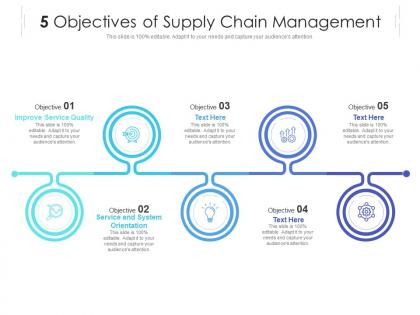
5 objectives of supply chain management




Try Before you Buy Download Free Sample Product
 Impress Your
 Audience
 100%
100% Editable
 Save Hours
 of Time


Our 5 Objectives Of Supply Chain Management are topically designed to provide an attractive backdrop to any subject. Use them to look like a presentation pro.
People who downloaded this PowerPoint presentation also viewed the following :
5 objectives of supply chain management with all 2 slides:
Use our 5 Objectives Of Supply Chain Management to effectively help you save your valuable time. They are readymade to fit into any presentation structure.
FAQs for 5 objectives of
The key objectives of effective supply chain management include cost reduction, inventory optimization, demand forecasting accuracy, supplier relationship management, and customer satisfaction enhancement. These objectives work synergistically by streamlining operations, minimizing waste, and improving transparency across the entire supply chain, with many organizations finding that strategic integration ultimately delivers competitive advantage and operational efficiency.
Cost reduction drives supply chain management by optimizing procurement processes, minimizing inventory holding costs, and streamlining transportation networks. Through strategic supplier partnerships and demand forecasting technologies, organizations eliminate waste, negotiate better terms, and reduce operational expenses, while improving delivery times and service quality, ultimately delivering competitive pricing advantages and enhanced profit margins.
Supply chain management enhances customer satisfaction by ensuring faster delivery times, maintaining consistent product availability, improving order accuracy, and enabling real-time shipment tracking. Through strategic inventory management and streamlined logistics, companies like Amazon and Walmart deliver reliable customer experiences while reducing costs, with many retailers finding that optimized supply chains ultimately create competitive advantages through superior service quality.
Inventory optimization enhances supply chain objectives by reducing carrying costs, minimizing stockouts, and improving cash flow through strategic demand forecasting and automated reordering systems. This approach enables organizations across retail, manufacturing, and healthcare sectors to achieve better service levels while reducing working capital requirements, ultimately delivering improved customer satisfaction and competitive operational efficiency.
Technology significantly accelerates supply chain objective achievement by automating processes, enhancing visibility, and optimizing resource allocation across operations. Through AI-powered analytics and IoT sensors, organizations streamline inventory management, reduce costs, and improve delivery accuracy, with manufacturing and retail sectors finding that these digital solutions ultimately deliver competitive advantage and superior customer experiences.
Sustainability goals integrate into supply chain management objectives through environmental impact reduction, ethical sourcing practices, waste minimization, and circular economy principles. Companies like Unilever and Patagonia demonstrate how sustainable procurement, carbon footprint tracking, and supplier responsibility standards enhance brand reputation while reducing operational costs, ultimately delivering competitive advantage in an increasingly environmentally-conscious marketplace.
Risk management serves as a critical foundation in supply chain management by identifying potential disruptions, developing contingency plans, and building resilient operational networks that can adapt to unexpected challenges. Through proactive risk assessment and mitigation strategies, organizations streamline operations while protecting against supply shortages, quality issues, and delivery delays, with many companies finding that comprehensive risk management ultimately delivers competitive advantage and enhanced customer satisfaction.
Supplier collaboration significantly enhances supply chain objectives by improving demand forecasting accuracy, reducing lead times, and enabling shared innovation initiatives. Through integrated planning systems and transparent communication channels, organizations achieve greater cost efficiency, enhanced product quality, and accelerated time-to-market, with many manufacturers finding that strategic supplier partnerships deliver sustainable competitive advantages.
Agility strategies include demand sensing technologies, flexible supplier networks, cross-docking facilities, real-time inventory management, and modular product designs. These approaches enable organizations to respond rapidly to market changes, optimize resource allocation, and minimize disruption impacts, with many manufacturers and retailers finding that strategic combination of digital tools and partnership flexibility ultimately delivers competitive advantage in increasingly volatile markets.
Supply chain objectives align with business goals by enhancing operational efficiency, reducing costs, and improving customer satisfaction through streamlined processes and strategic resource allocation. This strategic combination enables organizations to achieve competitive advantage, faster delivery times, and better market responsiveness, with many companies finding that integrated supply chain management ultimately delivers sustained profitability and growth.
Essential supply chain metrics include inventory turnover, order fulfillment accuracy, delivery performance, cost per transaction, and supplier reliability scores. These measurements enable organizations to optimize operational efficiency, reduce carrying costs, and enhance customer satisfaction, with many manufacturing and retail companies finding that comprehensive metric tracking delivers competitive advantage and strategic supply chain optimization.
Supply chain management objectives vary significantly between industries based on specific operational priorities, customer demands, and regulatory requirements. Manufacturing focuses on cost reduction and efficiency, healthcare emphasizes compliance and product safety, retail prioritizes inventory turnover and customer satisfaction, while technology sectors concentrate on innovation speed and flexibility, with each industry finding that tailored objectives deliver optimal competitive advantage.
Lead time reduction significantly enhances supply chain efficiency by minimizing inventory holding costs, improving cash flow, and enabling faster customer response times. Through streamlined processes and strategic supplier partnerships, organizations achieve greater operational agility, reduced stockouts, and enhanced customer satisfaction, with many manufacturing and retail companies finding that shorter lead times deliver substantial competitive advantages in increasingly demanding markets.
Globalization trends significantly reshape supply chain management objectives by demanding enhanced flexibility, cost optimization across multiple markets, and improved risk diversification strategies. Organizations increasingly focus on building resilient networks that span continents, streamline cross-border logistics, and leverage regional advantages, ultimately delivering competitive pricing and faster market responsiveness in an interconnected global economy.
Organizations face challenges including demand volatility, supplier reliability issues, transportation disruptions, inventory optimization complexities, and technology integration hurdles. These obstacles can significantly impact operational efficiency and customer satisfaction, with many companies finding that strategic partnerships, advanced analytics, and diversified supplier networks help mitigate risks while ultimately delivering greater supply chain resilience and competitive advantage.
-
Excellent design and quick turnaround.
-
Graphics are very appealing to eyes.
-
Qualitative and comprehensive slides.
-
Easily Editable.
-
The content is very helpful from business point of view.