


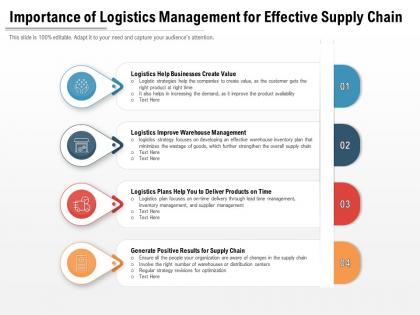
Importance of logistics management for effective supply chain




Try Before you Buy Download Free Sample Product
 Impress Your
 Audience
 100%
100% Editable
 Save Hours
 of Time


Our Importance Of Logistics Management For Effective Supply Chain are topically designed to provide an attractive backdrop to any subject. Use them to look like a presentation pro.
People who downloaded this PowerPoint presentation also viewed the following :
Importance of logistics management for effective supply chain with all 2 slides:
Use our Importance Of Logistics Management For Effective Supply Chain to effectively help you save your valuable time. They are readymade to fit into any presentation structure.
FAQs for Importance of logistics management for
Look, you'll want to focus on demand forecasting, inventory management, transportation planning, and warehouse optimization first. Supplier relationships matter too - honestly, this part gets overlooked way too often. Technology systems need to connect everything instead of working separately, which sounds obvious but you'd be surprised how many companies mess this up. Performance metrics are crucial since you can't fix what you're not tracking. My advice? Map out what you're currently doing and spot the biggest bottlenecks. That'll tell you where to start tackling things.
So basically, tech integration gives you real-time visibility into your whole supply chain. You can see shipments instantly and let AI optimize routes automatically. The demand forecasting gets way better too with all the data analytics. IoT sensors track temperature, location - honestly the visibility now vs like 5 years ago is crazy different. Automation cuts down human errors big time, especially for inventory and order stuff. I'd say start small though - maybe just tracking software first, then build it out from there. Don't try to do everything at once.
Oh man, last-mile delivery is such a pain. Failed deliveries are probably the worst part - people aren't home, so you're stuck doing expensive re-runs. Traffic in cities is brutal, and rural areas? You're driving forever between stops. Customers want everything yesterday but don't want to pay for it, which is kind of ridiculous if you ask me. Plus there's package theft, route planning headaches, all that stuff. Honestly I'd start with decent route optimization software - it actually helps. Maybe look into partnering with local pickup spots too, cuts down on those annoying failed deliveries.
Honestly, data analytics can totally transform your supply chain. Start by tracking delivery times, inventory turnover, and transportation costs - you'll catch inefficiencies that would slip by otherwise. Route optimization alone can cut costs by 15-20% (which is pretty wild when you think about it). The trick is pulling data from everywhere - warehouses, suppliers, transport, even weather. Don't try to tackle everything at once though. Pick one area first, maybe demand forecasting or warehouse ops, and map out what data you've already got. Real-time route adjustments and demand pattern predictions make a huge difference once you get rolling.
Look, inventory management is literally the backbone of everything logistics-wise. You don't want to run out of stuff, but you also don't want your warehouse packed with junk that won't sell - both kill your cash flow. It affects how fast you can fill orders, storage costs, shipping efficiency. The whole thing's connected in ways that'll surprise you. Bad inventory creates this crazy domino effect. You're either panicking about rush orders or stuck with products gathering dust. Honestly? Start by figuring out your demand patterns and setting proper reorder points. That'll fix like 80% of your headaches right there.
So basically start with route optimization software - that's your easiest win right there. Cuts fuel costs and emissions at the same time. Electric or hybrid vehicles are great if you can swing it, but honestly the route stuff pays for itself pretty quick. Oh and definitely look into your packaging - less material = cheaper shipping anyway. Try consolidating shipments when you can, maybe use rail for the longer hauls since it's way more efficient. Find carriers who actually care about this stuff too, not just the ones who say they do. The fuel savings alone make most of this worth doing.
Ugh, trade policies mess with literally everything you're doing - shipping costs, how long stuff takes, where you can even send things. Tariffs hit and suddenly your go-to supplier costs way more, so you're scrambling for alternatives or eating the expense. Trade deals can actually help though, opening up cheaper/faster routes. Then there's stuff like Brexit that just breaks everything for months. The paperwork alone will drive you crazy when new regulations drop. Honestly, you'll save yourself so much stress if you diversify your suppliers now and actually pay attention to policy news. Sounds boring but trust me, it beats panicking when rules change overnight.
Look, your logistics basically make or break how happy customers are with you. Get orders there on time and undamaged? People love you. Screw it up with delays or broken stuff? They're gone forever - honestly, I've watched businesses lose customers over one bad shipping experience. The thing is, smooth logistics let you do cool stuff like same-day delivery or easy returns. Oh, and tracking! Customers get super anxious when they can't see where their package is. Keep them in the loop and you're golden.
First thing - map out your whole supply chain and spot where things could go wrong. Weather, suppliers failing, regulations changing, whatever. Build backup plans everywhere: extra suppliers, different shipping routes, more inventory than you think you need. 2020 taught me this lesson the expensive way! Keep tracking your numbers religiously. Honestly, good insurance and solid relationships with partners matter more than people realize - when stuff hits the fan, communication saves your ass. Run through disaster scenarios every few months so you're not scrambling later.
So reverse logistics is basically about capturing stuff that would normally get tossed - returns, broken products, packaging, whatever. Instead of letting it hit the landfill, you refurbish or recycle it. Way cheaper than making new stuff from scratch. Plus customers actually notice when you're not being wasteful (which is kinda sad but whatever). Look at what's coming back to you regularly first. Some items are gonna be easier to give a second life than others. It cuts costs and waste at the same time, so honestly there's no real downside here.
Dude, logistics is changing fast right now. Automation's everywhere - warehouses are packed with robots doing inventory stuff, and honestly it's getting wild how much AI handles. Sustainability is massive too since everyone wants carbon-neutral shipping. Real-time tracking? Yeah, that's just expected now. Customers lose their minds if they can't see exactly where their package is. Oh, and supply chain visibility became super critical after all those recent disruptions (you know what I mean). Data analytics is the other big one - companies are using it to predict everything. You should definitely check how this affects your processes because the fast movers are crushing it right now.
Shipping costs will absolutely crush your margins if you're not careful. Higher transport fees mean you either eat the cost or pass it to customers - both suck honestly. Your whole supply chain gets affected too. Where you put warehouses, how often you ship, all that changes. Sure, you could bundle shipments to save cash, but then deliveries slow down. It's this constant balancing act between spending too much on fast shipping versus keeping customers happy. I'd definitely track your per-shipment costs monthly so you can catch problems before they spiral.
Look, getting your suppliers and logistics people to actually work together is a game-changer. You'll stop having those awful coordination disasters that always happen at 4pm on Friday (why is it always Friday?). When they communicate regularly, your demand forecasting gets way better and inventory flows smoother. Plus you can optimize routes and bundle shipments to cut costs. The best part? Issues get caught early instead of becoming your emergency. Set up regular meetings between your key suppliers and logistics partners - trust me on this one.
Honestly, automation tools are a game changer - they'll slash your manual work and cut way down on those annoying human errors. Start with something simple like order entry, then build from there. You can automate inventory tracking, shipments, route planning, all that stuff. The best part? Your whole team gets real-time visibility into everything happening. No more scrambling when something goes sideways because you'll actually see problems coming. I probably sound like I'm overselling it, but seriously - once you get even basic automation running, you'll kick yourself for waiting so long. The time savings alone make it worth the setup headache.
Honestly, start with the basics - order fulfillment time and shipping costs as a percentage of revenue. Those'll tell you the most right away. Inventory turnover is huge too, especially if you're sitting on dead stock (been there). Delivery accuracy matters more than people think - like, fast shipping means nothing if it's the wrong product, right? Customer satisfaction scores are obvious but still worth tracking. Oh, and if you're using third-party carriers, definitely monitor their performance. Warehouse efficiency too, though that one's trickier to measure at first.
-
Great designs, really helpful.
-
Nice and innovative design.
-
I discovered this website through a google search, the services matched my needs perfectly and the pricing was very reasonable. I was thrilled with the product and the customer service. I will definitely use their slides again for my presentations and recommend them to other colleagues.
-
Great quality product.
-
Easily Understandable slides.
-
Much better than the original! Thanks for the quick turnaround.
-
Enough space for editing and adding your own content.
-
Topic best represented with attractive design.
-
Enough space for editing and adding your own content.
-
Informative presentations that are easily editable.
-
Page:
- You're currently reading page 1
- Page 2
-
