

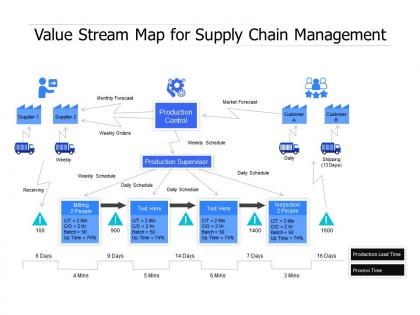
Value stream map for supply chain management




Try Before you Buy Download Free Sample Product
 Impress Your
 Audience
 100%
100% Editable
 Save Hours
 of Time


Our Value Stream Map For Supply Chain Management are explicit and effective. They combine clarity and concise expression.
People who downloaded this PowerPoint presentation also viewed the following :
Value stream map for supply chain management with all 2 slides:
Give your audience a fulfilling experience. They will find our Value Stream Map For Supply Chain Management elevating.
FAQs for Value stream map for
You'll want process boxes showing each workflow step, plus data boxes underneath with your cycle and wait times. Inventory triangles go between processes. Information flows show how communication works - honestly, this part gets messy but it's worth mapping out. The timeline at the bottom is huge because it reveals your total lead time versus actual value-add time. Customer/supplier boxes bookend everything. Map your current state first, then dream up your future state. That contrast? That's where you'll spot the biggest improvement opportunities.
Okay so value stream mapping is basically like drawing out your whole process from beginning to end. You'll immediately see where stuff just sits around doing nothing and where handoffs between people create these annoying delays. Honestly, it's kind of eye-opening - like finally understanding why certain tasks feel like they take forever when they shouldn't. Once you've got it mapped out, you can spot the steps that actually matter versus the ones that are just... there. Then redesign everything to cut out redundant crap and make handoffs smoother. I'd start with whatever process currently makes you want to bang your head against the wall.
So value stream mapping is literally just drawing out your whole process from start to finish. Walk through it with a stopwatch and map every single step - you'll be shocked at how much waste you find. All those bottlenecks and delays that drive you crazy? They become super obvious once you see everything laid out visually. Honestly, it's like finally understanding why things take forever. You time each stage, spot where inventory builds up, and figure out which steps actually add value (spoiler: way fewer than you think). Then sketch out how it should work without all the junk. Pick one process first though - don't try to map everything at once.
So basically you map out your whole process step by step - every handoff, every wait time, all of it. Once you see everything laid out visually, the waste just jumps out at you. Bottlenecks become obvious, you'll notice redundant steps you never paid attention to before, and suddenly it's clear where people are just sitting around waiting. I always tell people to start with mapping what you're actually doing now (not what you think you're doing). Trust me, you'll be surprised how much inefficiency was right there the whole time. It's honestly pretty eye-opening.
Honestly, just grab some sticky notes and hit the whiteboard first - way easier to move stuff around when you're figuring things out. Visio's solid if you need something digital, or Lucidchart if your company has it. There are fancy specialized tools like ValueStreamGuru, but they're probably overkill unless you're doing this constantly. Miro's great for remote teams. I'd personally stick with whatever software you already know rather than learning something new just for this. You can always get fancier later if the basic approach isn't cutting it.
Start with hands-on workshops mapping a process they already know well - way more effective than just theory. Get an experienced facilitator for the first sessions, then have those people train others (teaching it is honestly when you really understand it). Do gemba walks mixed with classroom stuff so they spot waste happening live. Don't train everyone at once though, that's chaos. Train your champions first, let them mess around on small projects, then spread it out. Oh and make it practical from day one - nobody wants boring academic stuff when they're trying to learn this.
So basically, your current state map is just documenting the hot mess you're dealing with right now - all the inefficiencies and roadblocks that make you want to scream. Future state? That's your dream scenario after you've fixed everything. I always tell people to start with current state first because honestly, you can't fix what you don't really understand. The difference between where you are now versus where you want to be becomes your action plan. It's like having a GPS - you need to know your starting point before plotting the route to your destination.
Honestly, every 3-6 months is the sweet spot for most teams. But if your processes are changing fast or you're actively fixing stuff, maybe bump it to monthly. I've seen some teams go crazy with weekly updates - total waste of time unless everything's on fire. Pick whatever works and actually stick to it, that's the real trick. Don't be rigid about it though. If you spot a major bottleneck tomorrow, don't wait for your next scheduled review. Just set a recurring meeting now or you'll forget (we all do).
Honestly, the data collection part is gonna be your biggest headache - everyone tells you different cycle times and you're left trying to figure out what's actually true. Half your team will think it's just another management thing that'll blow over (can't really blame them tbh). Different departments get weird about it too since they're all focused on their own stuff. Oh, and getting people to actually participate? Good luck with that. Start with just one process though - makes everything way easier. Bring people into the actual mapping sessions instead of just asking for their input later. They'll care more if they're part of building it.
Start with value stream mapping - it's like getting a bird's eye view of everything. Once you map your current state, you'll spot exactly where 5S makes sense (usually those chaotic workstations that slow everything down). Then your future state map basically screams where Kanban should go to fix flow issues. Teams always want to dive straight into the sexy tools, but honestly? That's backwards. VSM shows you which tools will actually make a difference instead of just keeping you busy. Map first, then hit the biggest bottlenecks with 5S and Kanban. Way more effective than throwing tools at random problems.
Toyota's probably the best example - they went from 4 weeks to 10 days just by mapping everything out and cutting bottlenecks. Boeing did the same thing with their 737 line, shaved off 25% assembly time. Intel saw 30% better throughput in their chip fabs. Hospitals too - Virginia Mason cut patient waits by 65%, which honestly sounds almost too good to be true but whatever. The thing is, none of these companies mapped once and walked away. They kept at it, constantly finding new waste to eliminate. My advice? Pick one process you already know inside and out and start there.
Dude, value stream mapping is actually genius for this. Everyone literally looks at the same picture of how work flows - sales to production to delivery. Suddenly marketing sees how their crappy leads mess up conversion rates (whoops!). The visual aspect makes problems super obvious to everyone, not just whoever's dealing with the headache. Each team finally gets how their stuff impacts the next guy down the line. Instead of the usual finger-pointing fest, people start brainstorming fixes together. Next time you do process improvement, stick that map on the wall and watch what happens.
So basically, value stream mapping shows you what actually matters to customers vs all the useless stuff slowing you down. Map your whole process end-to-end and you'll see these ridiculous delays and handoffs everywhere - honestly made me a little mad the first time I did it, like why didn't we notice this before? Cut out those bottlenecks and suddenly you're delivering better products way faster. Just pick one product line to start. Follow it from order to delivery. Trust me, you'll find some wild inefficiencies hiding in there.
Look for lead time vs cycle time first - that's customer wait time compared to actual work happening. Processing times, wait periods, and inventory levels at each step matter too. The efficiency ratio is wild though - divide value-added time by total lead time and you'll probably get like 5-10%, which seems awful but honestly that's pretty standard for most places. Track your defect rates and changeover times while you're at it. Pro tip: hunt down your longest wait times first since that's where the big wins usually hide. Oh, and don't forget batch sizes - those can mess things up more than you'd think.
Honestly, you need that baseline before throwing tech at everything - otherwise you're just automating mess. Map out your current process first and you'll spot exactly where things get stuck or slow down. Those manual handoffs are usually the worst culprits. It shows you which pain points deserve your budget most. I'd start with whatever process is driving your team absolutely crazy right now - just pick one end-to-end flow. Then when you do implement changes, you've got real numbers to prove it actually worked.
No Reviews