


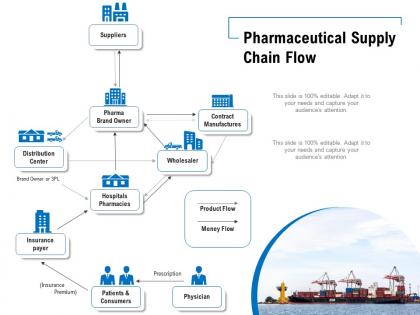
Pharmaceutical supply chain flow





Try Before you Buy Download Free Sample Product
 Impress Your
 Audience
 100%
100% Editable
 Save Hours
 of Time


Our Pharmaceutical Supply Chain Flow are explicit and effective. They combine clarity and concise expression.
People who downloaded this PowerPoint presentation also viewed the following :
Pharmaceutical supply chain flow with all 2 slides:
Give your audience a fulfilling experience. They will find our Pharmaceutical Supply Chain Flow elevating.
FAQs for Pharmaceutical
So basically it goes: manufacturing → warehousing → wholesaling → retail. Manufacturers make the drugs, then ship everything to distribution centers for storage. Wholesalers buy bulk quantities and sell to pharmacies, hospitals, clinics - that middle part gets messy with tons of different companies involved. Finally pharmacies dispense to patients. Oh, and if you're looking at where things go wrong? Focus on those handoff points between stages - that's where most issues pop up, at least from what I've seen.
Honestly, regulatory stuff is such a pain but you can't ignore it. Every step needs crazy documentation, temperature monitoring, serialization - the works. FDA and EMA will literally shut you down for one screw-up, which is terrifying when you think about it. You can't even swap suppliers quickly because everything has to get requalified first. The costs add up fast too - documentation, validated processes, special handling from manufacturing to delivery. My advice? Budget for compliance from the start and loop in your regulatory people before making any supply chain moves. Trust me on this one.
Honestly, start by spreading your suppliers around - putting everything with one vendor is just asking for trouble. Stock up on the stuff you absolutely can't live without, and get some tools that'll give you real visibility into what's happening upstream. I know regional sourcing costs more but it's worth it sometimes. Map out where you're most screwed if something breaks, then build backups there first. Having a second manufacturing site sounds expensive but man, when your main one goes down you'll be glad you did it. Short version: multiple options for everything critical.
Honestly, data analytics is like having a crystal ball for your supply chain. You can predict demand way better than just guessing, catch supplier problems before they screw you over, and actually know how much inventory to keep around. The real-time tracking stuff is pretty cool too. Quality issues get spotted faster, you waste less money on expired products, and seasonal spikes don't blindside you anymore. Plus the predictive models these days are insane - though I still don't totally understand how they work. Just start with demand forecasting first. Don't try to do everything at once or you'll overwhelm yourself.
Yeah, temperature control is make-or-break for pharmaceuticals. Most need to stay between 2-8°C (refrigerated stuff) or 15-25°C for room temp storage. Heat and cold swings will destroy the active ingredients - I've seen entire shipments get trashed from one temperature spike. You'll want carriers with real-time monitoring and solid cold chain experience. The tracking reports are crucial too since regulators love their documentation. Honestly, don't cheap out on this part. Proper packaging and backup systems aren't optional when you're talking about meds that could lose potency or become unsafe.
So blockchain creates this tamper-proof record that follows every pill from factory to your pharmacy. Pretty neat stuff, honestly. You can check if your meds are legit, weren't stored in some hot truck for days, or got swapped with fakes somewhere along the way. Way faster than old-school tracking methods too. Temperature problems? You'll know right away instead of finding out weeks later. If your company's having supply chain headaches, maybe check out some pilot programs - I've heard pharma companies are actually making money off this, not just burning cash on fancy tech for once.
Honestly, start with qualifying your suppliers properly - audit their facilities and check certifications before bringing them on. The paperwork's brutal at first but trust me, it saves you later. Set up scorecards to track performance quarterly and do regular audits. Real-time quality metrics help catch problems early. Oh, and always have backup suppliers for critical stuff - learned that one the hard way. Building actual relationships with key suppliers makes everything smoother. They'll work with you on forecasting and risk issues instead of just treating you like another order. Continuous monitoring's where most people drop the ball though.
Dude, fake drugs are such a headache for supply chains. They slip in and suddenly you can't trust anyone in your network. Patient safety goes out the window since these counterfeits might have zero active ingredients or straight-up poison. Makes me wonder how this stuff even gets past customs sometimes. You'll need way more verification steps, tracking systems, and vetted suppliers just to stay legit. Quality control becomes this massive puzzle. Short answer? Audit who you're buying from and get some track-and-trace tech running ASAP.
So globalization basically made pharma supply chains this crazy global network - raw materials from one place, manufacturing somewhere else, distribution everywhere. One pill probably hits like 5 countries before you get it, which honestly blows my mind sometimes. Yeah, it cuts costs and you can find specialized suppliers anywhere. But man, when something breaks down, it cascades everywhere. COVID was the perfect example of that mess. For planning though, definitely map where your critical stuff comes from and have backups ready. Don't get caught with your pants down.
Alright so three big things to nail down: documentation, training, and audits. Get all your manufacturing processes documented properly and make sure everyone actually follows the SOPs. Staff training is huge - most companies mess this up by doing like one session and calling it done. Internal audits should happen regularly so you catch problems before the regulators show up (trust me on this one). Keep detailed batch records for everything too. The real trick is making GMP part of how people work every day, not just some compliance thing they check off. I'd start by looking at your current SOPs this week.
Honestly, temperature control is gonna be your biggest headache - once those packages leave the main hubs, keeping cold chain intact gets messy fast. Security's another nightmare. Plus patients can't wait around for their meds, so delivery windows are super tight. Don't even get me started on rural deliveries, the costs are insane. Oh and everything needs signatures, which makes it way more complicated than regular shipping. My advice? Find carriers who actually specialize in pharma stuff instead of using whoever's cheapest.
So branded drugs are way more predictable - you've got patent protection and steady market share, which makes forecasting pretty straightforward. Generics though? Total chaos. Price competition is brutal and you're constantly dealing with supply issues from different manufacturers. Plus generics expire faster and have thinner margins, so you can't really stockpile much safety inventory. Honestly, the key with generics is having rock-solid backup suppliers - like, multiple ones - because stockouts will absolutely kill you. Oh and the stock rotation is constant since shelf lives are shorter. It's just a completely different beast from branded stuff.
Dude, supply chain mess-ups in pharma are brutal for profits. We're talking billions lost across the industry. Expired inventory sitting around, crazy expensive emergency flights, regulatory headaches, stockouts killing your revenue streams. Cold chain breaks down? There goes millions worth of product, just like that. The worst part is how it snowballs - customers lose trust and jump to competitors who actually deliver on time. Honestly feels like pharma supply chains are held together with duct tape sometimes. I'd start by figuring out your weakest links first, then get some decent tracking systems in place.
Dude, policy changes totally mess with pharma supply chains. New FDA rules or pricing reforms hit immediately - your demand forecasting goes haywire, inventory gets tricky, distribution priorities flip overnight. Procurement costs can spike out of nowhere. Some products just vanish from shelves suddenly. I've seen managers scramble to redesign entire logistics networks just to stay compliant. Build in flexibility wherever you can - seriously, don't get caught flat-footed. Keep tabs on regulatory stuff too, because honestly? Being reactive in this space is expensive as hell.
Yeah, sustainability's exploding in pharma right now. Companies are scrambling to cut their environmental impact without screwing up drug quality - green packaging, carbon-neutral shipping, renewable energy in facilities. Regulators are starting to weigh environmental stuff in their assessments too, which honestly makes sense. Here's the thing though: going sustainable usually saves money long-term through less waste and better energy efficiency. I'd start by checking what your current suppliers are actually doing sustainability-wise. Gives you bargaining power and helps you stay ahead of where things are headed.
No Reviews