

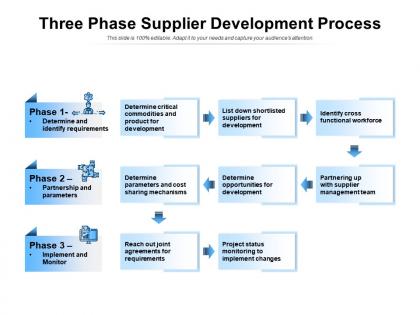
Three phase supplier development process




Try Before you Buy Download Free Sample Product
 Impress Your
Audience
 100%
Editable
 Save Hours
of Time


Our Three Phase Supplier Development Process are explicit and effective. They combine clarity and concise expression.
People who downloaded this PowerPoint presentation also viewed the following :
Three phase supplier development process with all 2 slides:
Give your audience a fulfilling experience. They will find our Three Phase Supplier Development Process elevating.


FAQs for Three phase
Key metrics include quality scores, delivery performance, cost competitiveness, innovation capability, and compliance ratings. These assessments enable organizations to track supplier progress systematically, identify improvement opportunities, and strengthen partnerships, with many companies finding that comprehensive performance monitoring ultimately delivers enhanced supply chain reliability and competitive advantage.
Collaboration with suppliers enhances innovation by leveraging their specialized expertise, advanced technologies, and unique market insights throughout the product development cycle. Through strategic partnerships, companies access cutting-edge materials, manufacturing processes, and technical capabilities that accelerate time-to-market, reduce development costs, and deliver superior products, ultimately gaining competitive advantage.
Organizations can foster long-term supplier relationships through collaborative planning, regular performance reviews, joint innovation initiatives, transparent communication channels, and strategic partnership agreements. These approaches enhance trust and mutual investment, with many companies in automotive and technology sectors finding that shared risk management, co-development projects, and integrated supply chain systems ultimately deliver reduced costs and competitive advantage.
Supplier development strengthens supply chain resilience by improving supplier capabilities, diversifying sourcing options, building stronger partnerships, and establishing risk mitigation protocols. Through strategic investment in supplier training and technology integration, organizations reduce vulnerabilities, enhance operational continuity, and maintain competitive advantage, with many manufacturing and retail companies finding significantly improved crisis response capabilities.
Technology plays a pivotal role in modern supplier development through automated performance monitoring, digital collaboration platforms, data analytics for risk assessment, cloud-based training systems, and AI-powered supplier matching. These technologies streamline communication, enhance transparency, and accelerate capability building, with many organizations finding that digital supplier development delivers faster onboarding, improved compliance, and stronger strategic partnerships.
Companies effectively identify and select suppliers for development programs by evaluating strategic importance, performance gaps, willingness to collaborate, financial stability, and growth potential. Through comprehensive assessments of current capabilities, quality metrics, and alignment with long-term goals, organizations in manufacturing, retail, and healthcare increasingly find that strategic supplier partnerships deliver enhanced innovation, reduced costs, and improved supply chain resilience.
Supplier development programs face challenges including resource allocation constraints, supplier resistance to change, varying quality standards across vendors, communication barriers, and measuring program effectiveness. While these obstacles can be significant, organizations increasingly find that strategic partnerships with committed suppliers, clear performance metrics, and phased implementation approaches ultimately deliver enhanced supply chain resilience and competitive advantage.
Cultural differences significantly impact supplier development through varying communication styles, business practices, relationship expectations, and decision-making processes across regions. While these differences present challenges, they also create opportunities for deeper partnerships, with many global organizations finding that culturally-sensitive approaches, localized training programs, and cross-cultural teams ultimately deliver stronger supplier relationships and enhanced competitive advantage.
Suppliers typically need training in quality standards, compliance requirements, technical specifications, operational processes, and performance metrics during development. Through comprehensive onboarding programs, many organizations provide hands-on workshops, documentation support, and regular coaching sessions, ultimately delivering improved supplier capabilities, reduced defects, and stronger partnership foundations that enhance overall supply chain efficiency.
Regulatory compliance requirements significantly shape supplier development processes by mandating rigorous auditing, standardized quality systems, documentation protocols, and performance monitoring frameworks. Organizations in highly regulated sectors like pharmaceuticals, aerospace, and financial services find that compliance-driven supplier development ultimately enhances operational transparency, minimizes risk exposure, and delivers competitive advantages through stronger vendor partnerships.
Organizations can ensure sustainability in supplier development by establishing clear environmental and social criteria, conducting regular audits, providing capacity-building support, and implementing collaborative improvement programs. Through strategic partnerships, companies in manufacturing, retail, and technology sectors streamline compliance monitoring, enhance supply chain transparency, and reduce environmental impact, while many organizations find that sustainable supplier relationships ultimately deliver cost efficiencies and stronger competitive positioning.
Feedback loops between organizations and suppliers can be established through regular performance reviews, digital collaboration platforms, joint improvement workshops, supplier scorecards, and structured communication channels. These mechanisms enable real-time issue resolution, shared best practices, and collaborative problem-solving, with many organizations finding that systematic feedback processes drive innovation, reduce costs, and strengthen long-term partnerships.
Investing in supplier development typically involves upfront costs for training, technology, and support programs, but delivers significant long-term returns through reduced procurement costs, improved quality, and enhanced supply chain resilience. Many organizations find that strategic supplier partnerships ultimately streamline operations, minimize risk-related expenses, and create competitive advantages that far outweigh initial investments.
Risk management integrates into supplier development through comprehensive assessments, continuous monitoring systems, diversification strategies, collaborative mitigation planning, and performance-based contracts. These approaches enable organizations to identify vulnerabilities early, strengthen supplier capabilities, and build resilient supply chains, with many companies finding that proactive risk integration ultimately delivers competitive advantage and operational stability.
Successful supplier development case studies include Toyota's supplier partnership programs, Walmart's sustainability initiatives, Boeing's supply chain integration projects, and Procter & Gamble's innovation collaborations with key vendors. These programs demonstrate how strategic supplier investment streamlines operations, reduces costs, and enhances product quality, with many organizations finding that long-term partnerships ultimately deliver competitive advantages and operational resilience.
No Reviews