

Three phases of value delivery process





Try Before you Buy Download Free Sample Product
 Impress Your
Audience
 100%
Editable
 Save Hours
of Time


Our Three Phases Of Value Delivery Process are topically designed to provide an attractive backdrop to any subject. Use them to look like a presentation pro.
People who downloaded this PowerPoint presentation also viewed the following :
Content of this Powerpoint Presentation
Value delivery is the cornerstone of every successful enterprise in today's highly competitive world. But what exactly is value delivery, and why does it play such an integral role?
Imagine you have created a unique product or service, and all your time, energy, and resources were spent on getting the product to the market. Unfortunately, with no proper value delivering process in place, the product fails, remaining obscure and useless. This is where the problems arise.
However, if the importance of value delivery is recognized, the path that it follows is quite hard but doable. From overcoming the challenge of making the internal process match requirements of the market to the need to meet customers’ demands, there is work galore.
However, there is a way to stand up to the challenges. Want to know how? SlideTeam’s easily editable, partially customizable, and user – friendly Three Phases of Value Delivery Process PowerPoint Template offer a comprehensive range of opportunities for making your operations more proficient and your communication aimed at the best outcomes in terms of value delivery.
Also, please take a look at our blog on Three Components of Value Delivery for better success.
Let’s explore!
Template 1 Three Phases of Value Delivery Process PPT Slide
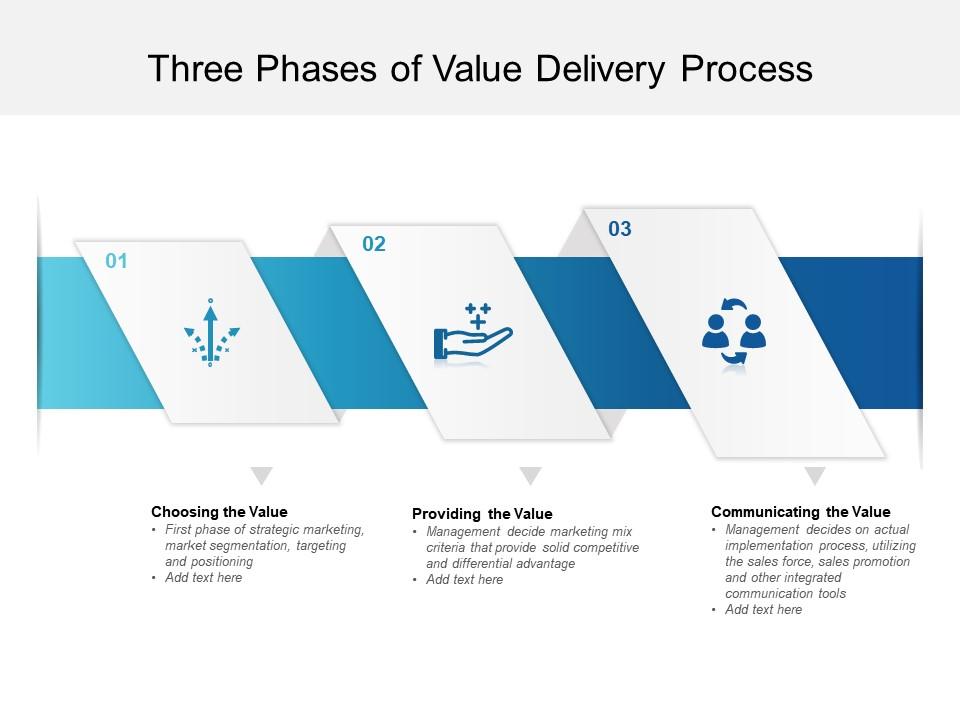
Understanding the Three Phases of the Value Delivery Process is vital for corporate strategy and marketing as it provides a means of efficiently accommodating client requests. The phases are:
1. Choosing the Value
The first step in the value delivery process is the selection of the value. At this stage, businesses become involved in strategic marketing, which includes market segmentation, targeting, and positioning. The first element is used for distinguishing between aspects of the market. Targeting is involved in the division of the market into groups that can be operated, with the most profitable areas being selected. Positioning is aimed at showing how your brand is seen as advantageous compared to competitors. On the other hand, strategic marketing can be defined as the way of explaining the unique value proposition of a product. Hence, choosing the value begins with a definite value proposition .
2. Providing Value
The second stage is concerned with providing value, i.e., with fulfilling the proposed value proposition. In this phase, the management plays a significant role as it has to select the set of marketing mix criteria to give the company a competitive and differential advantage. This set requires marketing decisions to be made so that they yield benefits that outplay competitors. Decision-making must also be aligned with the value that was chosen at the previous step.
3. Communicating The Value
During the final stage, the value proposition is transmitted to the destination. The management assures that the actual implementation process is such that, through the use of sales force people, sales promotion, personal selling, advertising, publicity, or direct digital marketing means, the company is able to communicate, provoke awareness of, and persuade target customers to select this offering over competitors.
Check out our blog on Value Delivery Process to Execute Growth to master the process in detail.
Purpose of slide
The slide depicts the central stages in delivering value to customers. It also gives companies a formal structure to think about. Strategic decisions concerning value proposition, delivery channels, and communication are also to be made. This helps stakeholders to understand and work together making better-informed decisions that improve the company’s competition and customer satisfaction.
Who can use this?
The slide is meant for organizations of all sizes and industries that attempt to improve their provisioning of value. The framework could be used by startups which focus on differentiating their offering. Companies can use it to enhance their ability to anticipate their customer needs and wants.
Would you like to improve your provision of value and gain a competitive edge in the market? Implement it and boost your company’s sustainable success.
Embrace Value Delivery with SlideTeam
In today’s ever-changing business environment, the ability to deliver value is critical. SlideTeam’s Three Phases of Value Delivery Process PowerPoint Slide can help you master that skill and navigate past your competition. The formal structure for dealing with different stages of your value delivery process provides a seamless and efficient approach and helps you fight challenges paving your way for progress, novel solutions, and victory.
Don't forget to check out our blog on the Value Delivery Process Framework to understand it in detail.
Three phases of value delivery process with all 2 slides:
Use our Three Phases Of Value Delivery Process to effectively help you save your valuable time. They are readymade to fit into any presentation structure.


FAQs for Three phases of
So the Value Delivery Process breaks down into three parts: Choose (picking your target market), Provide (actually building the thing), and Communicate (getting it out there). It's like decide-build-sell, but honestly? You'll bounce between these stages way more than you think. I've watched so many teams dive straight into building without figuring out who they're even serving - huge mistake. Start with nailing down your actual customer first. Sounds obvious but you'd be surprised how often people skip this step and wonder why nothing's working later.
Honestly, just start with what you're actually doing right now - map out every step from when customers first reach out to final delivery. Get people from different teams involved because they all see different parts of the mess. Most teams try jumping straight to the "perfect" process, which is completely backwards if you ask me. Document the real process first, warts and all. Look for where things get stuck or handed off between departments - that's usually where stuff falls apart. Then you can figure out what the better version looks like. The trick is being totally honest about reality versus what's supposed to happen on paper.
Customer feedback is your reality check - without it, you're basically flying blind and hoping for the best. It shows you where there's a gap between what you think you're delivering and what people actually experience. Pretty eye-opening sometimes, honestly. Use it to figure out what needs fixing first and adjust how you're doing things. The cool part is you'll often discover value opportunities you totally missed. Oh, and collect feedback throughout your whole process, not just at the end when you can't really do much about it. Multiple touchpoints give you way better insights.
Dude, tech basically handles all the boring stuff for you so you can focus on what matters. Project management tools let you see everything happening in real time - no more wondering where things stand. CRM systems help you actually understand what customers want instead of guessing. And automation? Total lifesaver for cutting out manual work that nobody wants to do anyway. The communication tools are honestly my favorite part - those endless email threads asking for updates become a thing of the past. Analytics catch problems early too. But don't go crazy - just pick one annoying process and fix that first.
Honestly, start with customer satisfaction and delivery speed - those two will tell you the most. Then add cost per delivery and revenue per customer. Repeat purchases are huge too since that's when you know people actually like what you're doing. I'd throw in some operational stuff like order accuracy and fulfillment errors. But seriously, don't go crazy tracking everything under the sun. Pick maybe 5-7 things you can actually fix when they tank. The whole point is having numbers you'll act on, not just stare at in a dashboard all day.
So the Value Delivery Process is basically your execution engine - it turns those big strategic goals into real customer value. Map your strategic priorities straight to value streams. Every process step needs to connect back to what you're actually trying to achieve as a business. Think of it like GPS for strategy execution (honestly, that's the best way I can explain it). Your value delivery metrics have to align with strategic KPIs. Measure outcomes that matter to customers AND the business. Start by auditing current processes against your objectives - you'll probably find some annoying gaps.
Honestly, communication breakdowns will kill your project faster than anything else. Don't promise stuff you can't deliver - I learned that one the hard way. Getting clear requirements upfront is huge, otherwise scope creep becomes a nightmare. Teams that disappear for weeks then show up with something totally wrong? Yeah, that happens more than you'd think. Weekly check-ins save you from that mess. Document everything and get actual sign-offs at milestones. The worst part is when everyone thinks they're on the same page but they're picturing completely different outcomes. Set up those stakeholder touchpoints from the start.
Honestly, the magic happens when you get everyone talking to each other instead of working in their little bubbles. Have actual sync meetings where product, engineering, design, and ops hash out problems together - skip the boring status updates, nobody cares about those anyway. Get everyone focused on the same customer metrics instead of protecting their departmental turf. Try joint planning sessions and shared retros where people can actually see how their work connects to the whole customer experience. Oh, and pick one messy workflow that touches multiple teams and fix that first. You'll be amazed how much faster things move.
Your value prop is literally everything - it's what holds your whole Value Delivery Process together. Think of it as your North Star that tells you what value you're delivering and who actually wants it. I've watched so many startups (including mine, honestly) just throw stuff at the wall without knowing their core promise first. Big mistake. Every product decision, every customer interaction should connect back to that value you promised. Plus it makes measuring success way easier - you'll know if you're actually delivering what people signed up for. My advice? Take a hard look at your current value prop and make sure it's not some vague corporate nonsense.
Start with your basics - map out how customers experience each touchpoint right now. Most companies totally blow this step, which is why everything feels disjointed. Write down clear guidelines for calls, emails, in-person visits, whatever you've got. Everyone needs to know the same standards. I'd honestly focus on training first since your team probably doesn't realize they're giving different experiences. Use the same metrics everywhere too - can't improve what you don't measure consistently. Oh, and do regular check-ins. Stuff drifts over time if you're not watching.
You gotta keep your value delivery flexible when markets go crazy - kinda like how your GPS reroutes when there's traffic. Map out which parts of your process are most likely to break first, then build in some buffer room there. Maybe you'll need to go digital, cut steps, or bring in new players. The main thing is setting up feedback loops so you're not guessing what's happening. I've seen companies pivot their whole delivery approach overnight when customer behavior shifted. Start tweaking touchpoints and channels based on what competitors are doing too.
So here's what I'd do - pull your data and look for where stuff gets stuck most often. That's your biggest headache right there. Track delivery times, quality scores, and what customers are actually saying about the experience. You can break it down by customer type too, which honestly gives you way better insights than looking at everything as one big mess. Pick one metric that really hits customer experience hard and start there. Test small changes, see what moves the needle. Don't try to fix everything at once or you'll go crazy.
Oh man, there are some killer examples out there. Amazon's Prime thing is obviously the gold standard - they basically perfected every step from click to your door. Toyota's been doing this forever with their lean manufacturing stuff, just cutting out anything wasteful. Netflix absolutely crushed it during that DVD-to-streaming transition (still can't believe how smooth that was). Spotify's playlist algorithms are pretty brilliant too. Definitely dig into how they tracked success at each phase. Most of them just kept tweaking based on what customers actually wanted, not what they thought people wanted.
Dude, culture is huge for this stuff. Some places want everyone to agree before moving forward, others just need the boss to say yes. Your team's background totally changes how they read customer feedback too. I learned this the hard way on a project last year - what worked in NYC bombed in Tokyo. Communication styles are different everywhere. Build some wiggle room into your process from day one. Short version: test your approach with local people first, don't just copy-paste what worked somewhere else.
So honestly, start with the basics - get your teams trained on Agile/Lean stuff and customer research. They need actual hands-on practice with value stream mapping and user stories, plus learning how to track the right metrics. Design thinking workshops are clutch too, way better for generating ideas than boring brainstorming sessions. For tools, grab some good analytics platforms and feedback collection systems. But here's what really works - make everyone shadow customer-facing roles quarterly. Sounds like overkill but trust me, nothing beats seeing firsthand what customers actually value. Oh, and budget for regular customer interviews. Can't stress that enough.
No Reviews