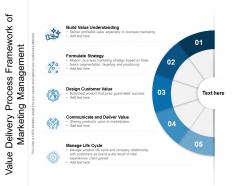
Value delivery process framework of marketing management
Try Before you Buy Download Free Sample Product
Audience
Editable
of Time
Our Value Delivery Process Framework Of Marketing Management are topically designed to provide an attractive backdrop to any subject. Use them to look like a presentation pro.
People who downloaded this PowerPoint presentation also viewed the following :
Value delivery process framework of marketing management with all 2 slides:
Use our Value Delivery Process Framework Of Marketing Management to effectively help you save your valuable time. They are readymade to fit into any presentation structure.
FAQs for Value delivery process framework
You've got four main things to nail: customer discovery, value prop design, delivery, and feedback loops. Most people totally skip the discovery phase and then can't figure out why their stuff doesn't work - honestly it drives me crazy. Start by really digging into what problems your customers face and what jobs they're trying to get done. Then build a clear value prop around those specific pain points. For delivery, focus on the smallest thing that proves value fast. Set up ways to capture feedback constantly. The real magic happens when you're iterating based on actual customer data instead of just guessing.
Honestly, you've gotta get super close to your customers through surveys and interviews - that's where the real insights are. Your website analytics will show you what's actually breaking down vs what people claim is the problem. Support tickets are gold for this too. I'd also creep on social media and see what competitors are missing. The trick is mixing hard data with those messy human conversations to build solid customer profiles. Once you have that, compare it against how you're delivering stuff now. You'll spot the biggest gaps pretty fast, and some might surprise you.
Technology is basically your efficiency multiplier across the whole process. Automate the boring stuff, get real-time visibility into bottlenecks, and use analytics to spot problems before they hit. CRM systems track customer interactions, project management tools keep everyone aligned. Honestly, automation platforms are game-changers - they handle routine processes without needing people to babysit them. Just don't create more silos by picking random tools that don't talk to each other (learned that one the hard way). Map out your current process first. Then tackle the biggest pain points.
Honestly, focus on what actually moves the needle for your business - pick like 3-5 metrics max. Customer satisfaction scores and revenue impact are obvious ones. Time-to-market stuff matters too if you're launching products. But don't just chase numbers, you know? Employee engagement tells you a lot about whether changes will stick. I'd also track customer retention because that's where you really see if improvements are working. Oh, and definitely set up regular check-ins with stakeholders - they'll tell you things data can't. Trust me, it's way better to deeply understand a few key metrics than drown in spreadsheets you'll never look at again.
Honestly, the worst part is when teams just don't talk to each other - like, at all. You'll spend forever waiting on resources or clarification from someone two departments over. Most places I've seen can't even agree on what "value" means, which is wild when you think about it. Handoffs between stages get messy fast, and don't get me started on metrics - everyone's obsessing over pageviews instead of whether customers actually give a damn. Without proper feedback loops, you're basically guessing half the time. My advice? Map out your whole process first, then figure out where stuff consistently gets stuck.
So basically, product businesses are way easier to explain - you hand someone a thing, they get it immediately. Services though? You're constantly having to prove yourself because everything's so abstract. Like, they can't hold your "expertise" in their hands, you know? With services, value gets delivered bit by bit through every conversation and interaction. Makes communication skills super important since you don't get that one big "ta-da!" moment. My advice? Document everything you do for them. Screenshots, progress updates, whatever. You've gotta make the invisible stuff visible somehow, otherwise they forget what they're paying for.
So I'd probably start with Lean - it's super popular because it cuts out waste and focuses on what customers actually want. Value Stream Mapping is clutch for seeing your whole process and catching where things get stuck. Design Thinking keeps you focused on the customer side of things, while Six Sigma is more about fixing quality problems. Agile's perfect if you need to pivot quickly. Honestly though? Most places just cherry-pick pieces from different frameworks instead of committing to one. I'd map out what you're doing now first, then figure out which approach tackles your biggest headaches.
Honestly, good training is like a cheat code for better results. Your team screws up less when they actually know what they're doing. They work faster too. Confident employees don't just shuffle customer problems around - they fix them, and customers can tell the difference. The whole thing snowballs from there. Better skills mean smoother everything, which makes customers happy, which is obviously what you want. I'd start by figuring out where your people are getting stuck because of gaps in what they know. That's usually where the biggest improvements happen. Fix those spots first and you'll see it spread everywhere else.
Honestly, you need to watch both sides - what customers think AND how your team's actually performing. Track customer satisfaction, NPS, and how fast people see real value from your product. That last one's a game-changer, trust me. For internal stuff, cycle time and delivery frequency are crucial. Also watch your defect rates because shipping fast means nothing if it's broken. Lead time from concept to customer is probably the most telling metric though. Set up some dashboards and check them weekly with everyone - just don't get obsessed with speed at the expense of quality.
Honestly, just bake feedback collection right into your normal workflow. Grab input during onboarding, those mid-project calls, and after you deliver stuff. The teams that actually win? They don't wait around - they adjust things immediately when customers complain. Set up quick feedback loops so your delivery people can pivot fast. I'd also do regular customer advisory sessions (sounds fancy but it's just asking what sucks). The whole point is actually using what they tell you, not just collecting it to feel good. Oh, and make those tweaks in real-time instead of some quarterly review nonsense.
Oh man, this is huge. What people actually value changes completely between cultures. Japan? They want relationships first, tons of detail. Germany prefers you just get straight to the point - learned that one the messy way lol. Your messaging has to change, sometimes even your actual product features. Timing's weird too. Some places expect instant replies, others think you're being pushy if you respond too fast. Honestly, the research phase is boring but you gotta dig into how your target market actually communicates and makes decisions first. Then you can figure out how to pitch your value prop without looking clueless.
Oh for sure! Getting your delivery process right is honestly one of the best ways to keep customers coming back. Think of it like being that friend who always shows up when they say they will - people just start trusting you automatically. The trick is nailing it every single time across all your touchpoints. Customers definitely pick up on consistent timing, quality, and communication. I'd probably start by looking at where you're delivering value now and figuring out which spots could be more reliable or valuable. It's kinda like building a reputation one interaction at a time, you know?
Startups are doing some pretty wild stuff these days. Instead of those massive quarterly rollouts, they're pushing updates constantly. AI-driven personalization is everywhere now - companies are tracking your every move to customize experiences. The really gutsy ones only charge when you actually hit your goals, which honestly seems risky but smart. They're also baking analytics right into their products so you don't need separate dashboards and whatnot. My advice? Pick one thing and test it out first. Don't go crazy trying to overhaul everything at once - you'll just mess up what's already working.
Track your revenue and costs across everything - customer lifetime value vs what you spend getting and serving them. Then figure out which touchpoints actually convert people instead of just burning cash. Attribution gets super messy but there's no way around it. Profit margins by customer type and channel matter too. Honestly, most people wait too long to set up proper tracking and then wonder why they can't tell what's profitable. Start measuring from day one or you'll just be throwing darts in the dark trying to guess what works.
Start by literally drawing connections between what your teams deliver and your company's big goals - sounds simple but most people skip this step. Set up regular cross-team meetings so conflicts get surfaced before they blow up (boring meetings beat chaos any day). OKRs work great for pushing goals down to delivery teams, just focus on measuring actual outcomes instead of busy work. Oh and definitely create feedback loops so you can change direction when priorities inevitably shift. I'd honestly just pick one team as a pilot first - way easier than trying to transform everything at once.
No Reviews