


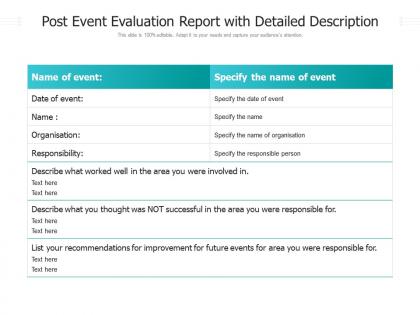
Post event evaluation report with detailed description




Try Before you Buy Download Free Sample Product
 Impress Your
 Audience
 100%
100% Editable
 Save Hours
 of Time


Our Post Event Evaluation Report With Detailed Description are topically designed to provide an attractive backdrop to any subject. Use them to look like a presentation pro.
People who downloaded this PowerPoint presentation also viewed the following :
Post event evaluation report with detailed description with all 2 slides:
Use our Post Event Evaluation Report With Detailed Description to effectively help you save your valuable time. They are readymade to fit into any presentation structure.
FAQs for Post event evaluation report
Track three big things: how many people actually showed up vs. what you expected, how engaged they were (participation, feedback, social buzz), and whether it made financial sense - leads, sales, cost per person. Budget stuff is boring but you'll hate yourself later if you don't track it. Participant satisfaction and Net Promoter Scores are honestly the best way to know if you nailed it. Write down what went wrong operationally too. Oh, and collect this data while it's happening, not weeks later when everyone's forgotten half of what occurred. People's memories are terrible.
Get that survey out within 48 hours max - people forget stuff fast. Mix rating scales with open-ended questions so you're not just getting numbers. But honestly, keep it short or you'll lose people after question 5. Nobody has patience after sitting through presentations all day. Focus on the big stuff: content, logistics, overall vibe. When you're analyzing responses, look for trends instead of obsessing over that one person who complained about the coffee temperature. Oh, and break down feedback by attendee type - speakers care about different things than regular attendees do.
Honestly, templates are a game-changer for post-event stuff. You'll actually be able to compare events properly instead of scrambling through random data formats each time. Same structure means your whole team knows where to find the important numbers without digging around. Time-saver too - no more starting from scratch every single time. I'd go with something basic first: attendance, engagement, ROI, what went wrong/right. You can always add more later. Trust me, once you get everyone using the same format, those post-event reports become way less painful.
Look, this is where most people mess up - they totally forget what they actually wanted from their event. Pull out whatever proposal or planning doc you wrote months ago. See that goal about "increasing brand awareness by 30%"? Don't ask people if they had a good time. Ask them to name three brands they remember from the event. Your survey questions should match up with those original targets you set. I've watched so many organizers get distracted by generic feedback when they should be measuring the stuff that actually matters. Each goal needs its own question. Otherwise you'll never know if you hit what you were aiming for.
Honestly, you need both quick wins and the long game here. Right after your event, survey people about new connections and conversation quality - plus which formats actually worked for networking. I always throw in follow-up questions too because some activities just flop for meeting people. But here's the thing - circle back in like 30-60 days to see what stuck. That's where you'll find the real partnerships and deals that came from your event. The best feedback? When someone mentions they're still chatting with a contact from months ago.
Honestly, post-event feedback is a game changer - it stops you from making the same dumb mistakes over and over. Get input from everyone: attendees, vendors, your whole team. What actually worked vs what you hoped would work? Those early events of mine... yikes. But the patterns you'll spot are super helpful. Like maybe your check-in process always creates chaos, or certain venues are just cursed. Document everything while it's still fresh in your head. Then use all that info to build better templates and refine your go-to vendor list. Future you will thank present you, trust me.
Honestly, I'd just go with SurveyMonkey or Typeform - they're super easy and get the job done fast. Google Forms is solid too if you're trying to save money. Most of the time you can just throw the results into a basic spreadsheet, which is totally fine unless you're running some massive conference or whatever. Oh, and check if your event platform already has feedback stuff built in - Eventbrite does this, saves you from juggling multiple tools. Just pick something simple that you'll actually want to use again. I've seen people get all fancy with complicated systems and then never touch them.
Oh yeah, there's totally a connection there! People who actually participate during events - like asking questions or networking - always rate things higher afterward. Makes sense, right? They're getting way more out of it than someone just zoning out in the back row. I've noticed session attendance and Q&A participation usually match up pretty well with your satisfaction scores later. Honestly, sometimes the correlation is almost scary how tight it is. Your best bet is creating tons of ways for people to jump in throughout the day. Do that and your ratings will probably go up too.
Honestly, I'd focus on four main things when judging speakers. First - did they actually know what they were talking about? Nobody wants someone clearly making stuff up on the spot. Content quality matters. Then look at how they delivered it and whether people stayed engaged or were just on their phones the whole time. Also check if what they said matched your event's actual goals - sometimes speakers go totally off-track. Quick surveys after each session work great for getting honest feedback. Oh, and definitely note if they stuck to their time slot because that affects everything else on your schedule!
Oh this is actually pretty easy! Set up monitoring for hashtags, mentions, and geotags during your event - Twitter, Instagram, LinkedIn, whatever. Hootsuite and Brandwatch work great, or just use Google Alerts if you're being cheap about it. Honestly, social media gives you way better feedback than those boring surveys nobody fills out anyway. People post their real thoughts when they think you're not watching. Screenshot the good comments for later marketing stuff (trust me on this). Watch for patterns in what people complain about or love. Just make sure you're tracking everything live, not trying to catch up after.
Budget totally controls how thorough you can get with evaluation. Limited cash? You're looking at basic surveys and whatever internal data you can scrape together. More money opens up external evaluators, proper attendee interviews, solid ROI analysis, plus all those analytics tools that actually work. I've watched so many teams completely skip evaluation because they spent everything on the event itself - honestly drives me crazy. Here's what works: earmark 5-10% of your total budget for post-event analysis right from day one. Otherwise you'll be sitting there after the event wondering how to pay for the insights you actually need.
Skip the generic stuff and focus on actual findings with clear next steps. Different people need different info - your sponsors don't care about the same details as your venue team. Pick 3-5 key improvements and assign owners with deadlines. Honestly, most post-event reports are just boring data dumps that nobody reads. Include your wins AND your failures with equal detail. The golden rule? Schedule follow-ups within two weeks while everything's still fresh in people's minds. Trust me, stakeholders will actually act on focused insights instead of ignoring another 20-page report.
Don't wait forever to collect feedback - people forget details super quickly. Also, skip the yes/no questions and avoid getting stuck in blame mode (kills honesty every time). You'll want input from everyone involved, not just whoever speaks loudest. Leading questions are useless too - they just tell you what you already think. Oh, and this might be obvious but actually DO something with the feedback instead of filing it away. I've seen so many post-event reports that never see daylight again. Mix up your questions between what worked and what didn't.
Rating scales are cool but those open text boxes? That's where the real stuff is. People get super honest when they're typing - sometimes way too honest lol. You'll find out which speakers bombed, what went wrong behind the scenes, stuff you never would've thought to ask about. The complaints usually follow patterns too, so you can actually fix things next time. Plus grab some of those comments for your report - way better than just showing charts. Those little stories make everything click. Numbers tell you what happened, but the written feedback tells you why it happened.
Do both honestly. Right after it happens, grab everyone for a quick debrief while everything's still fresh - people forget details crazy fast. Then circle back maybe a week later once everyone's calmed down. That second one hits different though. What felt like total chaos might've actually gone pretty smooth, or you'll catch stuff you completely missed when you were in the thick of it. I'd literally put both meetings on the calendar before you even start the project. Otherwise you'll definitely forget the follow-up one.
No Reviews