


Project management process with activities and deliverables




Try Before you Buy Download Free Sample Product
 Impress Your
 Audience
 100%
100% Editable
 Save Hours
 of Time


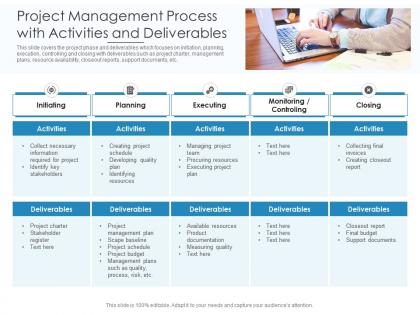
This slide covers the project phase and deliverables which focuses on initiation, planning, execution, controlling and closing with deliverables such as project charter, management plans, resource availability, closeout reports, support documents, etc.
People who downloaded this PowerPoint presentation also viewed the following :
Project management process with activities and deliverables with all 2 slides:
Use our Project Management Process With Activities And Deliverables to effectively help you save your valuable time. They are readymade to fit into any presentation structure.
FAQs for Project management process with
So there's five main phases: initiation, planning, execution, monitoring/controlling, and closing. They kinda flow into each other like dominoes. First you figure out what you're actually trying to accomplish (initiation), then map out how you'll get there - seriously, don't skip this part even if everyone's breathing down your neck to start. Execution is the fun part where stuff actually happens. Monitoring runs alongside everything to catch problems early. Oh, and it's not really linear - you'll bounce between phases constantly. Like, monitoring will send you back to planning when things go sideways. Trust me on the planning thing though.
Dude, stakeholder communication can totally make or break your project. I've watched so many things go sideways because people felt ignored or blindsided. You gotta map out who needs what info first - sounds boring but trust me on this. Then just stick to regular check-ins and be super transparent about what's actually happening. Don't sugarcoat the messy stuff either. When stakeholders feel heard and in the loop, they'll have your back when things get complicated. Oh, and managing expectations early saves you from those awful "wait, I thought we were doing X" conversations later.
Honestly, Asana and ClickUp are pretty great for most stuff - they've got Gantt charts, task dependencies, the works. Monday.com is solid too. Microsoft Project is like the old reliable option if you need all the bells and whistles, but it's honestly way too much for most teams. Trello's perfect if you just want something simple with kanban boards. Here's the thing though - whatever your team will actually stick with is better than the "best" tool that sits unused. I'd grab free trials of maybe 2-3 options and see what feels right. Sometimes the simpler choice wins out.
Think of risk management as your project's insurance policy - you'll want it baked in from the start. During planning, list out everything that could potentially blow up. Then keep that risk list alive throughout the project, updating it as things change. Honestly, most people treat this like a checkbox exercise and wonder why they get blindsided later. Make it part of your regular team check-ins instead. At every big milestone, just ask "what's gonna bite us next?" Then actually plan for those top few risks. Trust me, future you will be grateful when something inevitably goes sideways and you're not scrambling.
Honestly, weekly check-ins are a game changer - just don't make them feel like interrogations. I always put people's names right next to their deliverables because nobody wants to be the person who drops the ball publicly. Shared dashboards work great too, everyone can see what's happening without you having to chase updates constantly. The buddy system thing might sound cheesy but it actually works? People care more about not letting their teammate down than disappointing management. Define who does what upfront though - vague roles kill projects faster than anything. Make it collaborative, not micromanage-y.
Honestly, Waterfall's great when you know exactly what you want from day one - like building compliance systems or actual construction. Requirements won't change much there. But software dev? Marketing campaigns? Go Agile all the way since you'll need tons of client feedback and flexibility. I've watched teams try cramming Agile into everything though, which gets messy fast. Research projects work better with some hybrid thing that mixes structure and adaptability. Really comes down to how much your requirements will shift mid-project and how involved stakeholders want to be. That's your starting point right there.
Honestly, document EVERYTHING upfront - like seriously everything. Break down exactly what you're doing and what you're not doing, then get everyone to sign off on it. I made this mistake before and it was a nightmare lol. When people ask for extra stuff (and they will), just say "that's outside our agreed scope." Don't feel bad about it! Set up some kind of formal process where scope changes need written approval first. Also make it crystal clear that new features = more time or money. People think they can just tack things on for free but that's not how it works.
Get your change control process locked down right away - trust me on this one. You'll want everything documented so when stakeholders start throwing random requests at you, you can actually assess them properly. Be honest about timeline and budget impacts instead of just nodding along to keep people happy. That honesty pays off way more than you'd think. Keep a change log tracking requests and approvals. When you show them how their "quick addition" pushes the deadline back two weeks, suddenly they realize what's actually critical versus just wishful thinking.
Honestly, your project's budget can make or break everything. Get it wrong upfront and you'll either run out of money halfway through or have to cut corners on the good stuff. I always add like 15-20% padding because something always goes sideways - trust me on this one. Bad budgeting creates so much unnecessary drama too. Your team gets stressed, deadlines become impossible, and management starts breathing down your neck. Track your spending every week though, not monthly. Catching problems early saves you from those awkward "we need more money" conversations later. Been there, it sucks.
Look, metrics basically show you if your project's actually on track or if you're fooling yourself. I always check schedule variance first - tells you right away if you're behind. Budget burn rate catches overspending before it gets ugly. Quality indicators are huge too because nobody wants to ship crap. Oh, and resource utilization shows when your team's either drowning or sitting around bored. Don't go overboard though - pick maybe 3-4 that actually matter for your situation. I just throw them in a simple dashboard and review weekly with everyone. Way better than flying blind.
Do it within 2-4 weeks while people actually remember what happened. Make sure everyone feels safe being honest - no blame game bullshit. I always stick to three questions: what worked, what sucked, and what we'd change. Don't just invite your usual team either, get everyone who touched the project. Write everything down and give people actual tasks to fix stuff. Oh, and here's the kicker - you've gotta bring up these lessons when you start the next project. Otherwise you're basically just paying people to vent for an hour.
Ugh, cultural stuff can totally derail your timeline if you're not paying attention. Some people won't push back on your ideas because of respect/hierarchy things, while others will argue immediately. Time zones are already a pain - cultural miscommunication just makes it worse. People interpret "urgent" differently too, which is honestly so frustrating. You'll notice different approaches to conflict and decision-making. I'd set communication expectations early and just ask people directly how they prefer to work. Also ask about any cultural things you should know. Way easier than guessing!
Honestly, when projects go sideways, your team's gonna look to you for answers. You can't just disappear or freak out - I've watched that tank so many projects. Break the mess into smaller chunks they can actually handle. Keep everyone calm and make sure they know what they're supposed to do. The tough calls? That's on you, but don't dump all the stress on your team. Oh, and definitely keep your stakeholders in the loop or they'll make things worse. Practice being upfront about problems even when everything's fine - you'll thank me later.
Dude, visual tools literally save my sanity on projects. Gantt charts are clutch for seeing dependencies and figuring out where stuff's getting stuck. Kanban boards though? That's where it gets addictive - dragging cards from "in progress" to "done" hits different, I swear. Both help you chop up massive projects so they don't feel overwhelming. Plus you'll spot team burnout way faster when someone's column is packed. I'd say just pick whatever clicks with how your team already works. Oh, and pro tip - start simple or you'll get lost in features.
Honestly, don't wait till the end to check your work - that's a recipe for disaster. Build quality checks right into each phase instead. First thing: nail down your acceptance criteria upfront. Then set up regular reviews at major milestones. Peer reviews are clutch for catching stuff early. I'd also create feedback loops with stakeholders throughout (saves so much headache later). Track your metrics and issues as you go too - you'll start seeing patterns way sooner. Oh, and make quality everyone's problem, not just something you dump on QA at the finish line.
-
Nice and innovative design.
-
Best way of representation of the topic.
-
Great quality product.