


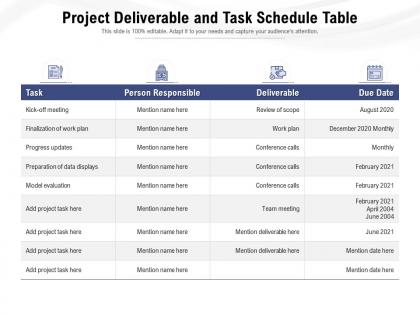
Project deliverable and task schedule table




Try Before you Buy Download Free Sample Product
 Impress Your
 Audience
 100%
100% Editable
 Save Hours
 of Time


Our Project Deliverable And Task Schedule Table are topically designed to provide an attractive backdrop to any subject. Use them to look like a presentation pro.
People who downloaded this PowerPoint presentation also viewed the following :
Project deliverable and task schedule table with all 2 slides:
Use our Project Deliverable And Task Schedule Table to effectively help you save your valuable time. They are readymade to fit into any presentation structure.
FAQs for Project deliverable and
So there are five main phases you'll deal with: initiation, planning, execution, monitoring, and closure. First you define scope and get everyone on board. Planning's where you map out timelines and resources - seriously, this part will save your ass later so don't skip it. Then your team actually does the work during execution. Monitoring means tracking progress and putting out fires. Closure wraps everything up with a post-mortem. Oh, and leadership will always push you to start ASAP, but resist rushing through planning. Trust me on that one.
Honestly, just talk to people constantly - that's like 90% of it. Map out who needs what updates and when, because I've learned the hard way that someone always gets left out otherwise. Set realistic deadlines from the start and actually explain why you're making certain calls. People are way more chill when they get the reasoning behind trade-offs. Oh, and those regular check-ins? Total game changer compared to dropping bad news out of nowhere. Write stuff down too - saves you from the whole "but I thought we agreed on..." drama later. Seriously, start those regular touchpoints ASAP.
Honestly, start by breaking everything into smaller chunks - makes it way less overwhelming. I always do three-point estimates: best case, worst case, and realistic timeline for each piece. Your team members are gonna know the work better than you anyway, so get them involved in estimating. Old project data is seriously your best friend here if you have it. Oh and definitely pad your timeline - I learned this the hard way lol. Usually tack on like 15-20% extra because something always goes sideways. Gantt charts help you see the whole picture and catch problems early. Trust me on the buffer time thing though, you'll thank yourself later.
Honestly, risk management can totally save your project from going off the rails. I learned this the hard way on a project last year - we thought everything would go smoothly and then boom, three major issues hit at once. Now I always do a quick risk assessment upfront and check it weekly. Takes maybe 15 minutes but prevents so much chaos later. You'll stay on budget, hit your deadlines, and avoid those awful last-minute scrambles where everyone's panicking. Trust me, even teams that think they're bulletproof get blindsided. Don't be that team.
Honestly, good communication is huge - probably the biggest factor in whether projects actually work out. Your team needs to talk openly about what's expected, what's going wrong, progress updates, all that stuff. Otherwise people get confused and things fall apart fast. I've watched so many projects crash just because nobody was keeping each other in the loop! Getting different viewpoints helps you spot issues before they blow up too. Regular check-ins are key. Oh, and make sure people feel okay speaking up when something's off - that saves you later.
Dude, Agile basically makes everything way more flexible. You break projects into short sprints instead of trying to plan the whole thing upfront (which never works anyway). Daily standups keep everyone on track - though honestly some teams make them way too long. The cool part is stakeholders see actual working stuff every few weeks rather than waiting forever for the final thing. Retrospectives help you figure out what's broken in your process. You'll deliver value so much faster. Just pick one project to try it on first and see how it goes.
Okay so honestly, start with just three things: a project management tool (Asana or Monday work great), time tracking like Toggl, and Slack for team chat. Don't go crazy with a million tools - I've watched teams drown in that mess. Gantt charts are actually pretty clutch for showing stakeholders what's up. The real game changer is getting tools that sync with each other because manually updating everything separately is hell. Centralized dashboards make reporting way easier too - you can see progress, budget, timelines all in one spot. Pick one solid PM tool first, then add stuff as you need it.
Oh man, cultural stuff will definitely trip you up more than time zones ever will. Some cultures are crazy direct, others beat around the bush forever - and suddenly nobody knows what the actual deadline is. Hierarchy matters way more in some places too, like you can't just skip levels to get decisions made. Honestly, what people even consider a "real commitment" varies so much it's wild. Do your homework on their norms first. Then pad your timeline because you'll need those extra alignment talks, trust me.
Honestly, I just focus on three things: impact, urgency, and what's blocking other people. Figure out which tasks actually move the needle on your main project - those come first. Deadlines matter too, obviously. Dependencies are annoying but super important - like if Sarah can't start her part until you finish yours, bump that up. I learned this the hard way when I held up my whole team once. Quick wins are tempting but don't get sucked into busy work. That matrix thing actually helps - draw impact vs urgency and tackle the scary top-right corner first.
So honestly, start with the obvious stuff - did you hit your timeline, budget, and scope? But that's kinda the easy part. What really matters is whether people are actually using what you built and if stakeholders are happy with it. ROI numbers don't lie either. I always tell people to wait like 30-60 days after wrapping up, then do a proper review meeting. Get real feedback from users, not just the higher-ups who signed off on it. That's where you'll find out if you actually succeeded or just... technically delivered something on time.
Dude, scope management literally saves your ass on projects. Clients will try to sneak in "tiny changes" that aren't tiny at all - trust me on this one. What you need is crystal clear documentation of what's included and what's not. Get everyone to sign off before you start anything. Otherwise you'll end up working twice as hard for the same money while your timeline goes to hell. I learned this the hard way on a project last year. Just be ruthless about sticking to what you agreed on initially. It feels awkward saying no, but it's way better than project chaos.
Dude, templates are seriously a lifesaver. You know how you spend forever making the same documents over and over? Templates fix that - just fill in your project details and you're done. I was totally guilty of starting from zero every single time until I got smart about it. They keep your projects looking consistent too, plus you won't forget those random steps that always slip through the cracks. Oh, and start simple - grab basic ones for project plans and weekly check-ins. The time you'll save is honestly ridiculous.
Oh man, communication is gonna be your biggest headache - people just don't sync up when they're all over the place. Time zones are awful too, honestly. Video calls help tons though, and I'd definitely get something like Trello or Asana so you can actually see what's happening with projects. Document everything because someone's always gonna miss the meeting. Maybe rotate meeting times so it's not always the same person getting screwed over by scheduling? Oh and set up some basic rules about how people should update the team. Start simple with one good routine first.
Honestly, you've gotta nail down a change control process right from the start. Changes will happen - they just will. Don't give an immediate yes or no though. Take time to figure out how it'll mess with your timeline, budget, and team first. Document everything and get written approval from stakeholders before you do anything (this saves your butt later, trust me). I usually whip up a quick analysis showing what we gain vs what we lose. It's kinda like showing them the price tag upfront. Changes can actually be good opportunities if everyone knows what they're trading off.
Communication, organization, and adaptability - those are the big three for sure. When devs tell you "it's complicated" but your boss wants a timeline, you're basically a translator. Organization keeps everything from turning into chaos (and trust me, it will try). Things always go sideways though, so being flexible saves your sanity. Oh, and time management plus conflict resolution are total game-changers too. I'd honestly start with communication first - get good at explaining tech stuff in normal words and asking the right follow-up questions. That skill alone will carry you pretty far.
-
Nice and innovative design.
-
Professional and unique presentations.