

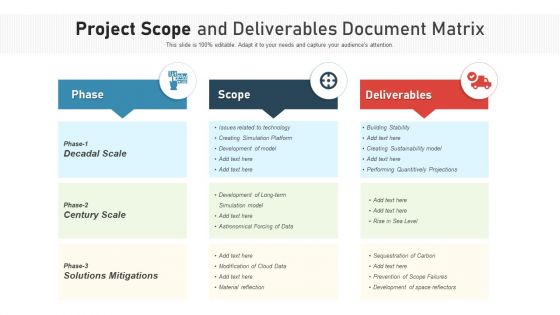
Project scope and deliverables document matrix




Try Before you Buy Download Free Sample Product
 Impress Your
 Audience
 100%
100% Editable
 Save Hours
 of Time


Our Project Scope And Deliverables Document Matrix are topically designed to provide an attractive backdrop to any subject. Use them to look like a presentation pro.
People who downloaded this PowerPoint presentation also viewed the following :
Project scope and deliverables document matrix with all 2 slides:
Use our Project Scope And Deliverables Document Matrix to effectively help you save your valuable time. They are readymade to fit into any presentation structure.
FAQs for Project scope and
Okay so a project scope matrix is just a visual grid that shows your deliverables mapped against stakeholders, phases, or requirements. Way more useful than those long scope statements that nobody reads. You can actually see who's doing what and when - makes it super obvious if something's falling through the cracks. I always make mine right after the scope statement is done because honestly? People will forget what they agreed to. The matrix saves you from those awkward "wait, I thought YOU were handling this" conversations later. It's like a smart checklist that actually prevents drama.
So basically, a project scope matrix is like your best friend when dealing with scope creep. You write down everything that's included (and what's NOT) right at the start. Then when people inevitably show up asking for "just one tiny change" - and trust me, they always do - you've got something solid to point to. It makes everyone think twice about whether their brilliant new idea is actually worth blowing up the timeline and budget. The trick is actually pulling it out during meetings instead of letting it collect digital dust. Honestly, half the battle is just having that documentation ready to go.
So for your scope matrix, you'll want deliverables (the actual stuff you're making), tasks to get there, timeline with milestones, and resource needs. Boundaries are huge - what's in vs out. I used to skip the "what we're NOT doing" part and wow, that was dumb. Caused so many arguments later. Stakeholders go in there too, plus acceptance criteria and any dependencies. Oh and constraints - budget limits, whatever. Start simple with a basic template, then tweak it based on how complex your project gets. The exclusions section honestly saves your butt more than anything else.
So basically, before you start anything, sit down with your team and map out what's actually included in the project vs what's not. I like to make three buckets - "definitely doing this," "maybe if we have time," and "nope, not happening." Walk through everything with stakeholders during planning. Get them to actually agree on the boundaries - like, make them say it out loud. Trust me, when someone comes back later asking for "just one small addition" (and they will), you can point to your matrix and be like "remember we agreed this was out of scope?" Have everyone sign off on it and keep that thing visible throughout the whole project.
Honestly, the matrix thing is a total lifesaver - you can see everything at once instead of scrolling through a million docs. Scope creep becomes obvious immediately, same with missing stuff or when people are stepping on each other's toes. The grid lets you match deliverables with timelines or whoever's responsible, depending on what you need to track. Stakeholders love it too because they don't have to guess what's included. I'd say start simple - maybe just deliverables against project phases? You can always add more columns later if you need them.
Honestly, you can't catch everything on your own - that's where stakeholders come in clutch. They'll spot stuff you'd never think of, like random compliance requirements or integration headaches that weren't in the original brief. Users especially will call out the obvious gaps you somehow missed. Getting everyone involved early means they actually care about the outcome too, which is huge. Their expertise helps you figure out what's realistic and what's total fantasy. Dependencies between different parts? They know that stuff cold. I'd do two review sessions while you're building your matrix - maybe more if it's a messy project. Trust me, it's worth the extra meetings.
So for agile, your project scope matrix needs to be super flexible - like a living doc that changes constantly. Don't try defining everything upfront like waterfall does. Focus on high-level themes and user stories instead. I've watched teams crash and burn trying to nail down every detail early on! Set up columns for sprint priorities and acceptance criteria rather than getting into technical weeds. Update that thing every sprint based on feedback and whatever new curveballs come up. Waterfall's totally different - you map out comprehensive boundaries from the start. But honestly, agile matrices work best when you treat sprint planning as your regular update time.
Honestly, scope matrices are a lifesaver because they stop those annoying "wait, I thought that was included" conversations. Put everything visual - what's in, what's out, and those weird gray areas that always trip people up. When scope creep starts happening (and it will), you can literally point to the matrix instead of arguing about it again. Make it early and stick it somewhere everyone can find it. I learned this the hard way after too many projects where people had totally different ideas about deliverables. Trust me, it's way better than constantly re-explaining what you're actually building.
Honestly, the worst thing you can do is be vague about boundaries. You'll get hit with "wait, I thought this was part of it" nonstop later. Get stakeholders involved when you're writing it - skipping that step is basically shooting yourself in the foot. Oh, and don't treat it like some static document you write once and forget. It needs to change as your project does. Make sure you clearly spell out what's NOT included too. That part trips people up all the time. Get everyone important to actually sign off before you start anything.
So basically you want to map each scope item to actual tasks in your Gantt chart. Connect it with your risk register too - seriously saves you from scope creep headaches later. Your WBS should match up with the matrix structure. Monday and Asana are pretty good at letting you cross-reference everything without jumping between a million tabs. Main thing is updating them at the same time, not doing one then forgetting the other. Export your scope matrix into whatever PM tool you're using first. Then set up alerts when scope stuff changes so everything stays current automatically.
Honestly, that project scope matrix is gonna save your butt when budget time rolls around. Map out who's doing what work, then you can actually estimate costs instead of just throwing numbers around. I always build mine super early - like, before anyone even asks about resources. When stakeholders see all that detail laid out, they're way more likely to approve your requests. Plus you'll catch those annoying resource conflicts before they mess everything up. Trust me, it beats going into meetings and just winging it with rough guesses.
Schedule weekly check-ins to review your scope matrix - bi-weekly works too if things aren't moving fast. Someone specific needs to own this (your PM probably), otherwise it just won't happen. Trust me on that one. Set up reminders and use tools where people can flag changes as they come up. The matrix should be alive, not gathering dust after you make it. Oh, and when changes get approved? Update it right away and tell everyone. I've seen too many projects where the matrix becomes totally useless because nobody keeps it current.
Track your scope completion percentage first - that's the big one. Also watch for scope creep beyond your original matrix. Budget variance will probably shock you (it always does). Timeline adherence for each piece matters too. Don't forget stakeholder satisfaction with what you're delivering. Your matrix basically defines what "done" means, so treat it like gospel. Weekly check-ins comparing real progress to the matrix catch problems fast. Oh, and the budget thing? Yeah, there's usually surprises there no matter how well you plan.
So basically, a project scope matrix is like drawing a fence around your project - you can actually see what's included and what's not. Makes spotting risks way easier when everything's mapped out visually. You'll catch stuff like resource conflicts or those deadlines that make you go "yeah right." Honestly, the best part is having something concrete to point to when people try adding random requests later. Use it to figure out how changes mess with your timeline and budget. Oh, and actually update the thing - reference it in your risk meetings or it's just pretty wall art.
Honestly, construction companies are probably your best bet - they've mastered this stuff out of necessity. Software teams like Spotify have solid release planning templates you can check out. Healthcare IT uses scope matrices for compliance vs functionality (bit of a nightmare but good examples). Manufacturing does product launch matrices too, mapping R&D to market needs. I'd hit up PMI's database first though - tons of real templates there. Your industry's PM communities usually share the good stuff. Start there and just adapt whatever fits your project. Way easier than building from scratch.
-
Editable templates with innovative design and color combination.
-
It saves your time and decrease your efforts in half.
-
Unique design & color.
-
Wonderful templates design to use in business meetings.