


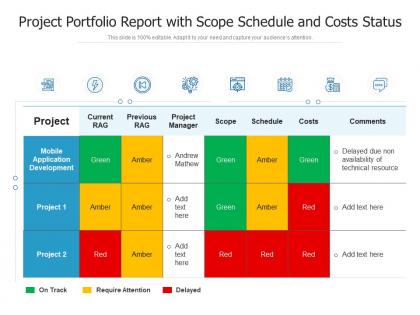
Project portfolio report with scope schedule and costs status




Try Before you Buy Download Free Sample Product
 Impress Your
 Audience
 100%
100% Editable
 Save Hours
 of Time


Our Project Portfolio Report With Scope Schedule And Costs Status are topically designed to provide an attractive backdrop to any subject. Use them to look like a presentation pro.
People who downloaded this PowerPoint presentation also viewed the following :
Project portfolio report with scope schedule and costs status with all 2 slides:
Use our Project Portfolio Report With Scope Schedule And Costs Status to effectively help you save your valuable time. They are readymade to fit into any presentation structure.
FAQs for Project portfolio report with scope schedule
So basically PPM helps you figure out which projects actually matter for your business goals - no more spinning wheels on random stuff. You get way better visibility into what's working and what isn't, plus smarter decisions about where to spend your budget and people. The risk management piece is huge too since you're seeing the big picture instead of just individual projects. Honestly, most companies are terrible at prioritization without it. I'd start by just mapping what you're currently doing against your actual business objectives - you'll probably find some weird gaps pretty quickly.
So PPM is like having a bouncer for your projects - only the ones that actually help your business get through the door. You know how we always get excited about new ideas and want to do everything? This forces you to step back and ask "does this actually matter for our goals?" Define what you're trying to achieve first, then be brutal about measuring every project against those objectives. The good ones get priority, the rest get axed. Honestly, most companies are terrible at this - they just chase whatever sounds cool instead of what moves numbers.
Honestly, the hardest part is just getting people on board - nobody wants another new system when they're already drowning in work. Data's usually a mess too since every team tracks stuff differently (or doesn't track anything at all). Once you implement PMO processes, resource conflicts become super obvious, which is actually helpful but feels brutal at first. Oh, and good luck dealing with all the random tools that don't talk to each other. My advice? Start with just one team as a pilot. Get some quick wins to show it works, then expand from there. Way less painful than trying to change everything at once.
Track the obvious stuff first - ROI, NPV, budget vs actual, timeline performance. But honestly, the strategic metrics matter just as much. Are projects actually moving the needle on business goals? Check resource utilization and stakeholder satisfaction too (those surveys can be brutal but they're telling). Monthly dashboard reviews with leadership work well - just don't go overboard picking metrics. Stick with 4-5 that really matter to your org instead of tracking everything under the sun. You'll burn out your team otherwise.
Honestly, risk management can make or break your whole portfolio. You've got to spot risks at both project and portfolio levels - but here's the thing that caught me off guard: sometimes "safe" projects can screw you over if they all need the same resources or tech stack. Map out how your projects connect to each other first. Then run some worst-case scenarios regularly. What if your biggest project tanks? What if that key vendor disappears? The portfolio-level stuff is way trickier than just adding up individual project risks.
Start with a scoring system for each project - revenue potential, how well it fits your goals, what resources you'll need. Honestly, a basic spreadsheet works perfectly for this. Weight everything based on what's actually important to your business right now. Then just rank them with numbers. Don't ignore project dependencies though - some things have to happen before others can start. Also be realistic about your team's bandwidth because we all know how that goes. The highest scoring projects that fit your current capacity should get first dibs. Just run your existing projects through this process and you'll spot the winners pretty quickly.
Honestly, it depends on how big your portfolio is. Microsoft Project Online or Smartsheet are solid choices to start with - they handle most stuff pretty well. Clarity PPM and Planview are beasts if you're dealing with really complex portfolios, but man, sometimes they feel way too heavy. Monday.com and Asana are perfect for simpler projects though. Your team won't get lost in a million features they don't need. Here's the thing - pick what actually matches how you guys work, not just the shiniest tool. Grab free trials of like 2-3 options and see what sticks.
Honestly, resource allocation can make or break your whole portfolio. Spread yourself too thin and everything turns to crap - timelines drag, quality tanks, you name it. I'd rather see three solid wins than ten half-baked projects any day. Kill the stuff that's not working, even if it hurts. Put your A-team on whatever's gonna move the needle most. Oh, and check your resource usage pretty regularly - don't just set it and forget it. When priorities change (and they always do), you've gotta be ready to shuffle things around fast.
Dude, stakeholder engagement is literally what makes or breaks PPM. Get them involved early and they'll actually buy into your decisions - plus you won't get blindsided later when priorities shift. The best part? People stop asking those annoying "why did my project get axed?" questions because they already know the reasoning. Without decent engagement, your portfolio might look perfect on spreadsheets but nobody's really committed to making it work. I've seen too many great strategies fail just because stakeholders felt left out of the process. Keep checking in with them throughout your cycles - it's worth the extra meetings, trust me.
Build in quarterly check-ins to see what's actually working in your portfolio. Get feedback from the teams doing the work - they spot issues way before the higher-ups do. Track stuff like how you're using resources and which projects are hitting their goals. Oh, and create a space where people can talk about failures without getting their heads chopped off. Those screw-ups teach you more than the wins sometimes. Don't just collect all this data though. Actually do something with it or you're wasting everyone's time.
Honestly, start by getting rid of those project silos - they're killing you. Pull people from different projects into cross-functional teams working on shared stuff. Those portfolio meetings? Make them actual workshops where people collaborate, not boring status updates (we've all sat through those nightmares). I'd pick one area where two projects overlap and just get those teams talking first. Set up group chat channels or whatever works. Also, celebrate wins across the whole portfolio, not just individual projects. The real trick is changing your performance metrics to actually reward collaboration instead of competition. Otherwise people will keep hoarding info.
Honestly, the numbers don't lie - analytics backs up those hunches you have about which projects are actually worth it. You'll see bottlenecks coming before they hit and catch patterns across your whole portfolio that individual reports miss completely. The predictive stuff is wild too, you can basically test-drive scenarios before spending real money. Politics and opinions stop mattering as much when you've got solid data (thank god). Pick maybe 3-4 metrics that actually move the needle for your company and build some dashboards. Makes decisions way less stressful when you're not just guessing.
Honestly, visual dashboards are your best friend here - just use those red/yellow/green indicators so people can see portfolio health instantly. Monthly updates hit the sweet spot without being annoying. Lead with the biggest problems first because nobody wants to dig through three paragraphs to find out something's on fire! Executives want the high-level view while sponsors need more detail, so adjust accordingly. Oh, and always include your action plan for fixing issues, not just what's broken. Create a standard template so stakeholders know exactly where to look. Trust me, consistency saves everyone time.
Ugh, market trends are always throwing curveballs at your portfolio - you're constantly shuffling priorities and figuring out where to spend your budget. New tech pops up? Time to rethink which projects actually matter and which ones are just burning cash. Honestly, it's draining trying to stay on top of everything, but you've gotta build some wiggle room into your planning so you can switch gears fast. Your stakeholders will definitely expect you to either jump on opportunities or at least not get blindsided by disruptions. I'd suggest doing quarterly reviews focused on what's happening in your space - keeps you ahead of the game.
So project management is pretty straightforward - you're delivering one specific thing with a set timeline and budget. Program management steps it up by juggling multiple related projects that all feed into some bigger goal. Portfolio management sits at the top, basically deciding which projects and programs are worth doing based on strategy and resources. Honestly, the scope is what separates them. Project = one thing. Program = bunch of related things. Portfolio = all the things your company's doing. I'd start by figuring out where you actually fit right now - that'll help clarify which direction you want to go.
-
Great product with effective design. Helped a lot in our corporate presentations. Easy to edit and stunning visuals.
-
Great designs, Easily Editable.