


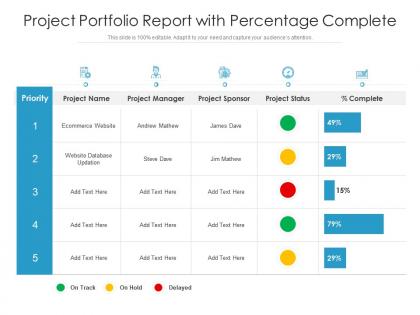
Project portfolio report with percentage complete




Try Before you Buy Download Free Sample Product
 Impress Your
 Audience
 100%
100% Editable
 Save Hours
 of Time


Our Project Portfolio Report With Percentage Complete are topically designed to provide an attractive backdrop to any subject. Use them to look like a presentation pro.
People who downloaded this PowerPoint presentation also viewed the following :
Project portfolio report with percentage complete with all 2 slides:
Use our Project Portfolio Report With Percentage Complete to effectively help you save your valuable time. They are readymade to fit into any presentation structure.
FAQs for Project portfolio report
Okay so you need three main things: strategic alignment, resource management, and performance monitoring. First step? Map your current projects against what you're actually trying to achieve as a business. Most people skip this and wonder why everything's a mess later. Set up clear criteria for picking and prioritizing projects, then figure out how you'll allocate people and budget across everything. The monitoring piece is honestly where teams screw up the most - you've gotta do regular check-ins to track progress and pivot when needed. Also don't forget governance structures so someone can make decisions when projects start stepping on each other.
First, figure out what you're actually trying to achieve - like, write it down clearly. Then score each project on how well it fits those goals, what resources it needs, and potential ROI. Honestly, most companies just wing this part and wonder why everything's a mess. Cut projects quarterly that aren't pulling their weight. Regular governance meetings help you pivot fast when things change (which they always do). Start by auditing what you have now against your strategy. You'll probably find some obvious losers to axe immediately.
Honestly, it really comes down to your team size. Microsoft Project Online and Smartsheet work great for most people. Enterprise stuff? Clarity PPM or Planview are solid but kinda pricey - probably overkill if you're just getting started. Smaller teams do fine with Asana or Monday.com since they're not intimidating to use. Here's the thing though - the "best" tool is whatever your team will actually use consistently. I've seen fancy setups sit there unused while simple ones thrive. Definitely grab free trials of like 2-3 options first. See what feels right with how you guys already work.
Honestly, just make a scorecard first - rate each project on ROI, strategic fit, resources needed, and risk. Weight the criteria so the important stuff counts more. I learned this the hard way trying to juggle everything mentally. Rank them by score, but watch out for dependencies between projects. Also factor in your team's bandwidth - no point planning what you can't actually do. Quick wins are gold for getting buy-in later. Be upfront about how you scored things so people don't think you're just picking favorites. Oh, and revisit this quarterly because priorities always shift.
Dude, you absolutely need stakeholders on your side for portfolio management. Without them, you're toast. They help prioritize projects, give strategic direction, and clear obstacles when everything goes sideways. Which it will, trust me. They also tip you off when priorities change or new stuff pops up. Figure out who actually has power over your decisions first - that's huge. Then keep them in the loop regularly, not just when you need favors. Honestly, setting up regular check-ins instead of random outreach makes relationships so much smoother. Way better than scrambling later.
Don't make the same mistake I see everywhere - treating risk like some afterthought. Score your projects on probability and impact right from the start, then factor those into your ROI rankings. Risk-adjusted returns are your friend here. Set some portfolio-level thresholds so you're not dumping everything into crazy risky stuff (learned that one the hard way). Put risk data right in your decision dashboards where stakeholders can actually see it. Makes the trade-offs super obvious and you'll get way better funding decisions. Trust me on this.
You definitely need both financial and strategic stuff. ROI and NPV are obvious ones for the money side. Resource utilization tells you if your team's drowning in work. Strategic alignment matters too - basically does this project actually help your business goals? Time-to-market and hitting milestones catch problems before they blow up. Honestly though, it really depends on what your execs care about most. Those metrics I mentioned cover the basics pretty well. Oh, and start small - pick like 3-5 metrics max. You can always add more later once you're not drowning in data.
Strategy changes are brutal - they force you to rethink your whole project lineup. Some projects suddenly don't make sense anymore and get axed. Others jump up the priority list. You'll probably need to launch new stuff too to cover the gaps your old strategy left behind. Resources get shuffled around like crazy since different priorities need different investments. I learned this the hard way at my last job - we kept funding a pet project for months after our strategy shifted. Total waste. The trick is moving fast once leadership confirms the new direction. Dragging your feet just burns cash.
Honestly, portfolio management is a lifesaver for resource headaches. You get this overview of everyone's workload across all projects - super helpful for catching who's drowning vs. sitting around. Plus you can actually prioritize the stuff that matters and pull people off dead-end projects. The best part? Spotting skill gaps early instead of scrambling later. I learned this the hard way last year when we had three teams all needing the same specialist at once. Start by just mapping what you've got now - bet you'll find some weird resource black holes you didn't even know existed.
Honestly, you're gonna be dealing with resource conflicts constantly - everyone wants the same people at the same time. Priorities shift like crazy too, which makes planning feel pointless sometimes. Communication between teams? Total mess most of the time. Plus you'll get hit with unrealistic deadlines and scope creep on basically every project. The data situation is usually garbage, so tracking anything becomes this whole ordeal. Oh, and trying to keep everything aligned with business strategy while juggling all this? Good luck with that. Get some decent reporting tools first - seriously, it'll save your sanity. Then focus on governance processes upfront.
So basically you're looking at total gains vs what you put in across everything. Add up all the good stuff - more revenue, money saved, whatever - then subtract what the whole portfolio cost you. Divide that by your total investment and boom, there's your percentage. Here's the annoying part though: some benefits show up way later than others. I'd pick like a 2-3 year window so you're comparing apples to apples. Oh and definitely track each project separately too - you don't want a few rock stars hiding the duds. First figure out what counts as a "benefit" for your company since that varies.
Honestly, start by figuring out who needs what info and how often. Monthly stakeholder meetings work great - use those visual dashboards because execs eat that stuff up. Mix up your communication style too. Give leadership the business impact angle while your project teams get the nitty-gritty metrics they actually want. Set up clear escalation paths so problems don't get buried (learned that one the hard way). Regular touchpoints are key, but don't overdo it. Oh, and keep your reporting formats consistent across everything - makes life way easier when you're juggling multiple projects.
Honestly, leadership buy-in is everything here - they need to actually use the PPM data, not just pretend to care. Focus on teaching the "why" behind it all instead of just boring process steps. Nobody wants more bureaucracy! Set up feedback loops so teams can see their input matters in real decisions. When someone kills a dead project early or moves resources around smartly, make noise about it. Celebrate those wins. Oh, and keep everything as simple as possible - if it feels like pointless paperwork, you're done for. People will check out immediately.
Project portfolio management is getting a major makeover right now. Predictive analytics help spot risks before they blow up, and automation handles boring stuff like resource allocation. Real-time dashboards actually make sense now too - thank god, because the old ones were awful. Companies are ditching those rigid annual planning cycles for continuous prioritization instead. Way more agile. Remote work obviously changed everything with collaboration tools becoming essential. It's honestly pretty overwhelming keeping up with all this stuff. But the upside? Portfolio decisions are becoming way more data-driven instead of just gut feelings. I'd start by automating whatever repetitive tasks are eating up your time.
Ditch the yearly planning thing - it's basically useless now. Do quarterly reviews instead, maybe even monthly if things are moving fast. Those heavy governance meetings? Replace them with quick check-ins focused on whether you're actually delivering value. Rolling roadmaps are your friend here since you can pivot when something's not working (which happens more than we'd like to admit). The real trick is connecting what your portfolio people decide with what dev teams learn during sprints. Pick your biggest wins first, then let teams experiment within those guardrails while keeping everyone pointed in the same direction.
-
Best way of representation of the topic.
-
Designs have enough space to add content.
-
Excellent products for quick understanding.