


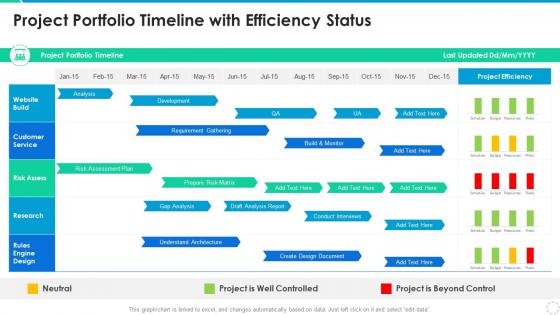
Project Portfolio Timeline With Efficiency Status




Try Before you Buy Download Free Sample Product
 Impress Your
 Audience
 100%
100% Editable
 Save Hours
 of Time


Our Project Portfolio Timeline With Efficiency Status are topically designed to provide an attractive backdrop to any subject. Use them to look like a presentation pro.
People who downloaded this PowerPoint presentation also viewed the following :
Project Portfolio Timeline With Efficiency Status with all 6 slides:
Use our Project Portfolio Timeline With Efficiency Status to effectively help you save your valuable time. They are readymade to fit into any presentation structure.





FAQs for Project Portfolio Timeline
Honestly, start by checking if your current projects actually match your business goals - so many companies skip this basic step and wonder why nothing works. You'll need solid resource management and some kind of governance structure to keep everything organized. Risk assessment is huge too, plus you want performance monitoring so you can see what's actually delivering ROI. Communication with stakeholders matters more than people think. Oh, and having a clear framework for deciding which projects get priority will save you tons of headaches later. The governance part basically holds it all together, but yeah - audit what you've got first.
Start by figuring out which projects actually support your business goals - seriously, if you can't draw a clear line, why are you doing it? Build a simple scoring system that looks at strategic value, ROI, and what resources you'll need. Too many companies get distracted by the latest shiny thing (guilty as charged sometimes). Check in every quarter to make sure things haven't drifted off course. And here's the hard part - you've got to be willing to kill projects that aren't working anymore. Being ruthless about priorities is honestly the only way to make sure your project budget actually moves the needle.
Track both the money stuff and strategic metrics to get the real picture. ROI, NPV, budget variance - classic financial ones you need. But honestly, most PMs get way too fixated on just those. Strategic alignment scores matter too, plus resource utilization, time-to-market, risk levels. Don't forget customer satisfaction and how engaged your team is on portfolio projects. Create a balanced scorecard that shows if you're actually delivering value, not just hitting budget targets. Stick to maybe 5-7 metrics max and review monthly - any more gets overwhelming.
Think of risk management as your backup plan when handling multiple projects. First, map out how your projects depend on each other - that's where the real trouble usually starts. One project tanks and suddenly three others are screwed too. Look beyond individual project risks and spot where they're competing for the same people or budget. I'd honestly prioritize based on what could actually wreck your bigger goals. Mix your high-risk stuff with safer projects so you're not betting everything on moonshots. Dependencies are sneaky - they'll bite you if you don't flag them early.
Resource conflicts are the absolute worst - plus you're dealing with unclear priorities and projects that don't actually match business goals. Everyone thinks their stuff is urgent (which honestly makes me want to scream). Get your executives to agree on how you'll prioritize things first. Then grab some decent resource planning tools so you can spot the trainwrecks coming. Oh, and those portfolio reviews everyone complains about? They actually help. Set up governance that people will follow instead of another useless meeting. Start with being transparent about everything, then build up from there.
So basically, you get this one dashboard where you can see everything happening with your projects at once. No more digging through a million spreadsheets. Tools like Microsoft Project or Smartsheet will automate your reporting and catch problems before they blow up. Resource allocation becomes way easier too. I'd honestly just pick whatever plays nice with what you're already using - don't go crazy trying to implement some complex system right away. The automated approval stuff is clutch though. Makes shifting priorities and moving people around actually manageable instead of a total headache.
You've gotta get your stakeholders bought in from day one - seriously, it's the difference between success and disaster. They're the ones with the budget and strategic vision you need. Without them engaged, you'll end up with projects that work perfectly but solve the wrong problems (been there, it sucks). Map out who matters early on. Set up regular check-ins for feedback and decisions. Trust me, having them as champions when things inevitably go sideways is worth its weight in gold. Skip this step and you'll get scope creep, mixed priorities, and a whole lot of headaches.
So prioritization is basically how you figure out which projects are actually worth your time and money. I always start by ranking everything against our top strategic goals - like ROI, risk, how much effort it'll take. Trust me, without this you end up juggling random projects that don't really matter. The hard part? You've got to be brutal about cutting the "nice to have" stuff, even when people push back (which they will). Set up clear scoring criteria first, then stick to it. Otherwise you're just throwing resources at whatever sounds cool that week.
So with PPM, you basically get this overview of all your projects at once - helps you see where people are actually busy vs just sitting around. No more project managers hoarding their star players "just in case something comes up" (which honestly drives me nuts). You can finally spot who has what skills and move folks where they're needed most. Think of it like cleaning out that junk drawer - suddenly you know what you've got and where it should go. Bottlenecks become obvious before they blow up. Start by mapping what you currently have to see the gaps.
Honestly, keep it simple with those traffic light dashboards - red/yellow/green for budget, timeline, scope stuff. Executives are busy so monthly summaries work fine, but sponsors usually want weekly check-ins. I swear, some portfolio reports are like reading War and Peace! Charts beat paragraphs every time. Always call out what decisions you need from them and what's happening next. The rhythm matters too - pick your schedule and don't flake on it. People get cranky when they don't know what's going on, so consistency builds way more trust than perfect reports.
Look, your company's culture and structure will make or break your portfolio management - no joke. Hierarchical places drag everything out with endless approvals and risk-averse attitudes. Collaborative teams? Way better at sharing resources and actually talking to each other across projects. Matrix setups are honestly a nightmare because you've got functional managers fighting project managers over priorities (been there). More project-focused structures give you actual authority to get stuff done. My advice: figure out what kind of culture you're dealing with first, then build your processes around that reality instead of fighting it.
So agile totally changes how PPM works. You're doing shorter cycles instead of those massive long-term plans with locked budgets. Teams deliver stuff every few weeks, which makes your whole portfolio way more fluid. Honestly, it felt like chaos when we first switched from waterfall - took forever to adjust! Budget planning becomes more frequent now, not just once a year. Your governance has to be flexible enough for quick changes based on what users actually want. Oh and definitely try quarterly portfolio reviews instead of annual ones to start.
Regular health checks and post-project retrospectives are your best bet here. Make sure project managers actually share lessons learned that get baked into your processes - can't tell you how many times I've seen good feedback just disappear into some folder. Track metrics beyond the usual time/budget stuff, like how well projects align strategically. Oh, and quarterly reviews where you can actually kill underperforming projects? Game changer. Don't let politics drive those decisions though - stick to the data. Resource optimization rates help too if you're not tracking those already.
Honestly, the AI stuff is everywhere now - portfolio optimization, resource dashboards, all that. ESG criteria are huge too, like companies actually care about sustainability metrics when picking projects (crazy how that shifted). Agile portfolio management is finally happening, which is wild since dev teams figured this out ages ago. Oh, and everyone's tracking outcomes instead of just hitting milestones. Way better approach if you ask me. Definitely mess around with predictive analytics tools - they're getting freakishly accurate at spotting which projects will tank or where you'll hit resource issues. Worth the time investment.
Build lessons learned right into your PPM process instead of just filing them somewhere they'll get ignored. Make templates that actually capture what worked and what bombed - then use those during project selection. I swear, most companies collect this stuff and never look at it again, which drives me crazy. Before approving new projects, have portfolio managers do quick retrospectives on past ones. The trick is making it standard practice, not something you tack on later. Oh, and definitely review lessons from your last few projects before that next portfolio meeting.
-
The templates you provide are great! They have saved me tons of time and made my presentations come alive. Thank you for this awesome product. Keep up the good work!
-
A beautiful, professional design paired with high-quality images and content that is sure to impress. It is a must-use PPT template in my opinion.